


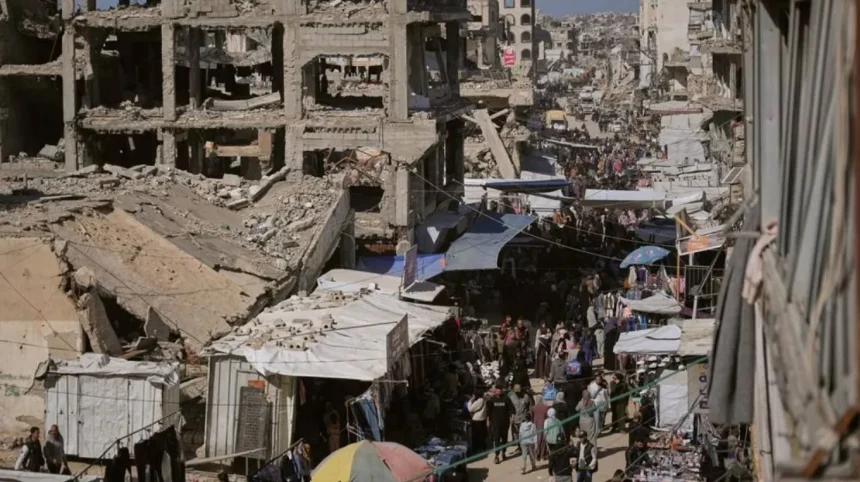
As reported in Asharq Al-Awsat’s English-language coverage, Hamas has launched consultations in Cairo aimed at overcoming obstacles to implementing the second phase of the Gaza ceasefire agreement, which was supposed to begin in mid-January but has since stalled for several reasons, including Israel’s ongoing war on Iran. According to this reporting, experts said Hamas officials are seeking ways to put the agreement back on track, halt alleged Israeli violations, and address daily crises created by the continued Israeli siege on the Gaza Strip. The consultations come as Gaza remains under significant humanitarian and security strain, with the ceasefire framework seen by mediators as essential to stabilizing conditions in the enclave.
Asharq Al-Awsat reported that the Hamas delegation in Cairo is led by senior figure Nizar Awadallah and includes leading Hamas member Ghazi Hamad. The delegation has held a series of meetings with Egyptian intelligence officials and United Nations envoy Nikolay Mladenov to review political and field developments in Gaza, as well as the status of the ceasefire understandings. Egyptian and Qatari media, cited in the same coverage, noted that Egypt and Qatar have continued to act as key mediators in maintaining and advancing the Gaza ceasefire arrangements.
According to Asharq Al-Awsat, the talks have tackled several core issues tied to implementation of the agreement’s next phase, including alleged Israeli violations on the ground, the integration of Hamas members into the local police structures, the operation of the Rafah border crossing with Egypt, and the role of the Gaza committee designated to assume administrative control of the enclave from Hamas. Sources close to Hamas told the outlet that disarmament of the movement has also been raised as part of the broader process, with discussions on that point expected to resume once Palestinian police and international stabilization forces are deployed in Gaza. A member of the Gaza committee told the newspaper that it had not met the Hamas delegation during these latest contacts, without giving a reason.
How Are Mediators and International Actors Responding?
According to details carried by Asharq Al-Awsat from Reuters reporting, three sources said envoys from US President Donald Trump’s so‑called “Board of Peace” met representatives of Hamas in Cairo in an effort to safeguard the Gaza ceasefire, which they described as under serious strain since the United States and Israel began bombing Iran. The weekend meeting was characterized as the first publicly reported encounter between the movement and the board since the start of the Iran war, with the board described as a new international body headed personally by Trump and tasked with overseeing post‑war Gaza. One of the sources told Reuters that Israel’s announcement it would soon reopen the Rafah pedestrian crossing, shut since the Iran bombing campaign began, was believed to be a direct result of these contacts.
Asharq Al-Awsat’s account of the Reuters report noted that Trump’s Gaza plan, which centers on an October ceasefire leaving Israel in control of more than half of Gaza’s territory while more than two million Palestinians are concentrated in a smaller strip under Hamas control, had been his flagship Middle East initiative before the war with Iran. The sources cited by Reuters said Hamas representatives warned the board that the movement could reconsider its commitments under the Gaza ceasefire if Israel maintains new restrictions imposed on the enclave during the Iran conflict, particularly the border closures and reduced movement at crossings. Israel had shut Gaza’s borders at the outset of the Iran war, later allowing a limited flow of goods and aid but keeping the Rafah pedestrian crossing closed until its latest decision to reopen it following a “security assessment.”
The same reporting stated that talks on the disarmament of Hamas, which were meant to be a central focus of the next phase of Trump’s Gaza plan, have been on hold since the outbreak of the Iran war. One source said the “Board of Peace” was represented in the Cairo talks by Aryeh Lightstone, a US aide to Trump’s special envoy Steve Witkoff, while other sources indicated meetings that included Lightstone were on the agenda though they could not confirm his actual participation. A US official cited by Reuters said Lightstone had taken part in Gaza-related meetings in Cairo in recent days and that US negotiators were continuing discussions with regional partners to implement Trump’s 20‑point plan for Gaza. Israel’s government did not comment on whether reopening Rafah was linked to these meetings, and Hamas declined to comment, according to the Reuters account.
Supporting Details and Broader Context
Asharq Al-Awsat reported, based on the same set of sources, that the second phase of the ceasefire agreement envisaged deeper steps toward stabilizing Gaza, including disarmament discussions and further Israeli withdrawals, but that these elements have been delayed by the broader regional war. The initiative had appeared to gain momentum in the month before the Iran conflict, with new reconstruction pledges and plans to reopen Rafah to regular traffic. The article noted that Israel’s military has nevertheless continued to carry out strikes in Gaza during the wider confrontation, including attacks that killed 12 people, among them nine police officers, with the army citing threats or fire by Hamas as justification.
A Palestinian official familiar with the Cairo talks told Asharq Al-Awsat that Hamas believes Israel is using the Iran war as an opportunity to evade commitments under Trump’s Gaza plan, particularly regarding easing restrictions and moving forward on reconstruction. According to this account, Trump’s plan relies in part on the prospect that Hamas fighters would lay down their arms in exchange for amnesty, which is intended to pave the way for large‑scale reconstruction and additional Israeli military withdrawals from the enclave. The sources quoted in the piece did not specify whether disarmament would be formally discussed in this week’s Cairo meetings, underscoring the sensitivity of that issue for the movement and its base.
The same article placed the Gaza discussions in the context of escalating Israeli strikes in Lebanon, including in Beirut and the Tyre region, and intense diplomatic efforts led by Lebanese President Joseph Aoun, French President Emmanuel Macron and United Nations officials to secure a ceasefire between Israel and Hezbollah. While these Lebanese developments are distinct from the Gaza file, Asharq Al-Awsat highlighted them to illustrate the wider regional conflict environment in which the Gaza ceasefire agreement is being tested and renegotiated. The piece also cited humanitarian warnings from the United Nations and aid organizations about strain on regional supply chains and medical stocks, particularly in Sudan, due to the expanded US‑Israeli war on Iran and related disruptions in airspace and shipping routes.
What Are the Implications and Next Steps?
According to Asharq Al-Awsat’s reporting, further meetings between Hamas representatives, Egyptian mediators and international officials are expected in Cairo this week as efforts continue to revive the Gaza agreement’s second phase. US officials quoted via Reuters indicated that Washington, through Trump’s envoys, intends to keep pushing the 20‑point Gaza plan in coordination with regional partners, even as the Iran war and tensions in Lebanon complicate the diplomatic landscape. The reported Hamas warning that it could reconsider its commitments if new Israeli restrictions persist suggests that the durability of the ceasefire and of Trump’s broader Gaza initiative will depend heavily on concrete changes on the ground, including border access and the pace of reconstruction.
Experts cited by Asharq Al-Awsat argued that the Cairo consultations could prove critical in determining whether the Gaza agreement moves forward or continues to stall amid the regional war. They noted that issues such as integrating Hamas personnel into official policing structures, operating Rafah in coordination with Egypt, and defining the mandate of the Gaza committee are all central to shifting governance away from a purely Hamas-led framework toward a more institutionalized arrangement under the ceasefire plan. At the same time, the unresolved question of Hamas’ disarmament, and whether international stabilization forces will eventually be deployed, remains a key point that could shape the trajectory of both Gaza’s internal politics and its relations with Israel.
For now, the consultations in Cairo signal that Hamas and mediators are still engaged in trying to salvage and adapt the existing Gaza ceasefire framework rather than abandoning it altogether. The reported involvement of Trump’s “Board of Peace,” continued Egyptian and Qatari mediation, and the cautious steps by Israel to reopen crossings like Rafah suggest that all sides recognize the risks of a complete breakdown. However, with Israeli military operations ongoing in Gaza and Lebanon and the war on Iran reshaping regional priorities, the path to fully reviving and implementing the Gaza agreement remains uncertain and closely tied to developments beyond the enclave itself.
In sum, Hamas’ consultations in Cairo, as detailed by Asharq Al-Awsat’s coverage of regional and Reuters sources, represent an attempt to revive a stalled ceasefire framework for Gaza at a time of heightened regional conflict and diplomatic strain. The talks encompass sensitive issues such as alleged Israeli violations, border operations, governance arrangements, and potential disarmament, while also intersecting with broader US and regional initiatives for post‑war Gaza. The coming days of meetings in Cairo, and any concrete steps on crossings, reconstruction and security deployments, are likely to determine whether the Gaza agreement’s second phase can move ahead or remains blocked by the wider war dynamics.