


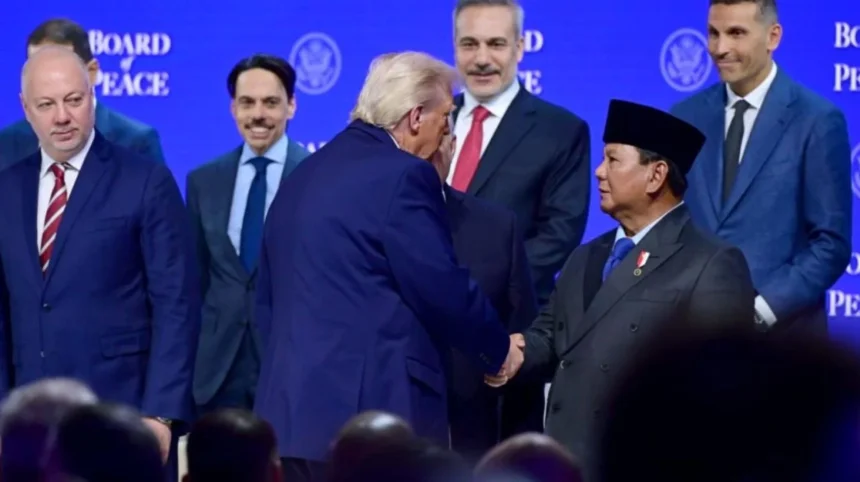
As reported by 360info, the US–Israel war against Iran has intensified scrutiny of Indonesia’s decision to participate in the US-led Board of Peace, an initiative originally linked to post-war reconstruction in Gaza and broader conflict mediation. According to 360info, Indonesia joined the board under President Prabowo Subianto as part of a strategy to influence outcomes in Gaza from within a US-driven framework that also includes Israel but no direct Palestinian representation.
According to the South China Morning Post, critics in Indonesia argue that joining the Board of Peace risks aligning Jakarta too closely with Washington at a time when US forces are directly engaged in military operations against Iran alongside Israel. The outlet notes that Indonesia has long championed Palestinian statehood and a non-aligned foreign policy, making its association with a US-led body particularly contentious amid a widening regional war.
The Jakarta Post has reported that domestic debate over the board has sharpened since the latest escalation, which followed a US–Israeli missile strike on Tehran and other Iranian cities that killed Iranian Supreme Leader Ayatollah Ali Khamenei. According to The Jakarta Post, the subsequent Iranian retaliation with missile barrages against neighboring Gulf states has deepened concerns in Jakarta about being seen as complicit in a conflict that threatens wider regional stability.
Context and reactions: How is Indonesia responding at home and abroad?
According to Reuters, Indonesian Foreign Minister Sugiono has said that all discussions related to the Board of Peace are currently “on hold” as a result of the war against Iran and the shifting diplomatic priorities it has created. As reported by Reuters, Sugiono stated that Jakarta would consult with partners in the Gulf region, who are also directly affected by the escalation and the economic disruptions caused by the conflict.
According to Arab News, Sugiono confirmed that the war has diverted attention from Gaza-focused initiatives under the Board of Peace framework, even as Indonesia had been considered a key contributor to a proposed international force in the territory. Modern Diplomacy has similarly reported that Indonesia’s pause reflects the impact of the US–Israeli air campaign on regional security and energy markets, including higher oil prices and risks to shipping through the Strait of Hormuz.
The Jakarta Post has reported that lawmakers in Indonesia’s House of Representatives have become increasingly vocal, with members of Commission I on foreign affairs urging the government to take a stronger stance against the US and Israel. According to The Jakarta Post, National Awakening Party lawmaker Oleh Soleh called for Indonesia to lead efforts to impose sanctions on the US and Israel, while TB Hasanuddin of the Indonesian Democratic Party of Struggle argued that Jakarta should promptly leave the Board of Peace to safeguard its “free and active” foreign policy.
Al Jazeera has reported that public anger over the war has also focused attention on President Prabowo’s broader relationship with the United States, including a bilateral Agreement on Reciprocal Trade (ART) signed prior to the current escalation. According to Al Jazeera, critics say the combination of deepening security and trade ties with Washington and participation in Trump’s Board of Peace has raised questions about whether Indonesia is drifting away from its traditional non-aligned posture.
Supporting details and expert commentary
As reported by the South China Morning Post, Indonesia’s role on the Board of Peace has been closely linked to discussions about sending up to 8,000 Indonesian troops to support an international stabilization force in Gaza under the board’s umbrella. According to Eurasia Review, President Prabowo pledged that contingent as part of an international effort tied to the Board of Peace, which was promoted by US President Donald Trump as an alternative to United Nations-led peacekeeping arrangements.
Al Jazeera has noted that Indonesia, which does not have formal diplomatic relations with Israel, has historically positioned itself as a strong supporter of Palestinian self-determination, making any cooperation in a framework that includes Israel highly sensitive domestically. According to Al Jazeera, some analysts and activists argue that Indonesia’s participation risks lending legitimacy to plans for Gaza that may sideline Palestinian representation and dilute multilateral oversight via the UN system.
Modern Diplomacy has reported that major domestic religious organizations have taken diverging positions on the board. According to Modern Diplomacy, the Indonesian Ulema Council (MUI) has urged the government to withdraw from the initiative, citing Trump’s decision to attack Iran as undermining the credibility of any US-led peace mechanism, while Nahdlatul Ulama has instead called on Jakarta to use its place on the board to push Washington and Israel toward a ceasefire.
The Times of Israel has reported that President Prabowo has publicly indicated he would consider withdrawing from the Board of Peace if it fails to deliver tangible benefits for Palestinians or contribute meaningfully to peace efforts. According to the same outlet, Indonesian officials have defended the decision to join by arguing that remaining outside the board would deprive Jakarta of leverage in discussions where Israel is present but Palestinians are not directly represented.
Implications and future developments: What could happen next?
According to 360info, the US–Israel vs Iran war has transformed Indonesia’s participation in the Board of Peace from a contested foreign policy bet into a central test of Jakarta’s ability to balance domestic expectations with its aspiration to act as a regional and global mediator. The analysis notes that as the conflict widens, Indonesia’s diplomatic maneuvering room may narrow, forcing clearer choices on whether to prioritize its seat on a US-led platform or its long-standing identity as a champion of Palestinian rights and non-alignment.
Modern Diplomacy has suggested that if the Iran conflict becomes prolonged, Indonesia could find greater diplomatic advantage in seeking a mediating role between Washington, Tehran, and regional actors rather than remaining tied to a Board of Peace perceived by critics as closely aligned with US strategic interests. According to Modern Diplomacy, Jakarta’s current decision to freeze board-related discussions keeps its options open while domestic debates over potential troop deployments to Gaza and trade ties with the US continue.
The South China Morning Post has reported that Indonesia’s next steps are likely to be shaped by the evolution of public opinion, parliamentary pressure, and the trajectory of the war, particularly any further expansion of hostilities in the Gulf that could affect Indonesian workers and economic interests. According to the outlet, Indonesia’s government has so far framed its position as consistent with a “free and active” foreign policy, arguing that engagement with the Board of Peace does not preclude criticism of military actions or advocacy for Palestinian statehood.
Al Jazeera has indicated that questions over Indonesia’s alignment will persist as long as Trump’s administration continues to lead the board and the US remains directly involved in the conflict with Iran. According to Al Jazeera, any future decision by Jakarta to withdraw from or downgrade its role in the Board of Peace would likely be interpreted domestically as a reaffirmation of non-alignment, while remaining fully engaged could deepen perceptions that Indonesia is moving closer to Washington’s regional agenda.
Indonesia currently appears to be seeking space to reassess its position while hostilities continue, maintaining its board membership but halting substantive talks and signaling openness to mediation efforts that extend beyond the Board of Peace framework. As the US–Israel war against Iran reshapes regional dynamics, Jakarta’s eventual decision on the board is expected to influence its broader diplomatic profile in the Middle East and its credibility as a supporter of Palestinian rights.