


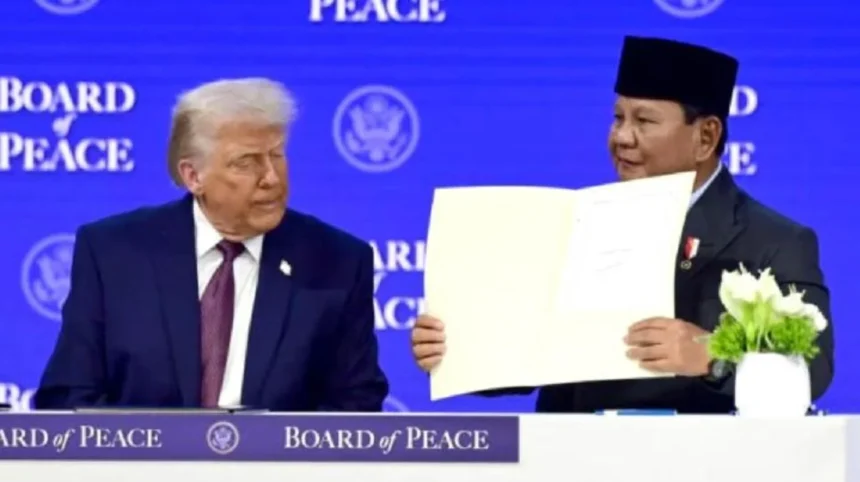
According to Tempo, President Prabowo Subianto has asserted that Indonesia has an important role to play in the newly formed Board of Peace, a multinational initiative that he says aims to help achieve peace in Palestine and Gaza. He has framed Indonesia’s participation as part of the country’s long-standing commitment to supporting Palestinian rights and pursuing a fair and sustainable peace in the Middle East.
As reported by state news agency ANTARA, Prabowo has reiterated Indonesia’s support for Palestinian peace through active involvement in the Board of Peace, describing it as a platform to push for a “sustainable solution for Palestine and Gaza.” The Indonesian government has said its participation is intended to ensure that any post-war arrangement for Gaza remains anchored in a two-state solution and does not sideline Palestinian political rights.
Officials in Jakarta have stressed that Indonesia’s approach includes advocating for a cessation of violence, the protection of civilians, the opening of humanitarian access, and the restoration of Palestinian civil governance. Government statements also emphasize that Indonesia sees its presence in the Board of Peace as a way to provide “moral and political balance” so that reconstruction and political arrangements comply with international law and relevant United Nations resolutions.
How have Indonesians reacted to Prabowo’s stance?
Tempo reports that since Indonesia formally joined the Board of Peace on January 22, 2026, criticism has emerged from civil society groups, academics, and segments of Islamic social organizations who question the effectiveness and transparency of the body. Some critics argue that the Board of Peace was formed rapidly and remains unclear in its mandate, raising concerns over whether it can genuinely advance Palestinian interests.
According to an explainer by Tempo on Indonesia’s decision to join the Gaza-focused Board of Peace, the government acknowledged the body was established in a relatively short time frame, but Foreign Minister Sugiono said Jakarta joined after evaluating various strategic considerations. He stated that the aim is to “accelerate the peace process in Gaza,” underscoring that Indonesia intends to use its membership to influence the direction and substance of the initiative.
As reported by Dawn and other regional outlets, Prabowo has also responded to domestic skepticism by assuring Islamic groups that Indonesia will withdraw from the Board of Peace if it fails to benefit Palestinians or contradicts Indonesia’s national interests. A government communication cited by Dawn noted that Prabowo told Muslim leaders he would disengage if he saw no tangible benefit for Palestine or if the body ran counter to Indonesia’s foreign policy principles.
Supporting details and regional context
According to a statement published on the Indonesian Cabinet Secretariat’s website, Indonesia’s participation in the Board of Peace is seen by the government as strategically significant because it allows Jakarta to be directly involved in shaping the transition process in Gaza. Officials say this includes advocating for humanitarian corridors, reconstruction, and political arrangements that reflect long-standing Indonesian support for Palestinian statehood.
As reported by ANTARA, Prabowo has said he agrees with and is committed to the Board of Peace’s proposed roadmap, which includes a 20‑point plan presented at its inaugural meeting. He has linked Indonesia’s decision to join to its broader foreign policy tradition of supporting decolonization and self-determination, particularly for Palestinians.
Regional media have also highlighted that Indonesia’s move comes at a time of heightened public concern over the humanitarian situation in Gaza, with strong pro‑Palestinian sentiment among Indonesians influencing domestic debate over the country’s foreign policy posture. Statements from Islamic organizations reported by Arab and regional outlets have urged the government to ensure that participation in any international platform results in concrete gains for Palestinians, rather than symbolic engagement.
What are the implications and possible next steps?
According to government briefings cited by Tempo and official Indonesian sources, Jakarta intends to use its Board of Peace membership to press for an immediate end to hostilities, expanded humanitarian access, and a political framework that leads back to a two‑state solution. Officials describe Indonesia’s role as one of “guarding” the implementation of any agreements so that Palestinian rights and international law are respected.
Reports in Arab News and other outlets note that Prabowo has indicated Indonesia could reconsider its membership if the Board of Peace does not deliver tangible benefits for Palestine, signaling that Jakarta may calibrate its engagement based on outcomes. This stance suggests that Indonesia’s future role will depend on whether the Board of Peace can translate diplomatic commitments into substantive progress on the ground in Gaza and for the broader Palestinian cause.
In practical terms, Indonesian officials have pointed to advocacy within the Board of Peace, support for humanitarian operations, and backing for Palestinian governance structures as likely areas of continued activity. Diplomats have also indicated that Indonesia will coordinate with like‑minded countries and international organizations to ensure that the initiatives discussed within the Board of Peace align with existing UN resolutions and broader multilateral efforts.
Indonesia’s decision to join the Board of Peace, and Prabowo Subianto’s insistence that the country has a significant role to play, underscore Jakarta’s effort to position itself as an active supporter of Palestinian peace while managing domestic scrutiny over the initiative’s effectiveness.