

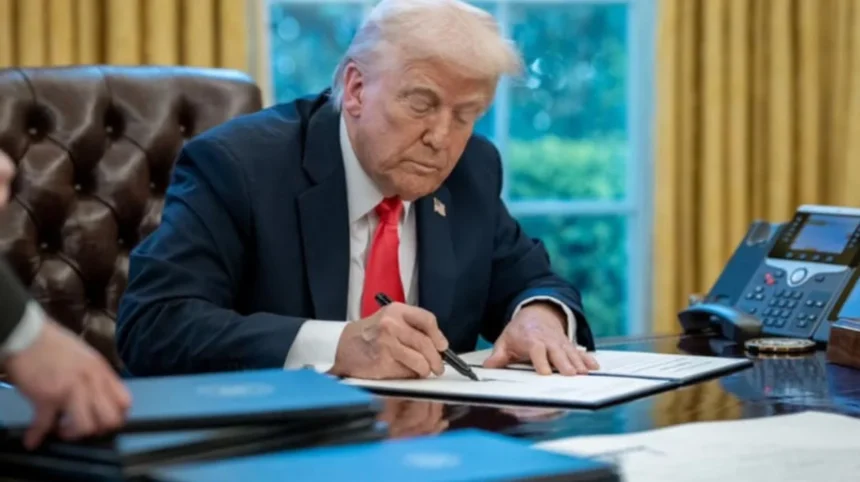
As reported by NDTV, Morocco’s King Mohammed VI has accepted US President Donald Trump’s invitation to join his “Board of Peace” as a founding member, according to a statement from the Moroccan Foreign Ministry published by the official MAP news agency. The ministry said the monarch welcomed President Trump’s commitment and vision to promoting peace and confirmed that Morocco will ratify the charter establishing the board. According to Arab News, Rabat framed the decision as part of Morocco’s continued engagement in regional peace efforts and its established role in Middle East diplomacy.
According to Anadolu Agency, the board is a newly formed US-led initiative announced by Trump as part of broader efforts to support peace in the Middle East, with a particular focus on Gaza. The Moroccan Foreign Ministry statement described the invitation as recognition of King Mohammed VI’s standing as an international actor on peace issues and the trust he enjoys with the US administration and the wider international community. TASS also reported that the Moroccan monarch “kindly accepted” Trump’s invitation and that Morocco will move to ratify the founding charter of the Board of Peace.
As reported by Anadolu Agency, the ministry reiterated Morocco’s commitment to a just, comprehensive and lasting peace in the Middle East, including the establishment of an independent Palestinian state based on the 1967 borders with East Jerusalem as its capital. The same statement linked Morocco’s participation in the board to its long-standing support for Palestinian rights and its diplomatic role under King Mohammed VI, who chairs the Al-Quds Committee of the Organisation of Islamic Cooperation.
What is the Gaza Board of Peace and how has it been framed?
According to NDTV, the Board of Peace was originally conceived to oversee the rebuilding of Gaza, but the charter does not limit its scope to the Palestinian territory alone. NDTV, citing the charter seen by AFP, reported that the US-led initiative aims to contribute to peace efforts in the Middle East and “adopt a new approach to resolving conflicts around the world.” The charter provides that member countries, represented by their head of state or government, would join for three years, with the possibility of a longer term if a country contributes more than 1 billion dollars within the first year.
Arab News reported that Morocco’s foreign ministry portrayed the decision to join as part of its support for Trump’s peace efforts and the wider initiative to stabilize Gaza. According to Anadolu Agency, the White House announced the creation of the Board of Peace alongside the approval of a National Committee for the Administration of Gaza, designed as one of several bodies to manage a transitional phase in the enclave. Anadolu Agency added that this announcement coincided with the launch of the second phase of a ceasefire agreement that halted Israel’s war on Gaza, which has resulted in tens of thousands of deaths and injuries since October 2023.
Khaleej Times, citing a statement from Morocco’s Foreign Ministry, reported that Rabat “welcomes the second phase of Trump’s comprehensive peace plan” and the official creation of the National Committee for the Administration of Gaza as a temporary transitional body. The same report said King Mohammed VI accepted Trump’s invitation to join as a founding member of the Board of Peace, with Morocco emphasizing its support for reconstruction and stabilization efforts in Gaza within a broader political framework.
Context, reactions, and regional significance
According to NDTV, the Board of Peace’s charter indicates that the White House has invited a select group of world leaders to sit on the body, which Trump himself would chair. NDTV reported that invitations were extended to leaders including Russian President Vladimir Putin, Hungarian Prime Minister Viktor Orban and Canadian Prime Minister Mark Carney, among others, though not all invitees have publicly confirmed their participation. Initial reactions from some key allies, such as France and Canada, were described as lukewarm, reflecting cautious responses to the new US-led structure.
Arab News reported that Morocco is among a set of states that have agreed to join the board so far, with others including countries from different regions, underlining the initiative’s international rather than purely regional character. According to Anadolu Agency, Rabat’s statement underlined that the move “underscores the monarch’s role in advancing Middle East peace” and highlighted Morocco’s perceived credibility as a mediator and supporter of diplomatic solutions. This positioning aligns with Morocco’s historical role within the Arab and Islamic worlds, including its chairmanship of the Al‑Quds Committee, which focuses on Jerusalem.
As reported by Morocco World News, Morocco has also been active in discussions around the board’s operational focus, including reconstruction commitments and governance arrangements in Gaza. That outlet noted that at the inaugural meeting of the Board of Peace in Washington, Morocco emerged as one of the key contributors, reflecting Rabat’s intent to translate its political support into concrete engagement on Gaza’s reconstruction and long-term stabilization. While the details of specific financial commitments were not fully disclosed in those reports, Morocco’s participation was presented as both political and material.
Supporting details and expert commentary
According to the Moroccan Foreign Ministry statement summarized by Anadolu Agency, Morocco’s decision includes a commitment to ratify the board’s founding charter, which sets out governance rules, membership terms and financial participation thresholds. NDTV, citing AFP’s review of the charter, reported that states making substantial early contributions—over 1 billion dollars in the first year—could have their membership extended beyond the initial three-year term. This structure is designed, according to those reports, to incentivize large-scale funding for reconstruction and wider peacebuilding projects.
In its coverage, Khaleej Times highlighted that Morocco welcomed the “second phase” of Trump’s broader peace plan, which encompasses both security arrangements and economic measures, including the establishment of transitional bodies for Gaza. Anadolu Agency’s reporting emphasized that the Board of Peace would include a limited number of prominent international leaders committed to fostering long-term stability and prosperity for future generations, suggesting a selective and high-level membership rather than a broad multilateral forum.
Morocco World News noted that Moroccan officials have framed the country’s participation as consistent with Rabat’s long-standing policy of supporting a two-state solution, rather than as an endorsement of any departure from internationally recognized parameters for resolving the Israeli‑Palestinian conflict. At the same time, the outlet reported that Moroccan participation is viewed domestically as an opportunity to influence reconstruction priorities in Gaza and to ensure that humanitarian and development needs are addressed alongside political and security considerations.
What are the implications and likely next steps?
According to Anadolu Agency, the launch of the Board of Peace and the related National Committee for the Administration of Gaza coincided with the second phase of a ceasefire that paused large-scale fighting in Gaza, indicating that the body is expected to play a role during a sensitive transitional period. This timing suggests that the board’s work will intersect with immediate humanitarian and reconstruction efforts, as well as with political discussions on Gaza’s governance. Morocco’s decision to join as a founding member positions Rabat to participate directly in these deliberations, in line with its stated goal of supporting a lasting peace that includes Palestinian statehood.
NDTV’s report on the charter’s global scope indicates that, although the board was initially conceived with Gaza’s reconstruction in mind, it could become a platform for addressing other conflicts, depending on future political decisions by its members. For Morocco, Arab News and Anadolu Agency both suggest that participation may enhance its diplomatic profile and reinforce its role as a bridge between the Arab world, Africa and Western partners on peace and security issues. Future developments are expected to include formal ratification of the charter by Morocco, further clarification of financial contributions by member states and additional announcements from invited countries on whether they will accept Trump’s invitation to join.
As reported by Morocco World News, upcoming sessions of the Board of Peace are likely to focus on concrete reconstruction plans for Gaza, including infrastructure, health, education and economic recovery programs, with member states outlining their respective responsibilities. The effectiveness of the board will depend on coordination with existing international mechanisms, including United Nations agencies and regional organizations, as well as on the durability of the ceasefire on the ground. Observers will be watching how Morocco leverages its position within the board to advocate for both immediate relief and a political process aligned with its support for a two‑state solution.
In sum, Morocco’s King Mohammed VI has formally accepted Donald Trump’s invitation to join the Gaza‑focused Board of Peace as a founding member, with Rabat committing to ratify the body’s charter and to support reconstruction and wider peace efforts in the Middle East. The move reinforces Morocco’s established diplomatic role on Palestinian and regional issues and places it at the heart of a new US‑led initiative whose structure, membership and impact will be shaped by decisions in the coming months.