


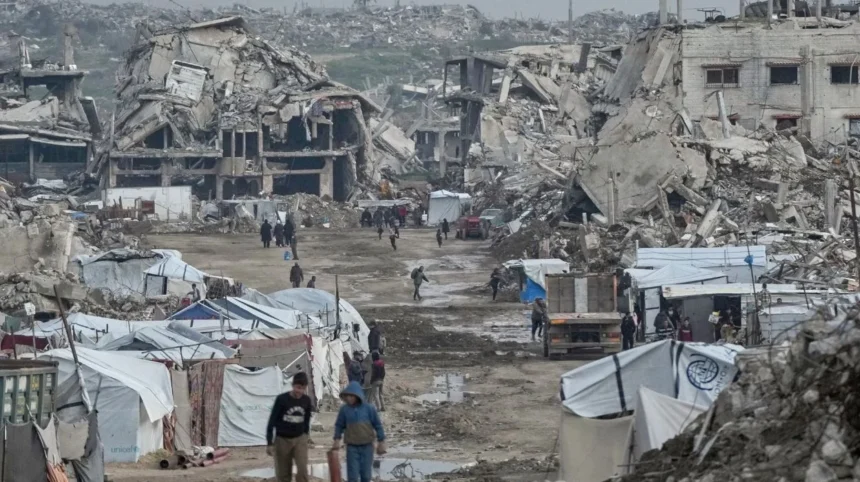
As reported by ABC News, President Donald Trump is preparing to formally constitute the Gaza Board of Peace during the World Economic Forum in Davos, Switzerland, with a signing ceremony expected as early as Thursday, even as some allies question whether they will join the body. According to ABC News, Trump announced the Gaza Board of Peace on Friday as a mechanism to oversee the rebuilding and reconstruction of the war‑devastated Gaza Strip, framing it as part of a broader 20‑point peace plan for the territory. The mandate approved by the United Nations Security Council in November is described as focusing solely on Gaza and running through the end of 2027, underscoring the international expectation that the body’s work remain tied to implementation of the Gaza peace framework.
According to reporting carried by AOL and ABC News, the draft charter circulating online does not explicitly mention Gaza, prompting muted and cautious reactions from several governments that had been invited to participate. ABC News reports that Trump is set to chair the Board of Peace himself and has promoted it on Truth Social as “the Greatest and Most Prestigious Board ever assembled at any time, any place,” while providing limited operational detail. A copy of the draft charter posted by the Times of Israel and cited by ABC News describes the board as an international organization aimed at promoting stability, restoring lawful governance and securing durable peace in areas affected or threatened by conflict, language that appears to extend beyond Gaza alone.
According to ABC News, an executive committee is being assembled to guide the Board of Peace, with expected members including former British Prime Minister Tony Blair, Canadian Prime Minister Mark Carney, U.S. Secretary of State Marco Rubio, U.S. special envoy to the Middle East Steve Witkoff and Trump’s senior adviser and son‑in‑law Jared Kushner. ABC News and other outlets report that additional members are likely to be announced over the coming weeks, with U.S. officials indicating that further invitations and announcements could coincide with Trump’s travel to Davos. The board’s rollout follows what U.S. officials describe as the second phase of a 20‑point plan that they say begins the full demilitarization and reconstruction of Gaza, an effort the administration has presented as a key foreign policy achievement.
How are allies reacting to the Board of Peace?
According to ABC News, several U.S. allies have received invitations to join the Board of Peace in recent days, including Argentina, Belarus, Canada, Australia, Egypt, Hungary, Pakistan, Jordan, Turkey, Israel and India, but many of their leaders have so far avoided making clear public endorsements. ABC News reports that officials in some capitals privately view the charter’s broad language as a sign that Trump may be seeking to create a U.S.-led alternative to the United Nations, raising concerns about mandate overlap and geopolitical implications. Reporting by Al Jazeera notes that the initial announcement of board members has already triggered backlash in parts of the Middle East, particularly over the absence of Palestinian representatives and the prominence of figures seen as strong supporters of Israel.
As reported by Al Jazeera, Israeli Prime Minister Benjamin Netanyahu publicly criticized the proposed composition of the Gaza executive board, saying its formation “was not coordinated with Israel and contradicts its policy,” although his office did not detail specific objections. According to ABC News, some European officials have expressed unease that the board’s apparent scope could extend beyond Gaza to other conflict zones, potentially placing them at odds with existing commitments to multilateral institutions such as the UN and NATO. Ireland’s Minister for Foreign Affairs, Helen McEntee, warned in a statement cited by ABC News that the body envisioned by Trump “would have a mandate wider than the implementation of the Gaza Peace Plan,” highlighting growing European skepticism.
Supporting details and expert commentary
According to ABC News, the Board of Peace charter states that the body “is an international organization that seeks to promote stability, restore dependable and lawful governance, and secure enduring peace in areas affected or threatened by conflict,” and calls for a “coalition of willing States” focused on practical cooperation and effective action. Analysts quoted in coverage by major outlets suggest that such language positions the board as a nimble, intervention‑oriented structure that could act more quickly than existing institutions, although governments remain wary of how it would interact with the United Nations system. The Economic Times and other outlets report that at early discussions around the board, Trump emphasized financial commitments and security contributions for Gaza, including multi‑billion‑dollar pledges and offers of troop deployments for stabilization forces.
According to reporting cited by AOL and Yahoo News, Trump has argued that the Board of Peace can “go far beyond Gaza” while still working “in conjunction with the United Nations,” framing it as complementary rather than adversarial. However, ABC News notes that the UN Security Council’s formal mandate for the Board of Peace remains limited to Gaza, potentially setting up future friction if the board attempts operations elsewhere without additional UN authorization. Al Jazeera reports that critics in the region fear the board’s current composition and framework could marginalize Palestinian political actors and consolidate influence among states and officials aligned with Washington and Tel Aviv.
What are the implications and what comes next?
According to ABC News, U.S. officials expect “intense” planning in the coming weeks as the newly formed technocratic committee prepares to work with local authorities in Gaza and with regional actors to ensure that security and reconstruction objectives remain priorities. The Economic Times reports that unresolved issues, including the disarmament of Hamas and the long‑term governance structure for Gaza, continue to complicate implementation of the peace plan and could delay or derail aspects of the board’s agenda. ABC News notes that additional member announcements and formal commitments to funding and troop deployments are anticipated as Trump continues to pitch the Board of Peace to foreign leaders, including during high‑profile gatherings such as Davos.
According to reporting from AOL and ABC News, the extent to which allies sign onto the board’s broader vision will likely determine whether it evolves into a durable new platform for conflict resolution or remains narrowly focused on Gaza’s reconstruction under UN‑defined parameters. Al Jazeera and other outlets suggest that the absence of Palestinian representation and the perception of a board tilted toward pro‑Israel voices could fuel regional skepticism and raise questions about the legitimacy of any decisions taken under its auspices. ABC News indicates that for now, the Board of Peace’s authority is anchored in the Gaza mandate through 2027, and any expansion beyond that would require either additional UN approvals or a coalition of states willing to back a more ambitious, U.S.-led framework.
In sum, as Trump prepares to inaugurate the Board of Peace in Davos, the initiative stands at a crossroads between its original Gaza‑focused mandate and a contested, potentially global role that some allies view with caution. The coming months of diplomatic outreach, member recruitment and on‑the‑ground implementation in Gaza will test whether the board can overcome early headwinds from skeptical partners and regional critics.