


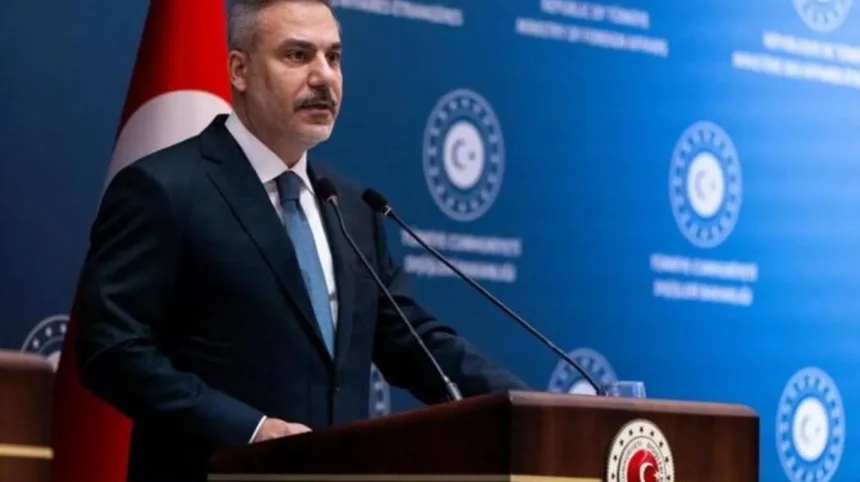
Turkish Foreign Minister Hakan Fidan will travel to Washington to attend the inaugural meeting of US President Donald Trump’s Board of Peace, representing President Recep Tayyip Erdogan at the leaders’ level gathering, the Turkish Foreign Ministry has announced. As reported by Asiye Latife Yilmaz and Seyit Kurt of Anadolu Agency, the ministry said Fidan will take part in the first Board of Peace session scheduled for Feb. 19 in Washington, DC. According to the ministry statement cited by Anadolu Agency, Fidan is expected to articulate Turkiye’s positions on the Gaza conflict and broader regional stability during the talks.
The Board of Peace was launched by President Trump at the World Economic Forum in Davos as a platform initially focused on overseeing a Gaza truce and coordinating reconstruction of the territory following the war between Hamas and Israel. According to Asharq Al-Awsat and other outlets, the initiative’s mandate has since expanded to address a range of international disputes, prompting debate over whether it could emerge as a rival forum to existing multilateral institutions. Washington has signaled that a growing number of states have signed the Board of Peace’s founding charter and plan to send representatives to the first meeting.
As reported by Asharq Al-Awsat, a Turkish diplomatic source said Fidan will call for determined steps to resolve the Palestinian question, stressing that Israel should end actions that impede aid deliveries to Gaza and must stop alleged violations of ceasefire understandings. The source added that Turkiye will underline the need for a two-state solution and for conditions that allow Palestinians to exercise self-determination. According to a readout cited by Asharq Al-Awsat, President Erdogan has expressed hope that the Board of Peace will contribute to “lasting stability, ceasefire, and eventually peace” in Gaza.
Meanwhile, Italy will participate in the session as an observer rather than a full member, with Foreign Minister Antonio Tajani representing the country in Washington. Italy’s decision to attend in this limited capacity has prompted criticism from domestic opposition parties, who argue that the Trump-led forum could undercut the role of the United Nations and established international legal frameworks. The Italian government, however, has defended its engagement with the US initiative as a way to remain closely involved in efforts to address the Gaza crisis and related diplomatic tracks.
Context and reactions: How are Turkiye and Italy framing their roles?
According to Asharq Al-Awsat and Arab News, officials in Ankara see Fidan’s attendance as an opportunity to press Turkiye’s longstanding calls for an end to restrictions on humanitarian aid to Gaza and for a sustainable ceasefire that can open the way to political negotiations. A Turkish diplomatic source quoted by these outlets said Fidan will emphasize that Israel must remove obstacles to aid flows and comply with ceasefire arrangements, while urging concrete steps toward resolving the Palestinian issue. Turkish media and officials have consistently framed the Gaza situation as a central test for regional peace and for the credibility of international mediation efforts.
In Rome, Tajani has publicly described Italy’s participation as that of an observer rather than a founding member, citing constitutional constraints that limit Italy’s ability to join organizations led by a single foreign leader. As reported by the Times of Israel and Asharq Al-Awsat, Tajani said he would go to Washington “to be present when talks occur and decisions are made for the reconstruction of Gaza and the future of Palestine,” underscoring Italy’s interest in following deliberations closely. According to the ANSA news agency, cited in multiple outlets, Tajani stressed that Italy cannot formally join the Board but considers it important to “be at the forefront, listening to what is being done.”
Italian opposition parties have criticized the government’s move, warning that engaging with the Board of Peace could be seen as endorsing an alternative diplomatic track that sidelines the United Nations. Reuters has reported that critics in parliament argue the Trump-led forum risks undermining existing multilateral structures and the principles of international law that underpin them. The government of Prime Minister Giorgia Meloni has countered that there is currently “no alternative” to the US-backed initiative for advancing a Gaza peace proposal, according to the same reporting.
Supporting details and wider diplomatic landscape
As reported by Time magazine, at least several dozen countries have either joined or signaled support for the Board of Peace, with many expected to send senior representatives to the Washington meeting. Turkey is among the states that accepted Trump’s invitation to join, and its decision to dispatch Fidan in place of Erdogan highlights both the importance Ankara assigns to the forum and the constraints on the president’s schedule. According to Time’s reporting, Fidan is expected to use the platform to reiterate Turkiye’s call for Palestinian self-determination and a comprehensive political solution.
The Board of Peace’s remit has broadened beyond Gaza, with supporters presenting it as a flexible mechanism for addressing various international conflicts where existing processes have stalled. According to Asharq Al-Awsat, the initiative’s evolution from a Gaza-focused body to a wider conflict-resolution platform has raised concerns in some capitals that it might duplicate or erode the role of established organizations. Reuters has similarly noted that Italy’s opposition fears the group could become an alternative to the United Nations for managing disputes, though supporters argue it can complement rather than replace UN efforts.
The first meeting in Washington is expected to focus heavily on Gaza’s reconstruction, humanitarian access, and the parameters of a long-term political settlement. According to statements cited by Asharq Al-Awsat and Anadolu Agency, participants are likely to discuss financial contributions, coordination mechanisms for aid, and frameworks for involving regional stakeholders, including Arab and European states. Russia has already indicated through Kremlin spokesperson Dmitry Peskov that it will not take part, signaling that some major powers remain wary of the initiative.
Implications and future developments: What could the Washington meeting signal?
According to multiple outlets, the Washington session will serve as a first test of whether the Board of Peace can function as an effective venue for coordinating international responses to the Gaza conflict and other crises. The level of participation, the scope of any joint statements, and the clarity of follow-up mechanisms are expected to shape perceptions of the body’s credibility. Observers will also assess how the forum balances the interests of the United States, regional actors like Turkiye, and European partners such as Italy.
For Turkiye, Fidan’s involvement offers an opportunity to advance its diplomatic agenda on Gaza and to reinforce its self-described role as a key regional interlocutor. According to reporting by Asharq Al-Awsat and Arab News, Ankara aims to use the meeting to amplify calls for an immediate end to ceasefire violations and for concrete steps toward a two-state solution. The outcome could influence Turkiye’s broader relations with Washington and with Arab partners engaged in Gaza diplomacy.
Italy’s observer status may provide Rome with insight into discussions without binding it politically to all decisions or structures associated with the Board. Reuters notes that the domestic debate in Italy over participation is likely to continue, particularly if the forum’s role vis-à-vis the UN remains contested. Future developments will depend on whether the Board of Peace can demonstrate tangible progress on reconstruction and political dialogue in Gaza, and on how many additional states decide to deepen their involvement.
In the immediate term, the inaugural meeting will bring together a diverse group of countries under a US-led framework that seeks to address one of the most pressing conflicts in the Middle East. Turkiye’s decision to send its foreign minister and Italy’s participation as an observer underscore both the interest in influencing the process and the caution among some governments about committing fully to a new, leader-driven structure.