


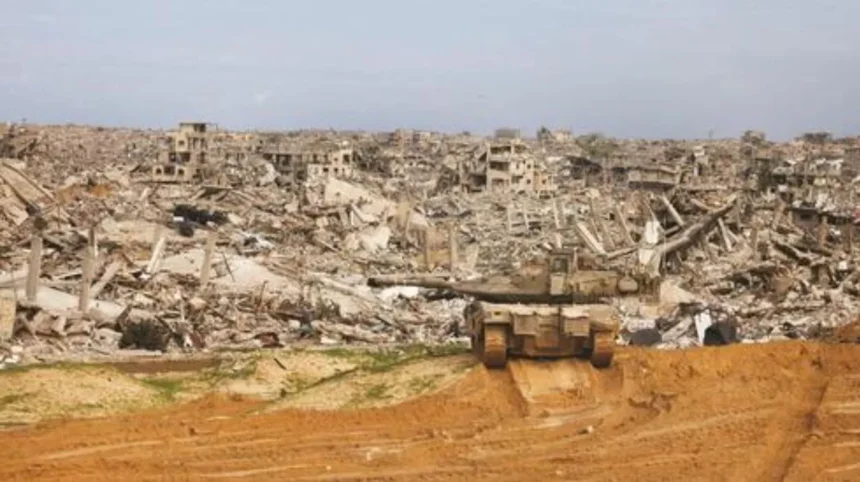
As reported in the original article, discussions are underway around pledging billions of dollars for relief and reconstruction in the Gaza Strip through a proposed “Board of Peace” involving the administration of U.S. President Donald Trump and other international donors. According to the piece, this debate is unfolding against a backdrop of widespread Palestinian concern over corruption within their own governing institutions.
The article cites recent public opinion surveys by the Coalition for Integrity and Accountability, a Palestinian civil society organization, indicating that 57% of Gaza residents believe corruption will stay the same or worsen following the war launched by Hamas on October 7, 2023. The same surveys reportedly found that 90% of Palestinians view current anti-corruption efforts as insufficient, whether led by Palestinian Authority institutions or Hamas authorities in Gaza.
Respondents in these surveys highlighted what they see as weak transparency in public institutions, lack of political will to prosecute corruption, ineffective penalties, and an absence of leadership that protects public resources. The article further notes survey findings that 61% of respondents said corruption increased in 2025, with many expecting it to continue rising in 2026.
According to the article, these results are consistent with earlier polling by the Palestinian Center for Policy and Survey Research, which has repeatedly found that more than 80% of Palestinians in Gaza and the West Bank believe corruption exists within Palestinian Authority institutions. This longstanding perception of corruption forms the backdrop to current debates over channeling new reconstruction funding into Gaza.
Why are corruption concerns central to Gaza aid plans?
The article explains that the corruption issue is gaining urgency because the Palestinian Authority is expected to play a central role in Gaza’s future governance framework. According to the report, Nickolay Mladenov, described as high representative for the proposed “Board of Peace,” recently announced the creation of a Palestinian Authority liaison office to coordinate with the board’s activities in Gaza.
The article states that a newly formed National Committee for the Administration of Gaza, presented publicly as a body of independent technocrats, reportedly includes many figures affiliated with Fatah, the ruling faction of the Palestinian Authority. Under the leadership of Palestinian Authority President Mahmoud Abbas, many Palestinians reportedly believe corruption has expanded rather than receded, including practices such as wasta, or nepotism and favoritism.
According to the article, critics accuse political elites of misusing public funds and enriching themselves while ordinary Palestinians face economic hardship. The piece notes that dissatisfaction with corruption in Palestinian Authority institutions was a key factor in Hamas’s victory in the 2006 Palestinian legislative elections, when Hamas ran on promises of cleaner governance and reform.
The article also argues that for more than three decades, critics say the international community has failed to rigorously monitor how aid to Palestinian institutions is used. Tens of billions of dollars sent to the Palestinian Authority and Hamas-controlled administration in Gaza are alleged to have been lost to corruption, diverted to terrorist groups or mismanaged by political leaders, according to the report.
Supporting details and expert concerns
The article asserts that since October 2023, Hamas is reported to have generated around 500 million dollars by seizing humanitarian aid shipments and reselling them to Gaza residents at inflated prices. It further states that diversion of resources has repeatedly undermined reconstruction efforts, with construction materials intended for civilian housing allegedly redirected to build Hamas’s tunnel network and other military infrastructure.
According to the article, funds intended for schools, hospitals and public development projects have instead been used in ways that reinforce militant capabilities and patronage networks. Gaza is described as a territory where armed groups can repeatedly wage war while international donors finance reconstruction of the same areas after each round of conflict.
The piece emphasizes that there is broad recognition of the urgent humanitarian needs in Gaza, including housing, infrastructure and economic opportunities. However, it argues that simply increasing the volume of financial aid without effective safeguards is unlikely to address what are presented as systemic governance and corruption problems.
The article notes that Gaza is among the most heavily funded territories worldwide in terms of aid per capita, yet remains impoverished, unstable and dominated by armed factions. Much of the international assistance intended for development is described as being absorbed into a system that prioritizes military confrontation over civilian reconstruction.
What are the implications and possible next steps?
According to the article, any credible reconstruction plan for Gaza under the proposed “Board of Peace” would need to go beyond the assumption that financial assistance alone can transform conditions in the territory. It argues that a serious approach would start with strict conditions on aid, including transparent tracking of every dollar spent and rigorous monitoring of construction materials.
The report further contends that such a plan would require that Hamas and other armed groups disarm and withdraw from governing structures to ensure that reconstruction funds are not diverted. Without these measures, the article warns that the strategy of “writing larger checks” risks repeating the past cycle in which funds are provided but underlying governance problems remain unaddressed.
As framed in the article, the core implication for international donors weighing “billions for Gaza” is that the success of any large-scale reconstruction effort will depend not only on the amount of money pledged but on confronting corruption and ensuring accountable administration. The piece concludes that without fundamental changes in oversight and governance, Gaza is likely to continue experiencing the same cycle of destruction, reconstruction and renewed instability.
In summary, the original report portrays deep public concern among Palestinians about corruption, long-running doubts about the integrity of Palestinian institutions, and a record of alleged diversion of aid funds, all of which shape the debate over new reconstruction financing for Gaza. It presents the argument that future aid strategies will be judged not just by the scale of financial commitments but by the strength of mechanisms designed to prevent corruption and ensure that funds reach civilians and critical infrastructure.