


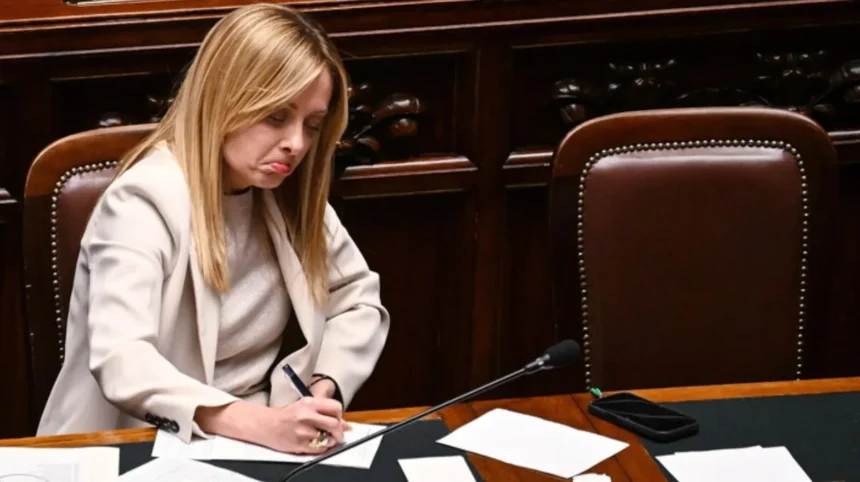
According to ANSA, Prime Minister Giorgia Meloni told Italy’s parliament on March 11 that Rome will not join United States President Donald Trump’s Board of Peace but will continue to take part in discussions around the initiative. She stated that Italy intends to contribute politically and diplomatically to debates on peace and reconstruction without becoming a member of the body. ANSA reported that Meloni’s remarks came as she outlined the government’s position on international efforts to address the conflict in Gaza and broader Middle East stability. She stressed that Italy remains engaged with allies while respecting domestic legal constraints.
As reported by Anadolu Agency, Foreign Minister Antonio Tajani has previously said Italy cannot join the Board of Peace as a full member due to what he called a “constitutional barrier.” He explained in a television interview that the Board’s current statute is not compatible with Article 11 of the Italian Constitution, which allows the country to cede sovereignty only under conditions of equality among states within organizations aimed at promoting peace and justice. Tajani nonetheless reiterated Italy’s readiness to support reconstruction and stabilization efforts in the region through other channels. His statements provide the legal and political context for Meloni’s latest clarification.
How is Italy defining its role and responding to the plan?
According to reports from Bernama and other international outlets citing Meloni, Italy has been invited by Washington to participate in the Board of Peace as an observer, a role she has described as a “good solution” given constitutional limitations. In earlier comments during a visit to Addis Ababa, she said Italy could not sign on as a full member but wanted to remain involved in discussions on Middle East stabilization. This observer status and Meloni’s March 11 clarification both emphasize that Rome seeks influence in the process without formal membership. The distinction allows Italy to attend meetings, follow deliberations, and offer input while avoiding a binding commitment that could clash with constitutional provisions.
Other Italian and international media have reported domestic political debate over the government’s approach. Reuters noted that opposition figures in parliament have criticized the decision to attend Board of Peace meetings even as an observer, questioning the extent of Italy’s alignment with Trump’s initiative. Critics have asked how far the government is willing to go in accommodating US requests. Meloni’s latest statement that Italy is “not joining” the Board, but only contributing to the discussion, appears aimed at clarifying this balance between engagement and formal distance.
Supporting details and broader background
Anadolu Agency reported that Tajani has framed the issue in terms of constitutional law, highlighting that the Board of Peace’s structure grants exceptional powers to its chair, Trump, which Italy considers incompatible with the principle of equality among member states. He has referenced Article 11 to argue that Italy cannot join organizations where sovereignty is ceded asymmetrically. This legal argument has been central to the government’s public justification for staying outside full membership.
European and regional media have noted that Italy’s stance aligns with reservations expressed by other European partners. Qazinform reported that both Germany and Italy signaled they “could not join” the Board in its current form, though they expressed openness to supporting peace efforts if the structure were adjusted. Coverage by Euronews and Bernama has also recalled that the Board of Peace was launched at the World Economic Forum in Davos with the stated aim of overseeing Gaza reconstruction, and that Italy has stressed the importance of a strong European presence in any such process. Together, these accounts situate Rome’s decision within a wider European debate over the initiative’s design and legitimacy.
What are the implications and next steps for Italy’s foreign policy?
International reports suggest that Italy’s choice not to join the Board of Peace as a full member, while taking part in its discussions, reflects an attempt to reconcile domestic constitutional constraints with a desire to remain active in US-led diplomatic efforts. By emphasizing its observer role and its contribution to debate rather than formal adhesion, the government signals that it wants a voice in shaping responses to the Gaza crisis and regional conflicts without accepting governance structures it views as unbalanced. Future developments may depend on whether the Board’s statute is modified and how other European states position themselves.
Looking ahead, statements from Meloni and Tajani indicate that Italy is likely to keep focusing on reconstruction, humanitarian support, and training or capacity-building initiatives in Gaza and the broader region through bilateral and multilateral channels outside the Board’s framework. Any change in Italy’s status would require a reassessment of constitutional compatibility and potentially wider political consensus at home. For now, Rome’s approach combines participation in discussions surrounding the Board of Peace with a clear refusal to join it formally, underscoring the weight given to constitutional limits in shaping foreign policy choices.