

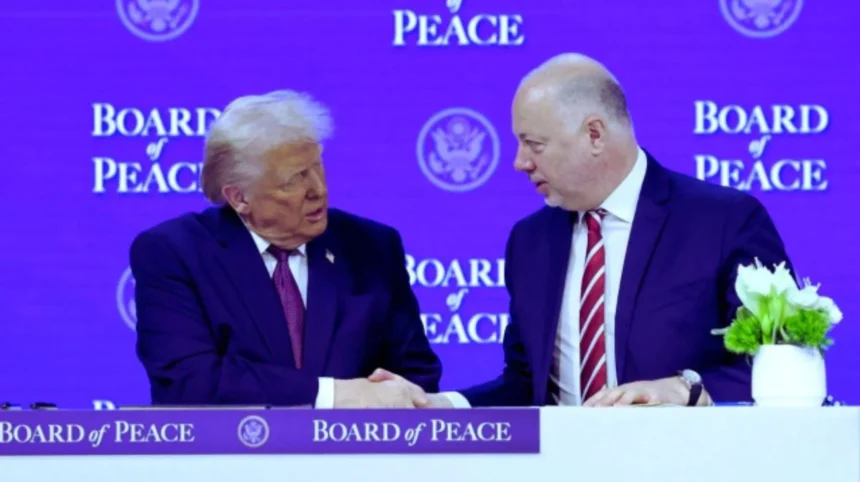
As reported by Novinite, Bulgarian authorities have informed United States President Donald Trump that Sofia will temporarily refrain from implementing the statute of the Gaza Board of Peace. According to Novinite, the government has cited constitutional requirements, under which such an international document cannot enter into force before it receives formal approval from the National Assembly. In a written reply to opposition lawmaker Vasil Pandov from the “We Continue the Change–Democratic Bulgaria” alliance, caretaker Prime Minister Andrey Gyurov explained that Bulgaria has notified Washington it cannot apply the statute on a provisional basis. Novinite reports that Gyurov stressed the agreement must first be ratified by parliament before any commitments can be implemented.
According to the Bulgarian government’s earlier Decision No. 46 of the Council of Ministers, adopted in January, the cabinet had approved the signing of the statute establishing the Gaza Board of Peace, but explicitly conditioned its entry into force on parliamentary ratification. Novinite notes that Gyurov characterized this approval as a framework for negotiations rather than an automatic commitment to put the statute into effect. The issue reached the caretaker cabinet after Pandov had previously raised the question with then–prime minister Rosen Zhelyazkov but did not receive a response before the regular government left office. As reported by Bulgaria’s government information service, the earlier decision empowered the prime minister to sign for Bulgaria’s accession while leaving the final decision to lawmakers.
According to Bulgaria’s state news agency BTA, the Council of Ministers had already approved Bulgaria’s participation in the inaugural meeting of the Board of Peace in Washington, D.C., scheduled for February 19, 2026, at the invitation of President Trump. BTA reported that this decision followed Trump’s invitation as founder and chairperson of the Board of Peace, a body designed to oversee elements of his Gaza peace initiative. The government announcement indicated that participation in the inaugural session would proceed in line with Bulgaria’s foreign policy priorities and its commitments as a US and NATO partner. However, as Novinite underlines, actual implementation of the statute remains on hold pending parliamentary action.
What Has Driven Bulgaria’s Position and Reactions?
As reported by Le Monde, Bulgaria’s initial decision to join the Board of Peace, announced at the World Economic Forum in Davos, provoked strong domestic criticism and debate in Sofia. According to Le Monde, then–caretaker prime minister Rossen Jeliazkov justified the move by pointing to the prominent role given to Bulgarian diplomat Nickolay Mladenov, chosen by the US administration as a senior representative for Gaza within the Board structure. Le Monde notes that in response to political backlash, Jeliazkov postponed a planned parliamentary review of Bulgaria’s accession and signaled a more cautious approach.
According to a statement from the Bulgarian government press service in January, Jeliazkov emphasized that Bulgaria’s accession to the Board of Peace would not involve financial commitments and would be conducted entirely on a voluntary basis. The government statement added that, in Jeliazkov’s view, the United States and the broader international community “duly appreciate” Bulgaria’s involvement in Trump’s Gaza plan. National public broadcaster BNR reported that Bulgaria signed the charter of the Board of Peace in Davos despite a broader reluctance among leading European Union states to join the initiative. BNR highlighted that Bulgaria’s choice came against a backdrop of EU-level skepticism and an internal debate about alignment with US policy in Gaza.
Internationally, media such as Al Jazeera and Le Monde have described Europe as divided over Trump’s Board of Peace, with only a limited number of EU member states agreeing to take part. Al Jazeera has reported that at least 14 countries declined invitations and that, within the EU, only Hungary and Bulgaria signaled participation. Le Monde similarly reported that Bulgaria’s decision to join, alongside Hungary, contrasted with the EU’s decision not to participate as an institution. According to these outlets, this division has placed countries such as Bulgaria at the center of a broader debate over the scope and legitimacy of the Board of Peace.
Supporting Details and Background
According to coverage by international outlets and policy institutes, Trump’s Board of Peace is a central element of his broader 20‑point plan to end the conflict in Gaza. The White House has described the Board as a coordination and oversight body tasked with managing implementation of the plan’s provisions, which include security arrangements, reconstruction, and governance frameworks. The Council on Foreign Relations has outlined how this Gaza peace plan followed a ceasefire agreed in late 2025 between Israel and Hamas, marking the start of a phased process toward longer-term stabilization. In this context, participating states such as Bulgaria are expected to contribute diplomatic support and technical input rather than direct military involvement.
Reporting by The Globe and Mail notes that Bulgarian diplomat Nickolay Mladenov, a former UN Middle East envoy, has been selected to play a leading role in directing the Board’s work on Gaza. According to that report, Israeli Prime Minister Benjamin Netanyahu announced Mladenov as the designated director-general of the Board of Peace, responsible for overseeing the more complex second phase of the ceasefire implementation. The appointment has been described as a significant step for the Board and for Bulgaria’s visibility in Middle East diplomacy. Le Monde reported that Jeliazkov cited Mladenov’s role as a key factor in Bulgaria’s initial decision to participate.
Le Monde and BNR both indicate that, despite the controversy, Bulgaria continues to engage with the process at a diplomatic level. Le Monde reported that, even as parliamentary review was delayed, Sofia planned to send a lower-ranking diplomat to the Board’s inaugural session in Washington. BNR similarly noted that Bulgaria’s signature of the charter in Davos signaled a willingness to stay involved even as domestic debate continued. Novinite’s latest reporting suggests that this approach is now being balanced by a strict adherence to constitutional procedures before any binding commitments can be enforced.
What Are the Implications and Next Steps?
According to Novinite, Bulgaria’s decision to delay implementation of the Gaza Board of Peace statute means that the country’s commitments under the Trump initiative will remain limited until parliament completes a ratification process. Gyurov’s written reply indicates that government approval alone does not provide sufficient legal grounds for provisional application of the statute. This could slow or condition Bulgaria’s role in any operational decisions taken by the Board in the coming months. At the same time, prior decisions on attendance suggest that Sofia may continue to participate in meetings in an observer or consultative capacity while the legal process unfolds.
According to Le Monde and other outlets, Bulgaria’s cautious stance mirrors wider European hesitation over Trump’s Board of Peace and its scope beyond Gaza. Analytical commentary from the French institute IRIS has argued that the Board reflects an expanded vision of US-led crisis management with potentially global implications, which has raised questions among some European partners. In this climate, Bulgaria’s insistence on parliamentary ratification may serve both legal and political purposes, allowing domestic actors to debate the country’s alignment with the initiative. Future developments will depend on when the caretaker or a subsequent regular government submits a ratification bill and how the fragmented Bulgarian parliament responds.
According to BTA, the government’s earlier decision on participation framed the Board of Peace as consistent with Bulgaria’s strategic partnership with the US and its broader foreign policy goals. However, Novinite’s reporting makes clear that constitutional safeguards will dictate the pace and scope of Bulgaria’s engagement. As the Board of Peace begins work under Trump’s leadership and with figures such as Nickolay Mladenov in key roles, Bulgaria’s final position will likely become clearer once lawmakers have debated and voted on the statute. Until then, the notified delay to Washington signals a preference for procedural clarity over rapid implementation.
In summary, Bulgaria has formally told the United States it will not implement the statute of Trump’s Gaza Board of Peace on a provisional basis, citing constitutional requirements for prior parliamentary ratification. Earlier government decisions opened the door to participation and attendance at the Board’s inaugural meeting, but domestic criticism and legal considerations have prompted a pause on full implementation. The outcome now depends on whether and when the National Assembly chooses to ratify the statute, a step that will determine the extent of Bulgaria’s future role in Trump’s peace initiative for Gaza.