


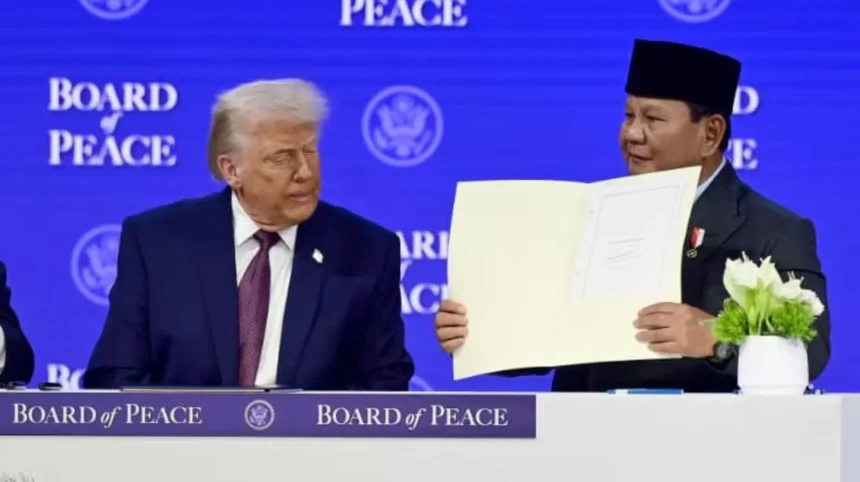
According to SBS, United States President Donald Trump has established a “Board of Peace” in Gaza as part of his 20‑point plan aimed at rebuilding the Strip after the Israel–Hamas war and overseeing a fragile ceasefire. Under the plan, the board is intended to back a National Committee for the Administration of Gaza, made up of Palestinian technocrats tasked with reconstruction and civilian governance. Representatives from dozens of countries have taken part in early meetings, where issues such as Hamas disarmament, the withdrawal of Israeli troops, and the cost of reconstruction have been discussed.
SBS reports that Indonesia, the world’s largest Muslim‑majority democracy and a longstanding supporter of the Palestinian cause, initially emerged as one of the most prominent participants in Trump’s initiative. Indonesian President Prabowo Subianto publicly endorsed Trump’s 20‑point plan and signaled that Jakarta was prepared to contribute to an international stabilization force in Gaza. At the same time, domestic debate intensified in Indonesia over whether joining the board was compatible with the country’s traditional pro‑Palestinian stance and concerns about the broader US approach to the region.
Why is Indonesia’s support wavering?
As reported by The Times of Israel, President Prabowo has sought to reassure domestic Islamic groups and civil society that Indonesia’s involvement is conditional on the Board of Peace delivering tangible benefits for Palestinians. The outlet notes that Prabowo has stated he would withdraw Indonesia from the board if it fails to help Palestinians or is seen as undermining their rights. This conditional stance reflects growing pressure from Islamic organizations and activists who worry that participation could be perceived as endorsing US‑led terms in Gaza without sufficient Palestinian input.
According to SBS and regional coverage cited by international outlets, critics inside Indonesia argue that Trump’s framework risks entrenching outside control over Gaza’s reconstruction while sidestepping key political questions, including Palestinian statehood and accountability for the war’s devastation. Some groups have warned that Jakarta’s role on the board may clash with its long‑standing foreign policy position that any peace arrangement must be firmly rooted in Palestinian self‑determination. The resulting backlash has contributed to a more cautious tone from the Indonesian government, even as official statements still emphasize a desire to contribute to peace and humanitarian relief.
Supporting details and official positions
Video and transcript material from international broadcasters shows that at earlier stages, Prabowo voiced strong, unambiguous backing for Trump’s 20‑point Gaza plan. In a speech reported by Associated Press Television and carried by regional media, Prabowo said Indonesia “completely agree[s]” with the plan and is “fully committed” to it, explaining this was the reason Jakarta joined the Board of Peace. He also stated that Indonesia was ready to send up to 8,000 troops to support an international mission in Gaza, positioning the country as a leading Muslim‑majority contributor to any stabilization force.
Coverage by outlets including Channel NewsAsia describes Indonesia as the only country to have offered such a firm troop commitment at the time of the inaugural Board of Peace meeting in Washington, D.C. The same reporting notes that the board is tied closely to Trump’s broader Gaza peace blueprint, which combines security measures, reconstruction financing, and political benchmarks. Against this backdrop, Indonesian officials have tried to emphasize that any security deployment or reconstruction role would be contingent on acceptable terms for Palestinians and on domestic political consent.
What could Indonesia’s wavering stance mean next?
According to The Times of Israel, Prabowo’s pledge to “bolt” from the Board of Peace if it does not effectively assist Palestinians introduces uncertainty over Indonesia’s long‑term role in Trump’s Gaza initiative. If Jakarta were to scale back or withdraw its participation, the board could lose one of its most symbolically important Muslim‑majority members, potentially affecting perceptions of its legitimacy in the wider Islamic world.
SBS reporting and related international analysis indicate that future developments will likely hinge on whether the Board of Peace can demonstrate concrete progress on reconstruction, humanitarian access, and political arrangements acceptable to Palestinians. Indonesian leaders face the task of balancing external expectations from Washington and other partners with strong domestic demands to uphold an uncompromising pro‑Palestinian line. How Jakarta navigates this tension may shape both Indonesia’s regional diplomatic profile and the trajectory of Trump’s Board of Peace in Gaza in the months ahead.