


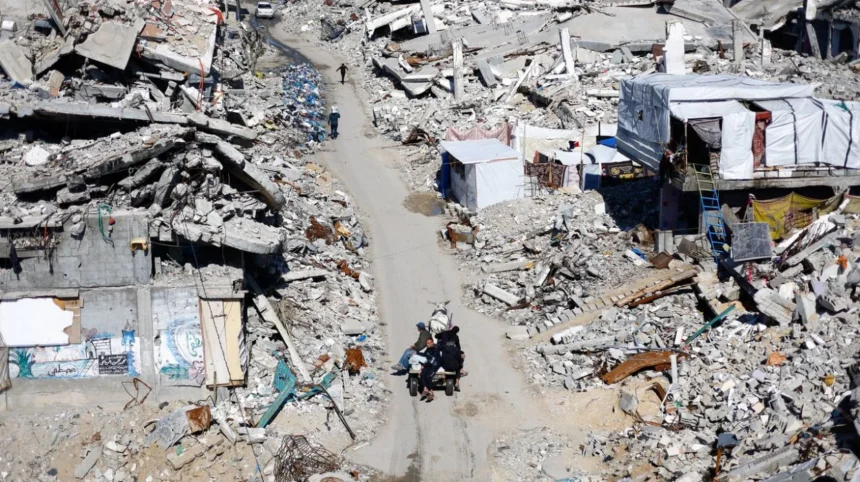
As reported by The Korea Herald, talks aimed at advancing United States President Donald Trump’s plan to end the Gaza war have been put on hold following joint US-Israeli attacks on Iran that triggered a wider regional conflict, according to three sources with direct knowledge of the negotiations who spoke on condition of anonymity. According to The Korea Herald, the pause in talks began after the outbreak of what is being described as a war with Iran on February 28, halting progress on a central component of Trump’s Middle East strategy. The Korea Herald reports that this interruption threatens to stall implementation of what Trump has promoted as a flagship Middle East peace initiative and key foreign policy objective.
According to coverage of the same development by The Straits Times and other outlets, Trump had recently secured billions of dollars in financial pledges for Gaza reconstruction from Gulf Arab states, which are now themselves facing Iranian attacks as the conflict spreads. The Korea Herald reports that Trump’s Gaza plan hinges in part on whether Hamas fighters would agree to lay down their arms in exchange for amnesty, in a process intended to enable large-scale reconstruction and facilitate further Israeli military withdrawals from Gaza. According to The Korea Herald, White House mediators have been engaged in backchannel talks between Israel and Hamas to address the disarmament question before the pause.
The Korea Herald reports that the negotiations covered both the proposed Hamas disarmament-for-amnesty arrangement and other elements of Trump’s broader Gaza roadmap, but all such talks were paused once the Iran war began. According to multiple outlets summarizing officials and diplomatic sources, the halt had not been publicly disclosed before these reports and marks a significant setback for efforts to move from a fragile ceasefire and partial Israeli withdrawal toward a more durable settlement in Gaza.
What reactions and context have been reported?
According to The Straits Times, analysts and regional experts have noted that the escalating confrontation with Iran is consuming diplomatic bandwidth and may delay or complicate any major decisions on Gaza’s future. The Straits Times reports that Zaha Hassan of the Carnegie Endowment for International Peace said the new conflict raises questions for Gulf states that had pledged funding for Trump’s initiative, including the United Arab Emirates and Qatar, as they reassess commitments under the pressure of Iranian attacks. According to these reports, these countries are now simultaneously concerned with domestic security, regional alignment, and their exposure to retaliation.
As reported by regional outlets citing the same underlying sourcing, Gulf Arab states’ promised contributions were considered a crucial financial pillar of Trump’s Gaza blueprint, designed to underwrite reconstruction projects and support a phased Israeli drawdown. According to Arab News Japan, Trump had previously warned Hamas that there would be “hell to pay” if it did not disarm and had also cautioned Iran against resuming or expanding its nuclear program, underscoring how the Gaza agenda intersected with broader US policy toward Iran. Arab News Japan reports that Trump’s plan envisages an eventual full Israeli withdrawal from Gaza, contingent on Hamas giving up its weapons and relinquishing a governing role in the territory.
According to reporting from other news organizations summarizing the same negotiations, the first phase of Trump’s Gaza ceasefire plan involved a partial Israeli withdrawal, increased humanitarian aid flows, and exchanges of Israeli hostages for Palestinian detainees and prisoners. These measures were described as precursors to more contentious steps, including the disarmament of Hamas’ military capabilities and the reconfiguration of Gaza’s security and political structures.
Supporting details and reported expert views
According to Gulf Daily News and similar regional outlets, the disarmament talks that are now on hold focused on whether Hamas would agree to lay down heavy and strategic weapons in return for amnesty and political concessions, with the understanding that this would open the way for large-scale reconstruction and foreign investment. Gulf Daily News reports that Trump’s team had been working through a “Board of Peace” structure and White House intermediaries to present a phased disarmament proposal to Hamas, while coordinating closely with Israel. A YouTube news transcript cited by regional media describes this plan as involving a staged surrender of long‑range weapons and other major systems, with some debate over what, if any, small arms might remain under local control.
According to Ynet News, Israeli officials have viewed the Gaza disarmament component as central to any durable security arrangement, but they have also remained wary about enforcement mechanisms and verification in an environment where Hamas retains significant support and underground capabilities. Ynet News reports that the Israeli government has not publicly detailed its internal deliberations regarding Trump’s blueprint or the pause in talks, while Hamas officials have confirmed through other outlets that discussions tied to Trump’s Gaza plan were frozen following the escalation with Iran. The Telegraph India, citing Hamas officials, reports that a Hamas representative confirmed that talks related to Trump’s Gaza proposal had been halted for the time being, without offering further specifics on when or how they might resume.
According to The Korea Herald and other outlets, the negotiations were taking place largely out of public view, with both American and regional officials concerned that premature disclosure could inflame opposition among domestic constituencies or rival factions. The Korea Herald notes that the reliance on anonymous sources reflects the sensitivity of both the Gaza disarmament track and the parallel military operations involving Iran, which have reshaped the diplomatic landscape since late February.
What are the implications and possible next steps?
According to The Korea Herald, the pause in disarmament talks raises the risk that Trump’s Gaza initiative could lose momentum or be overtaken by events if the Iran conflict deepens or becomes prolonged. The Korea Herald reports that the interruption has immediate practical consequences, including delays in formalizing any Hamas amnesty arrangements, postponing decisions on the scope and timing of further Israeli withdrawals, and complicating the release of pledged reconstruction funds. Regional outlets add that continued Iranian attacks on Gulf states may prompt those governments to reassess their financial commitments to Gaza or seek stronger security guarantees from Washington in exchange for following through on pledges.
According to Arab News Japan and other reporting, Trump’s broader Gaza roadmap ultimately envisions a sequence in which disarmament, political restructuring, and reconstruction proceed in a coordinated fashion, but these steps now depend on a reduction in regional tensions and a resumption of indirect talks between the United States, Israel, and Hamas. The Straits Times notes that US diplomatic attention is currently divided between managing the Iran war, reassuring regional partners, and preserving what remains of Trump’s Gaza framework, making it unclear when intensive mediation on the disarmament file can restart. Ynet News and other outlets indicate that Israel’s calculations may also shift as the conflict with Iran unfolds, potentially altering its willingness or timeline to implement further withdrawals from Gaza under the original plan.
According to multiple reports, no clear timetable has been publicly set for resuming the Gaza disarmament negotiations or for revisiting the suspended elements of Trump’s initiative. The Korea Herald and other outlets report that, for now, officials and mediators are monitoring developments in the Iran war and assessing whether conditions will allow the parties to return to the table without jeopardizing security or political standing at home.
The confirmed picture from current reporting is that President Donald Trump’s plan to end the Gaza war, built around a Hamas disarmament-for-amnesty framework, substantial Gulf funding, and phased Israeli withdrawals, has been placed on hold after the start of a war with Iran on February 28, with key negotiations paused and future steps contingent on how the wider regional conflict unfolds.