


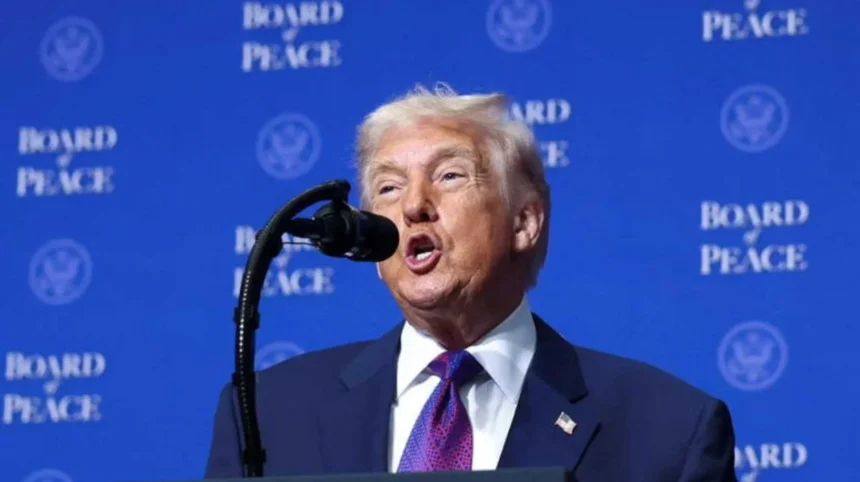
President Donald Trump opened the first meeting of his newly created Board of Peace by acknowledging that he had expected to receive personal payment connected to the role, remarking that he “could always use some extra cash.” According to coverage of the event, Trump made the comment while speaking at the recently named Donald J. Trump U.S. Institute of Peace in Washington, where he hosted foreign dignitaries and officials to launch the body focused on postwar Gaza and broader conflict resolution efforts.
As reported by PBS NewsHour, the inaugural session brought together representatives from more than 40 nations and observers from additional countries, with Trump describing the Board of Peace as one of his most consequential initiatives and announcing that the United States would allocate 10 billion dollars to support its work, including the reconstruction of Gaza. Trump also claimed that nine countries had pledged a further 7 billion dollars for relief in Gaza, positioning the board as a central vehicle for channeling international funds and coordination around the territory’s rebuilding.
According to a report summarized by MEXC and other outlets, Trump went on to tell attendees that he regarded the Board of Peace as “the most consequential board” in terms of power and prestige and asserted that “almost everybody” he had invited to join had accepted, while suggesting that those who had not yet committed would eventually do so. He further said that some potential members were “playing a little cute” and added that a “few that we really don’t want because they’re trouble” would need to be “taken care of,” underscoring the selective and highly personal approach he described to shaping the board’s membership.
Trump also used the event to praise the rebranding of the institute hosting the meeting, telling attendees that Secretary of State Marco Rubio and allies had secretly arranged to name the building after him. He recounted that he had been told there would be “a surprise” and said he initially assumed that meant he would receive “a lot of money or something, maybe cash,” before adding that “you could always use some extra cash,” a remark that has since drawn scrutiny because it implied he anticipated personal financial benefit connected to his leadership of the peace body.
How have officials and observers reacted?
According to PBS, Trump’s announcement that the United States would commit 10 billion dollars to the Board of Peace immediately raised questions about whether he had the legal authority to direct that level of funding and where the money would come from, as neither the White House nor the president offered specific details on the funding source or mechanism during the event. NBC News reporting similarly highlighted concerns among critics and experts that the board could function as a loosely regulated vehicle for large sums of public money, amplifying existing debates in Washington over congressional oversight of major foreign and reconstruction commitments.
As reported by National Today, Trump’s comment that he had expected to be paid personally for his role has been cited by critics as deepening ethical concerns about the Board of Peace, including whether the president’s personal financial interests might intersect with the board’s handling of very large public and international contributions. Commentators quoted in that coverage pointed to his remark about hoping for “extra cash” as an example of how Trump’s approach to official initiatives can blur lines between public duty and private gain, even as the administration promotes the board as a tool for global diplomacy and post-conflict rebuilding.
According to Sky News and other outlets that have covered the board’s launch, the initiative itself has already drawn debate among international observers because of its central role in implementing Trump’s Gaza plan, which includes conditions such as the disarmament of Hamas and the deployment of an international stabilization force. Those reports note that while some governments have welcomed pledges of reconstruction money and security support, others have expressed caution over the political terms attached to the plan and the concentration of financial control in a body closely associated with the U.S. president.
Supporting details and background
According to PBS NewsHour, Trump used his remarks at the inaugural Board of Peace gathering to declare that the conflict in Gaza had “concluded,” presenting the board as the primary forum for organizing the territory’s reconstruction, including infrastructure rebuilding and humanitarian support. During the same event, he said the United States’ proposed 10‑billion‑dollar contribution was small compared with the long-term financial burden of war, framing the pledge as both a strategic and fiscal argument in favor of large-scale peace-building investments.
As reported by Sky News, Trump told attendees that nine countries had collectively pledged 7 billion dollars for rebuilding Gaza and that five nations had agreed to send troops for an international stabilization force, commitments he portrayed as evidence of broad backing for the board and its mission. NBC News coverage of the launch noted that Trump also emphasized the presence of a wide array of foreign ministers and envoys, arguing that their participation validated the initiative and supported his efforts to assume a more expansive global role through the Board of Peace.
Background reporting from The New Republic and other outlets has traced the origins of the Board of Peace to a broader 20‑point plan Trump previously floated on Gaza, which envisioned a mix of international funding and security guarantees to reshape conditions in the enclave. Those accounts describe the board as both a diplomatic platform and a substantial financial mechanism, with critics warning that its structure, combined with Trump’s far-reaching control over its direction, could allow it to function as a de facto slush fund without strong external checks.
What are the implications and what happens next?
According to PBS and NBC News, Trump’s remarks about expecting personal payment and his promise of a 10‑billion‑dollar U.S. contribution set up potential clashes with Congress, which holds the power of the purse and would likely need to authorize any large-scale appropriation for the Board of Peace. Lawmakers and oversight bodies are expected to seek clarity on the legal basis for the proposed funding, the structure of the board, and the safeguards in place to prevent conflicts of interest or misuse of public money, particularly in light of the president’s own admission that he anticipated financial benefit.
As reported by National Today, ethics experts and watchdog organizations have already raised concerns that Trump’s candid comment about hoping for “extra cash” could intensify calls for stricter transparency requirements around the board’s finances and decision-making. Analysts quoted in that coverage suggested that future scrutiny is likely to focus on how contributions from the United States and other countries are managed, who has authority over disbursements, and whether independent auditing or legislative oversight will be established as the Board of Peace begins its work.
According to Sky News and other international reporting, the board’s next steps will involve turning headline pledges into concrete projects in Gaza and potentially other conflict zones, including determining which reconstruction and security initiatives to prioritize and how to coordinate with existing international agencies. Observers note that the success or failure of these efforts, combined with the resolution of open questions about funding and ethics, will shape both the credibility of the Board of Peace and the broader perception of Trump’s latest attempt to position himself as a central figure in global peace and reconstruction efforts.
In sum, Trump’s admission that he had hoped to be personally paid for his role with the Board of Peace has added an ethical dimension to an already controversial initiative that commands significant promised funding and international attention. As the board moves from its inaugural meeting toward implementation, its financial arrangements, oversight structure, and impact on Gaza’s reconstruction are likely to remain subjects of close examination in Washington and abroad.