


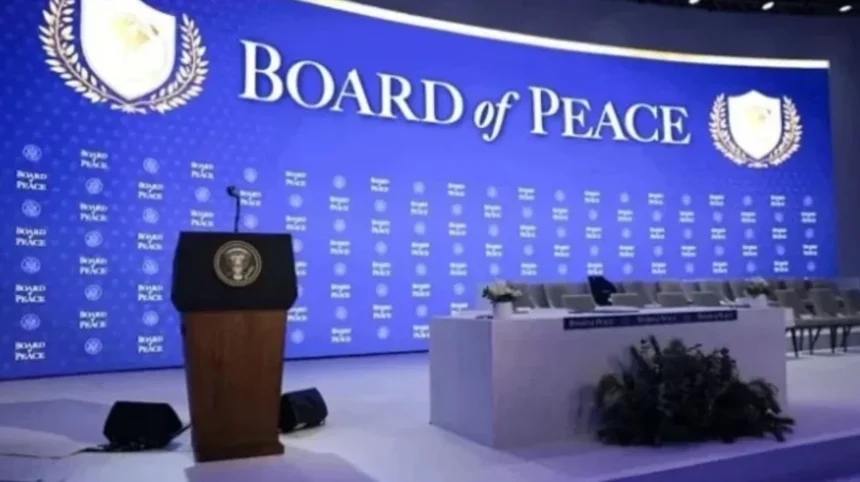
As reported by Jamal Khurshid of The News, Jamaat-e-Islami (JI) Pakistan Emir Engr Hafiz Naeemur Rehman has demanded that the government withdraw from the Gaza Board of Peace, which he linked to former US president Donald Trump’s role in regional diplomacy and US support for Israel. According to The News, he made this call while addressing a “Down with Israel and USA” public gathering and iftar event in the Gulshan-e-Maymar area of Karachi.
The News reports that Rehman argued Pakistan should not remain on a forum associated with powers he accused of forming a “satanic” alliance against Muslims, referring to Israel, India and the United States. He warned that if the country’s rulers did not leave the forum voluntarily, they would be compelled to do so through sustained public pressure.
According to the same report, the JI chief criticized both government and opposition parties, as well as the wider ruling elite in Pakistan, claiming they were unwilling to resist what he described as anti-Muslim policies. He stressed that internal sectarian divisions among Muslims weakened their ability to respond to external threats and called for unity and a collective struggle in the face of what he termed “anti-Islam” and “oppressive” global powers.
Rehman also linked his demand to broader regional conflict, accusing the United States of supplying weapons to Israel used in attacks on Gaza and condemning ongoing Israeli and US military actions in Gaza and Iran. He recalled that Trump had previously spoken about providing weapons to Israeli Prime Minister Benjamin Netanyahu, and criticized Pakistan’s prime minister for having once spoken about nominating Trump for the Nobel Prize at the same event.
In addition to foreign policy and conflict issues, Rehman used the gathering to condemn a recent 55-rupee increase in petrol and diesel prices in Pakistan. He urged the prime minister to bar government officers from using official vehicles with engine capacities above 1300cc and questioned why domestic fuel prices had not fallen when international oil prices had declined.
What reactions and context did the JI chief highlight?
According to The News, Rehman framed his call for Pakistan to quit Trump’s peace-related forum in the broader context of the war in Gaza and escalating tensions involving Iran. He accused the United States and Israel of violating international law and humanitarian norms by bombing children, women and the elderly in Gaza and by launching attacks on Iran.
The report states that Rehman also referred to the killing of Iran’s Supreme Leader Ayatollah Ali Khamenei in alleged attacks, saying that despite this, the Iranian nation was showing patience and resilience. He claimed Israel had restricted its own citizens from recording videos of missile strikes, presenting this as an effort to control information about the conflict.
The gathering adopted a resolution that, according to The News, described simultaneous US diplomacy and alleged attacks as “open terrorism.” The resolution condemned US and Israeli air strikes on civilians in Iran, including schoolgirls, and asserted that Khamenei was among those targeted, with reported casualties including a 14‑month‑old granddaughter.
The News further reports that a day earlier, the Karachi chapter of Jamaat-e-Islami organized protest demonstrations at more than 100 major locations and outside mosques across the city. Demonstrators carried banners and placards, chanted slogans against the United States and Israel, and demanded that Pakistan’s government and opposition publicly condemn both countries and declare support for Iran.
Addressing an iftar dinner in North Karachi, Karachi JI chief Monem Zafar said, according to The News, that the party saluted Iran’s “courage and steadfastness” in the face of what he called open aggression and terrorism by the US and Israel. He told participants that people in Karachi stood with “their brothers in Gaza and Iran” and pledged they would not abandon them in the current crisis.
Supporting details and broader background
The News reports that Zafar reiterated the party’s long-standing stance on the Palestinian issue, saying the JI had consistently raised its voice against Israeli aggression and terrorism in Gaza and supported the Palestinian struggle for the “liberation of Al-Quds.” He argued that recent attacks by the US and Israel on Iran, carried out under the stated rationale of regime change, represented open aggression, terrorism and a serious breach of international ethics and law.
According to the same report, Zafar claimed that these attacks caused the deaths of more than 150 schoolgirls and senior Iranian leaders, including Iran’s Supreme Leader. He criticized major powers for remaining silent despite presenting themselves as defenders of human rights.
The News notes that Zafar warned of far-reaching consequences from what he described as war-driven policies of the US and Israel. He said these actions were putting global peace at serious risk and pushing the world toward the possibility of a Third World War, alongside an intensifying global economic crisis.
On Gaza, the report cites Zafar as saying that since 7 October 2023, more than 75,000 people had been killed there, two-thirds of them women and children, and that around 85 percent of the territory had been reduced to rubble by Israeli bombardment. He alleged that the US and Israel aimed to expel Palestinians from their land, but insisted that residents of Gaza continued to resist and had refused to surrender.
Within this broader context, Rehman characterized Ramadan as a month of revolution, unity and solidarity, reminding attendees that the Quran was revealed in this month. According to The News, he urged Muslims to use the period to foster unity and eliminate hatred, tying religious messaging to the political demands he presented, including the call for Pakistan to exit Trump’s peace-related board.
What are the implications and possible future developments?
According to The News, Rehman made it clear that his party intended to maintain public pressure on the government over both foreign policy and domestic economic decisions. He warned that if Pakistan’s rulers did not voluntarily withdraw from the Gaza Board of Peace linked to Trump’s peace efforts, they would face growing street mobilization.
The reported protests in Karachi, with demonstrations at over 100 locations, suggest that JI is seeking to expand its campaign beyond speeches to sustained public action. The party has coupled its demand for a shift in Pakistan’s stance on US- and Israel-led initiatives with opposition to fuel price hikes, potentially broadening its appeal among economically strained citizens.
The News indicates that JI leaders are positioning the party as a consistent critic of US and Israeli policy and a defender of Palestinian and Iranian causes. By linking calls for Pakistan to leave Trump’s peace-related forum to the wider conflicts in Gaza and Iran, JI is framing its demands as part of a larger struggle over foreign alignment and national sovereignty.
Future political developments will depend on how the federal government responds to these calls and whether other parties join or reject JI’s position, but The News report does not detail any official reaction from state authorities. For now, the article highlights JI’s strategy of combining foreign policy criticism, religious messaging and economic grievances to build momentum behind its demand that Pakistan quit Trump’s peace board.
In summary, as reported by Jamal Khurshid in The News, Jamaat-e-Islami has moved to intensify its campaign against Pakistan’s participation in a Gaza-related peace forum associated with Donald Trump, tying this stance to broader criticism of US and Israeli actions in Gaza and Iran. Through speeches, resolutions and street demonstrations, JI leaders are calling on the government and opposition to adopt a more confrontational line toward Washington and Tel Aviv while also pressing domestic economic concerns, signaling a multi-issue political push that could shape upcoming debates over Pakistan’s foreign policy and internal governance.

