


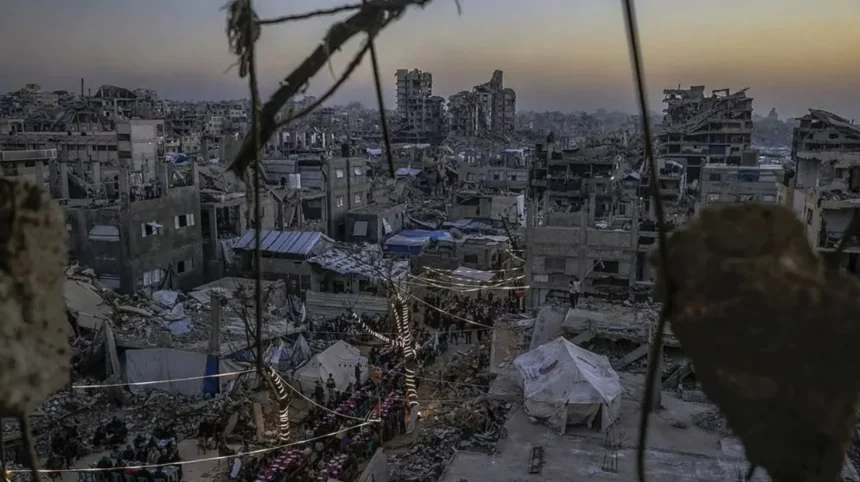
As reported by Asharq Al-Awsat, the first meeting of the Board of Peace, chaired by United States President Donald Trump, brought together representatives from more than 40 countries and observers from 12 others to outline an ambitious framework for post-war Gaza. According to Asharq Al-Awsat, Washington presented two central priorities: funding the reconstruction of Gaza and disarming Hamas, while several Arab states stressed that any progress must be tied to a fully implemented ceasefire and the deployment of an international stabilization force. Reuters has reported that members of the Board of Peace have collectively pledged more than 5 billion dollars for Gaza’s reconstruction as part of the Trump administration’s broader strategy to end the conflict between Israel and Hamas.
Asharq Al-Awsat notes that key political and security questions remained unresolved at the meeting, including the scope and timing of Israeli military withdrawal from Gaza and the mechanisms for Hamas disarmament. Israeli Prime Minister Benjamin Netanyahu, in comments cited by Asharq Al-Awsat and other outlets, has insisted there will be no large-scale reconstruction before Gaza is demilitarized, underscoring a sequencing dispute at the heart of the new framework. According to Reuters, although Israel and Hamas accepted a ceasefire framework last year, both sides have since accused each other of repeated violations, with continued casualties reported on both sides despite the formal truce.
What are the main reactions and points of tension?
As reported by Asharq Al-Awsat, Arab participants at the Board of Peace meeting linked their support for reconstruction and security arrangements to full implementation of the Gaza ceasefire, unhindered operations for a technocrats’ committee across the enclave, and the deployment of an international stabilization force. The same report states that Israel’s Foreign Minister Gideon Saar echoed Netanyahu’s stance by strongly backing the disarmament of Hamas and other armed factions before major reconstruction begins. This sequencing — demilitarization before reconstruction — is one of the central points of friction between Israeli officials and Arab states, who emphasize immediate relief and political guarantees for Palestinians.
According to Asharq Al-Awsat, Qatar’s Prime Minister and Foreign Minister Sheikh Mohammed bin Abdulrahman Al Thani pledged 1 billion dollars from Doha in support of the Board of Peace plan, positioning the contribution as part of a push toward a comprehensive settlement. Egypt, through remarks by Prime Minister Mostafa Madbouly cited by the same outlet, stressed the need to preserve territorial and administrative links between the West Bank and Gaza to enable the Palestinian Authority to resume responsibilities in the Strip. Asharq Al-Awsat reports that Egypt and Jordan also agreed to train future police and security forces for Gaza, while countries including Indonesia, Morocco, Kazakhstan, Kosovo, and Albania pledged troops for the proposed International Stabilization Force under the command of General Jasper Jeffers.
Hamas, for its part, has rejected any approach that prioritizes security steps without firm political commitments. According to Asharq Al-Awsat and Al Jazeera’s reporting on the Board of Peace discussions, Hamas has stated that any arrangements concerning Gaza must begin with a complete halt to Israeli military operations, lifting of the blockade, and guarantees of Palestinian national rights, including self-determination. Asharq Al-Awsat further quotes Hamas statements insisting that political tracks and future governance arrangements cannot be separated from these conditions, signaling reluctance to accept disarmament without broader assurances.
Supporting details: Expert analysis and implementation risks
Asharq Al-Awsat cites Saeed Okasha, an analyst at the Al-Ahram Center for Political and Strategic Studies, as warning that the Board of Peace proposals lack operational clarity and could lead to confusion in implementation, potentially stalling or freezing the agreement. Okasha is reported as saying that the heavy emphasis on security measures, especially disarming Hamas, without explicit commitments on Israeli withdrawal or Hamas’s future status, may create conditions for renewed instability. He also argued that an end to the offensive in Gaza, as demanded by Hamas, remains unlikely as long as the disarmament issue is unresolved, given US and Israeli positions.
Palestinian political analyst Nizar Nazzal, also cited by Asharq Al-Awsat, expressed concern that the Board of Peace framework leans heavily on economic incentives and security arrangements without a clear political roadmap. He cautioned that sidelining political commitments, such as timelines for Israeli withdrawal or steps toward a broader settlement, is likely to collide with “security complexities” on the ground and delay key provisions like deployment of stabilization forces and the empowerment of the technocrats’ committee. According to these experts, a core risk is that implementation could stall at the phase of pledges and planning, without translating into tangible changes for civilians in Gaza.
Reuters has reported that even after the formal ceasefire took effect, Gaza’s Health Ministry has documented hundreds of Palestinian deaths from continued Israeli military actions, while Israel has reported several soldiers killed by Palestinian fighters, underscoring the fragility of current arrangements. This ongoing violence is viewed by analysts as a major obstacle to the stabilization force and reconstruction plans envisioned by the Board of Peace. In parallel, Al Jazeera’s coverage of the Board of Peace meeting highlights that, despite large funding pledges, the situation for civilians inside Gaza remains precarious, with critical infrastructure, housing, and basic services heavily damaged.
What are the implications and possible next steps?
According to Asharq Al-Awsat, the Board of Peace’s pledges now face a “test of implementation” in a context where key actors diverge on sequencing and priorities, particularly around demilitarization, Israeli withdrawal, and political guarantees for Palestinians. Analysts cited by the paper suggest that without clearer mechanisms, timelines, and enforcement tools, the Board risks becoming another forum of promises that do not significantly change realities on the ground. In their view, the mandate, composition, and deployment schedule for the International Stabilization Force, as well as the authority of the technocrats’ committee inside Gaza, will be crucial indicators of whether the process advances.
Al Jazeera and Reuters both report that the Trump administration is presenting the Board of Peace as the centerpiece of its strategy to end the war and launch reconstruction, but they note persistent skepticism from Palestinian factions and some regional experts about whether the political dimensions of the conflict are being adequately addressed. A US mediator quoted by Asharq Al-Awsat, Bishara Bahbah, indicated that Hamas disarmament would depend on guarantees and protection for its members, a condition that remains undefined publicly. Until such guarantees, as well as clearer arrangements over governance and security in Gaza, are negotiated, the gap between diplomatic announcements and the day-to-day situation for civilians is expected to remain wide.
In the near term, according to the reporting by Asharq Al-Awsat and other outlets, the implementation test will revolve around three fronts: whether pledged funds are disbursed and reach reconstruction projects; whether the ceasefire holds sufficiently to allow deployment of international forces; and whether negotiations over Hamas’s future and Israeli withdrawal move beyond general statements. Observers quoted by these media outlets caution that failure on any of these fronts could delay or derail the Board of Peace initiative, prolonging instability in Gaza despite the high-profile pledges made in recent weeks.
Taken together, verified reporting from Asharq Al-Awsat, Reuters, Al Jazeera, the BBC, and other outlets indicates that the Board of Peace has generated substantial financial commitments and a broad framework for Gaza’s reconstruction, but its success will depend on resolving outstanding political and security disputes and translating pledges into concrete, monitored actions on the ground.