

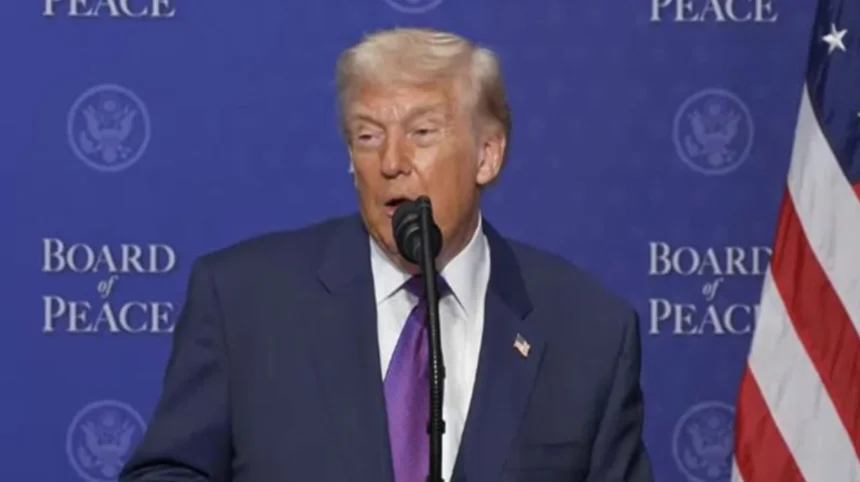
US President Donald Trump said his newly formed Board of Peace will “almost be looking over the United Nations and making sure it runs properly” as part of his administration’s wider effort to shape post‑war governance and reconstruction in Gaza. According to reporting by Yasin Gungor and Michael Hernandez of Anadolu Agency, Trump made the remarks at the inaugural Board of Peace meeting in Washington, where he described the UN as having “great potential” but in need of support. As reported by The Tribune in India, Trump linked the Board of Peace directly to his 20‑point peace plan for Gaza, saying the body would help make the UN “viable” and support it “money‑wise.”
According to Anadolu Agency, Trump told attendees that the United States would work “very closely” with the UN and “bring them back,” signaling that his initiative is intended to run alongside, rather than formally supplant, the world body. The Tribune reported that he reiterated his view that the UN has “not lived up to potential” but argued that under his approach the organization “is going to be much stronger.” Time magazine likewise reported that Trump framed the Board of Peace as an oversight mechanism to ensure the UN “runs properly” while criticizing its failure to meet what he called its “tremendous potential.”
What Is the Board of Peace and How Has It Been Framed?
According to CNN, the Board of Peace was launched by Trump as a central vehicle in his Gaza strategy, with a charter that positions the Board to oversee reconstruction efforts and potentially assume functions traditionally associated with the UN in that arena. CNN reported that the White House announced a founding executive board including figures such as former British prime minister Tony Blair, with Trump designated as chair for an open‑ended period under the draft charter. As reported by The Tribune, Trump has previously suggested the Board of Peace “might” replace the UN, a comment that has fueled concerns in diplomatic circles that the new body could evolve into a rival center of authority.
Tehran Times noted that Trump’s description of the Board “looking over” the UN has intensified unease among some UN officials and observers who view the move as an attempt to reshape the existing multilateral system. According to CNN’s account of reactions, former US Middle East negotiator Aaron David Miller questioned whether the Board of Peace could realistically take over the UN’s role, arguing that durable settlements depend on mediators working directly with parties on the ground rather than new institutional layers. CNN also reported that senior UN humanitarian officials have publicly stressed that Trump’s Board will not replace the UN’s mandate or its role in Gaza.
Supporting Details and Financial, Political Stakes
The Tribune reported that Trump told the inaugural meeting the United States would provide financial backing to strengthen the UN, saying Washington would “help it money‑wise” while the Board of Peace monitors its performance. According to The Tribune’s coverage, Trump cited what he described as eight wars he “settled” in the first year of his second term, adding that he “never” spoke to the UN about any of them but “should have” discussed all of them with the organization. Time magazine noted that Trump’s remarks fit a broader pattern of both criticizing and seeking leverage over international institutions, positioning his Board as a structure that can apply pressure while claiming to bolster multilateralism.
Tehran Times reported that some diplomats and analysts view the Board as a parallel architecture that could redirect funding and political attention away from UN agencies operating in Gaza and beyond. According to CNN, the draft charter indicates that future US presidents will be able to appoint a US representative to serve on the Board alongside Trump, suggesting the body is designed to outlast his current term if it continues to operate. Anadolu Agency reported that Trump’s comments in Washington emphasized continuity of US engagement, with the president promising to “strengthen” the UN and repeatedly describing it as an institution with “great potential” under closer scrutiny.
What Are the Implications and What Happens Next?
According to CNN, Trump’s earlier suggestion that the Board of Peace “might” replace the UN, combined with his latest promise that it will “look over” the organization, has raised questions among allies and UN officials about whether Washington is seeking to build an alternative center of legitimacy for conflict resolution. Tehran Times reported that UN officials have responded by underscoring the organization’s existing legal mandate and warning that any attempt to bypass its structures in Gaza could complicate humanitarian operations and reconstruction planning. Analysts cited by CNN have suggested that the effectiveness of the Board of Peace will depend on how much funding, international participation, and cooperation with existing UN agencies it can secure.
As reported by Anadolu Agency, Trump has indicated that the United States will “work very closely” with the UN under the Board’s framework, signaling an immediate focus on coordination rather than formal institutional change. The Tribune noted that leaders of countries that have joined the Board attended the inaugural meeting, hinting at a coalition‑building effort that could influence how reconstruction funds and diplomacy are channeled. Time magazine reported that, for now, Trump’s statements point to a dual track: publicly affirming the UN’s potential while using the Board of Peace as a platform to pressure and oversee the world body’s role in Gaza and broader peace efforts.
In sum, Trump’s assertion that his Board of Peace will “look over” the UN and ensure it “runs properly” marks a significant escalation in his attempt to reshape how international institutions manage conflict and reconstruction, particularly in Gaza. The initiative’s real impact will hinge on how it is implemented, the degree of cooperation or resistance from UN organs and member states, and whether the Board functions as a complementary mechanism or an enduring rival to the existing multilateral system.