


According to reporting based on documents seen by British newspaper The Guardian, the administration of United States President Donald Trump is considering the construction of a large military base in the Gaza Strip to support a proposed multinational security mission. The facility is described as a 350‑acre installation capable of accommodating about 5,000 personnel and serving as the operational headquarters for an International Stabilisation Force intended to oversee post‑war security and governance in the enclave. As reported by The New Arab, the base would be part of the implementation of an October ceasefire deal for Gaza that includes reconstruction and a new governing framework without Hamas.
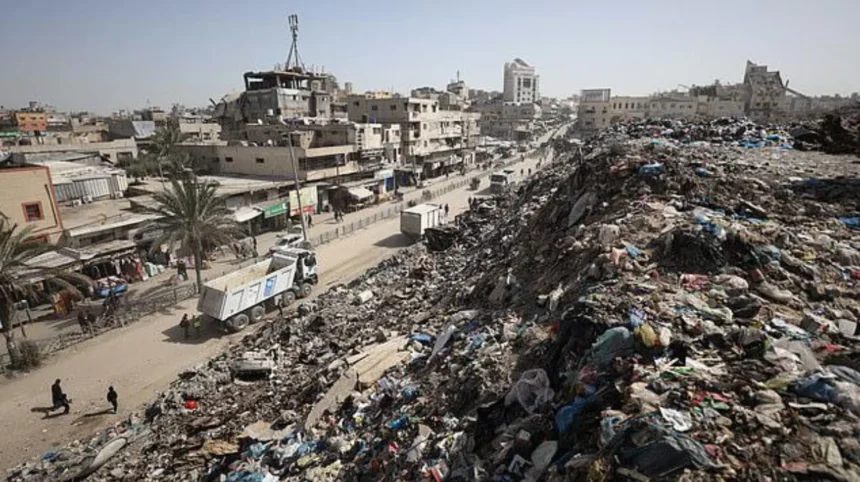
As reported by The New Arab, the planned base would be located in southern Gaza on a flat area heavily damaged by Israeli bombardment, with international construction companies experienced in conflict zones already invited for site visits. According to The Guardian’s account as summarized by multiple outlets, the complex is expected to include fortified infrastructure such as perimeter defenses and watchtowers to protect the thousands of troops and staff envisioned for the site. The base is tied to a broader Trump‑backed structure known as the Board of Peace, which would act as an overarching body for Gaza’s transition during reconstruction.
What reactions and context have been reported?
According to The New Arab, the International Stabilisation Force (ISF) associated with the proposed base has been authorized by the United Nations Security Council, with a mandate to secure Gaza’s borders, maintain internal stability, protect civilians, and support the development of Palestinian security institutions. The outlet reports that Indonesia has indicated it could contribute thousands of troops, while other countries such as Morocco, Kazakhstan, Kosovo and Albania have also expressed interest in participating. Coverage from regional and international media notes that these plans emerge after months of intense conflict in Gaza, with large areas devastated and many casualties reported.
As reported by The New Arab, the ceasefire that underpins the stabilization effort took effect on 10 October under a 20‑point proposal put forward by Trump, including the release of Israeli hostages in exchange for Palestinian prisoners and provisions for Gaza’s reconstruction. The same report recalls that the White House in November 2025 publicly denied earlier media suggestions that the United States was considering a large base in Israel near the Gaza border to support monitoring of ceasefire forces, underscoring how the current Gaza‑based project marks a distinct and more expansive plan. Broadcast and digital reports, including by WION and the Times of India, have highlighted that the envisioned stabilization deployment could eventually reach about 20,000 multinational troops across Gaza, with the 5,000‑person base acting as a central hub.
Supporting details and expert commentary
According to The New Arab’s summary of The Guardian’s findings, the planned base would measure roughly 1,400 meters by 1,100 meters and be protected by 26 trailer‑mounted armored watchtowers, reflecting expectations of a long‑term, high‑security presence. The same reporting says the base is conceived as the headquarters for the ISF’s operations, including command, logistics, and coordination with Gaza’s emerging institutions under the Board of Peace framework. The Board of Peace, chaired by Trump and including a leadership role for his son‑in‑law Jared Kushner, is described as the body that would guide post‑war governance arrangements and reconstruction phases in the territory.
Regional coverage cited by outlets such as The New Arab notes that international construction firms with experience in war zones have already carried out or been invited to conduct site surveys in southern Gaza, indicating that planning has moved beyond purely conceptual stages. Video and broadcast analyses, including those referenced by Indian and international channels, emphasize that the proposed base and force would sit in one of the world’s most unstable regions, raising questions among analysts about rules of engagement, relations with Israel and Palestinian factions, and the long‑term security architecture in Gaza.
What are the reported implications and next steps?
According to The New Arab, the ISF and its headquarters base are intended to operationalize elements of the October ceasefire agreement, including border security, civilian protection and the training of vetted Palestinian police forces to gradually assume local responsibilities. Reports indicate that early steps involve formalizing troop contributions from interested states, finalizing construction contracts, and defining command arrangements under the UN‑mandated framework and the Board of Peace. Analysts quoted in broadcast discussions, as summarized in regional coverage, suggest that the scale of the proposed base signals a long‑term international security role in Gaza, though its effectiveness will depend on political buy‑in from key local and regional actors.
Future developments, according to these news reports, will likely center on detailed UN planning for the International Stabilisation Force, negotiations over participating countries’ contingents, and decisions on how the force will coordinate with Israeli authorities and emerging Palestinian governance structures. Media coverage also notes that questions remain about how the presence of a large foreign base in Gaza will be perceived by the local population and regional states, an issue that diplomats and planners are expected to confront as designs for the 5,000‑person installation advance.
Taken together, the reporting describes an ambitious Trump administration proposal to anchor a UN‑mandated, multinational stabilization effort in Gaza around a 350‑acre base designed for 5,000 personnel, framed as part of a broader ceasefire and reconstruction plan and still subject to political, security and logistical tests as planning moves forward.