


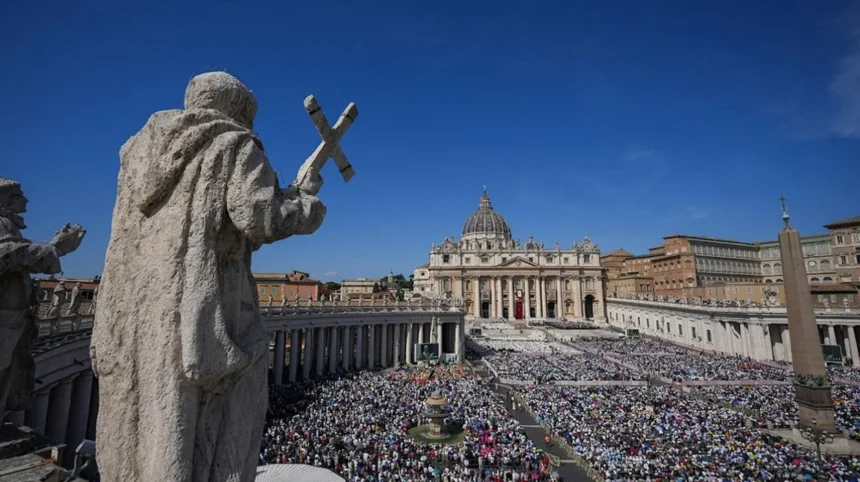
As reported by AOL News, the Vatican has formally declined an invitation to join United States President Donald Trump’s “Board of Peace,” an international body created to oversee reconstruction and post‑war governance in the Gaza Strip. According to AOL, the board is chaired by Trump and was originally conceived to manage Gaza’s recovery, but its mandate has since broadened toward a wider global peacekeeping role. Pope Leo XIV, the first US‑born pope, received the invitation in January as Trump sought to bring the Holy See into the new framework.
AOL reports that Vatican Secretary of State Cardinal Pietro Parolin confirmed the decision in comments to reporters, stating that the Holy See would not participate in the Board of Peace and highlighting concerns about the initiative’s nature and structure. Vatican officials, citing their long‑standing diplomatic approach, emphasized that international crisis management and peace efforts should remain under the leadership of the United Nations rather than a parallel US‑led mechanism.
According to AOL and other outlets, the Board of Peace includes a group of US‑aligned countries and partners that have pledged billions of dollars in aid for Gaza’s reconstruction under Trump’s plan. However, several European allies, as well as the Vatican, have opted not to participate, reflecting broader reservations about creating a new structure that some diplomats see as competing with the UN’s role.
Why Did the Vatican Refuse to Join?
As reported by AOL, Cardinal Parolin said Vatican officials were left “perplexed” by some aspects of the Board of Peace proposal and identified “critical points” that needed clarification, ultimately leading to the decision not to join. In remarks cited by AOL and America Magazine, Parolin explained that “one concern is that at the international level it should above all be the UN that manages these crisis situations,” underscoring the Holy See’s preference for established multilateral mechanisms.
According to AOL, Parolin also stated that the Holy See would not participate in the Board “because of its particular nature, which is evidently not that of other States,” signaling that the Vatican sees its unique status and moral‑diplomatic role as incompatible with the structure Trump has proposed. America Magazine reports that Vatican officials were wary of the board’s design and costs, and viewed it as an “expensive and destabilizing intrusion” into the UN’s peace‑making mandate.
Other reporting notes that the Holy See has consistently stressed that any long‑term solution for Gaza must be rooted in international law and involve Palestinian participation, and that creating a separate board chaired indefinitely by a single national leader raises governance and legitimacy questions. The Vatican has also expressed concern about any arrangements that might facilitate displacement of Palestinians or weaken existing UN frameworks that it sees as central to protecting vulnerable populations.
Supporting Details and Expert Commentary
According to AOL and Fox News, Trump’s Board of Peace was established in January with nearly 20 founding member states and a remit to coordinate reconstruction, security and governance in Gaza following the devastating Israel‑Hamas war. Fox News reports that Trump has presented the board as a flagship initiative of his Gaza peace plan and announced that member states have pledged more than $5 billion in assistance.
America Magazine notes that Trump has suggested the Board of Peace could eventually rival the United Nations in scope, and that each member state is expected to pay a substantial financial contribution to join, with the board raising several billion dollars so far. The same report says many traditional US allies in Europe declined invitations, reflecting skepticism about building a new, leader‑centric body instead of working through existing multilateral institutions.
In coverage by OSV News and other Catholic outlets, analysts point out that the Vatican has historically prioritized support for the UN system and for internationally recognized peace processes, especially in the Middle East. They note that the Holy See recognized the State of Palestine years ago and sees Gaza’s future as inseparable from Palestinian rights and self‑determination, a stance that shapes its cautious approach to any new governance structures.
What Are the Implications and Next Steps?
According to America Magazine, Vatican officials do not expect the decision to refuse a seat on the Board of Peace to derail diplomatic relations with the Trump administration, and they have signaled a willingness to maintain dialogue with Washington on Gaza and broader regional issues. Cardinal Parolin has indicated that the Holy See carefully studied the proposal before declining “in this phase,” leaving open the possibility of continued engagement on humanitarian and political questions through other channels.
At the same time, the Vatican’s stance reinforces broader international debates about the role of the United Nations versus ad hoc, leader‑driven coalitions in managing post‑conflict reconstruction and peace efforts. By explicitly calling for UN leadership in Gaza, the Holy See has aligned itself with governments and diplomats who argue that any durable settlement must rest on universally accepted norms and institutions rather than parallel structures.
As reported by AOL and America Magazine, the Board of Peace is expected to continue operating without Vatican participation, with Trump and his allies moving ahead on funding and planning for Gaza’s reconstruction. For now, the Holy See will focus on supporting multilateral efforts and humanitarian initiatives anchored in the UN system, while monitoring developments around Gaza’s recovery and the evolving role of Trump’s Board of Peace from the sidelines.