

Key Points
- Donald Trump, the current president of the United States, has launched an international “Board of Peace” to oversee post-war arrangements and reconstruction in Gaza.
- The body, initially billed as a Gaza ceasefire and reconstruction mechanism, has been given a broader global mandate in its founding charter.
- Trump chairs the board and holds veto powers over certain decisions, while the United States has pledged up to 10 billion dollars towards Gaza’s recovery and related peace initiatives.
- At least 27 states have formally joined the Board of Peace, with officials from around 45 countries attending its first full meeting in Washington in February 2026.
- Commentators and foreign policy experts say the initiative may challenge or bypass existing multilateral institutions, particularly the United Nations.
- China has cautiously endorsed the ceasefire and the stated aim of stabilising Gaza, while Chinese analysts have questioned the sustainability, inclusiveness and strategic intent behind Trump’s wider Gaza peace plan.
- Supporters present the board as an innovative model for conflict resolution and reconstruction, while critics warn it risks entrenching great-power rivalry and sidelining Palestinian political agency.
Gaza Board of Peace at the Centre of Trump’s Post-War Strategy
President Donald Trump’s newly created Gaza “Board of Peace” has rapidly become the central vehicle for United States-led efforts to manage the ceasefire, reconstruction and future governance arrangements in the Gaza Strip, prompting debate over its ambitions, its relationship with China, and its implications for the existing global order. The body, which Trump chairs, combines security, diplomatic and financial roles and has drawn participation from dozens of countries, but it has also raised concerns among analysts who say it may function as a parallel structure to the United Nations in conflict management.
- Key Points
- Gaza Board of Peace at the Centre of Trump’s Post-War Strategy
- Structure, Membership and Funding
- Mandate Beyond Gaza and Questions Over the UN
- China’s Calculated Response
- Regional and International Reactions
- Governance, Veto Power and Accountability
- Implications for Global Order and Great-Power Competition
- Palestinian Agency and Local Concerns
- What Happens Next
Launched after a prolonged and devastating war in Gaza, the Board of Peace has been tasked with helping to consolidate the ceasefire between Israel and Hamas, orchestrate reconstruction funding and coordinate a multinational stabilisation presence on the ground. Its creation builds on Trump’s earlier 20-point peace plan for Gaza, which secured U.N. endorsement but has divided opinion among regional actors and international observers.
Structure, Membership and Funding
The Board of Peace is structured as an international body composed largely of national leaders and senior envoys, with Trump serving as chair and holding veto authority over particular categories of decision, according to its charter. The Council on Foreign Relations reported that at least 27 states had joined as full members ahead of the inaugural meeting in Washington, while representatives from around 45 countries were expected in the room, signalling a substantial, if varied, level of engagement.
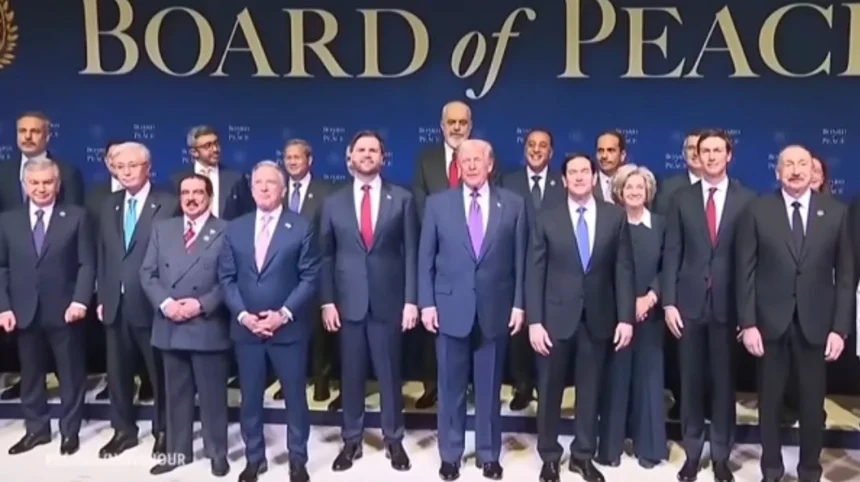
According to a detailed account in Time, the first meeting at the United States Institute of Peace in Washington brought together Trump, Vice President J.D. Vance, Secretary of State Marco Rubio, senior adviser Jared Kushner, special envoy Steve Witkoff and political and diplomatic representatives from participating states. FIFA president Gianni Infantino was the only participant not holding a political office, underscoring the high-level character of the gathering.
Trump has announced major financial commitments under the board’s umbrella. Time reported that he pledged a 10‑billion‑dollar U.S. contribution to the Board of Peace, framed as a down payment on Gaza’s reconstruction and related peace efforts. In a separate statement highlighted by Global News, Trump said the board would unveil around 5 billion dollars in reconstruction pledges, describing the entity as “the most consequential International Body in History,” although he did not specify which countries were responsible for which commitments.
Some participating governments have begun to outline their contributions in public. Indonesia’s military, for example, has stated that up to 8,000 of its troops could be ready by the end of June for possible deployment to Gaza as part of a humanitarian and peace mission under the board’s auspices. This would represent the first firm public commitment of personnel to a potential stabilisation force.
Mandate Beyond Gaza and Questions Over the UN
While the Board of Peace was initially described as a mechanism to oversee the Gaza ceasefire arrangements, its charter assigns it a wider remit that extends into other areas of conflict resolution and international coordination. The New York Times reported that the text of the founding document outlines “extensive global authority”, leading some analysts to suggest that Trump is attempting to fashion an alternative forum to the United Nations with himself at its helm.
This broader scope has raised questions about how the new body will sit alongside existing international law and multilateral institutions. The Express Tribune, in an opinion piece examining the Gaza peace plan, noted that Trump’s transitional arrangements for Gaza appeared to bypass the UN system and treat the enclave more as a development project than a political entity, a characterisation that speaks to wider concerns over institutional sidelining.
At the same time, Trump and his allies have presented the board as complementary to the UN rather than a replacement. Official communications have stressed that the 20‑point plan was U.N.-endorsed and that the board’s activities are directed at implementing an agreed ceasefire and reconstruction framework rather than rewriting international norms. This information could not be independently verified in respect of the full, final text of the board’s charter.
China’s Calculated Response
China has emerged as a significant, if cautious, interlocutor in relation to the Gaza peace process and the Board of Peace’s work. Beijing has consistently reiterated support for a two‑state solution and endorsed the ceasefire agreement in principle, while using diplomatic channels to signal scepticism about both the sustainability of the deal and the broader direction of Trump’s strategy.
According to the ChinaMed Observer, Chinese officials and experts have acknowledged that U.S. pressure under Trump played a notable role in pushing Israel towards accepting the ceasefire. Li Shaoxian, president of the China‑Arab Research Institute at Ningxia University, was cited as saying that the ceasefire was largely attributable to Trump’s pressure, even as Israel maintained its core positions. By contrast, Sun Degang of Fudan University characterised Trump’s efforts as heavily driven by a desire for international recognition, including a Nobel Peace Prize, highlighting divergent assessments within China’s policy community.
Chinese analysts have also focused on the structural features and perceived limitations of the peace plan linked to the Board of Peace. Commentators quoted by the ChinaMed Observer criticised what they saw as the transactional nature of Trump’s deal, the absence of a detailed timeline for implementation and the lack of attention to the root causes of the Gaza war and the wider Israeli‑Palestinian conflict. They expressed concern that the plan seeks to marginalise or exclude Hamas and, more broadly, Palestinian political agency in shaping Gaza’s future, raising doubts about the long‑term durability of any settlement overseen by the board.
Regional and International Reactions
Reactions across the Middle East and beyond have reflected a mixture of cautious engagement, pragmatic support and open criticism. Several governments, including traditional U.S. partners, have welcomed the injection of large-scale reconstruction funds and the prospect of a coordinated stabilisation mission while seeking clarity on their roles and responsibilities.
Media analyses have been divided on the likely impact. An opinion piece in Pakistan’s Express Tribune argued that Trump’s 20‑point Gaza peace plan—and by extension the Board of Peace—may be difficult to take seriously as a durable framework, suggesting it risked prioritising optics over structural change. In a later commentary, the same outlet described Trump’s new transitional board as one that “sidesteps the UN, treating the enclave more like a development project,” underscoring fears that political questions, including sovereignty and self-determination, could be overshadowed by a technocratic focus on rebuilding.
Al Jazeera’s coverage of the board’s first major meeting framed the event as a “proof of concept” moment, asking what Trump could realistically achieve through the new body. Analysts cited in that reporting noted Trump’s prediction that the board would become the “most consequential International Body in History” and his expectation of 5 billion dollars in humanitarian and reconstruction funding pledges, but they also pointed to unresolved questions over demilitarisation, security arrangements and the representation of Palestinian voices.
Governance, Veto Power and Accountability
The governance structure of the Board of Peace has attracted particular scrutiny, given Trump’s position as chair with veto powers. The New York Times reported that under the charter, Trump can exercise veto authority over certain decisions, a feature that, according to experts quoted in that report, reinforces perceptions that the new institution is built around presidential authority to an unusual degree for a multilateral body.
Critics argue that such concentration of authority may complicate efforts to ensure transparency and shared ownership among member states. Questions have also been raised about the criteria for membership, the process for appointing senior officials and the mechanisms for resolving disputes within the board. As of early 2026, there is limited publicly available detail on internal voting procedures and oversight frameworks, and it remains unclear how, if at all, the board will integrate with existing international accountability mechanisms.
Supporters contend that a streamlined leadership model could allow the board to act more quickly than traditional multilateral bodies in responding to humanitarian and security developments in Gaza. They argue that the combination of significant financial resources and centralised decision-making could enable faster delivery of reconstruction projects and more coherent management of a multinational stabilisation presence. These claims cannot yet be assessed against long-term outcomes, as implementation is at an early stage.
Implications for Global Order and Great-Power Competition
The Board of Peace has been interpreted by some analysts as a test case for how the United States under Trump seeks to shape global governance and manage competition with China in conflict-affected regions. By placing a U.S.-led structure at the centre of Gaza’s post-war reconstruction and security architecture, the administration has asserted a prominent role in a conflict that has drawn intense international attention and diplomatic involvement.
Chinese experts quoted in the ChinaMed Observer view the Gaza arrangement as part of a broader pattern in which Washington aims to retain leverage over key regional security issues, even as Beijing promotes its own diplomatic initiatives and positions itself as an advocate of multilateralism. They highlighted the risk that Gaza could become another arena in which great‑power competition complicates local dynamics and long-term peacemaking, particularly if Palestinian actors perceive the Board of Peace as externally imposed.
At the same time, some Western commentators argue that the board may offer a practical framework for coordinating donors and security partners in a highly complex environment, provided its activities remain anchored in international law and involve regional stakeholders. They note that the United States remains Israel’s most significant political backer and that any arrangement for Gaza’s future is likely to depend heavily on U.S. influence, whether channelled through existing organisations or new bodies such as the Board of Peace.
Palestinian Agency and Local Concerns
A recurring theme in expert commentary is the question of how far Palestinians, including but not limited to Hamas and other factions, will be able to shape the outcomes of processes led by the Board of Peace. Chinese analysts cited by the ChinaMed Observer argued that the peace plan underpinning the board does not sufficiently address the root causes of the conflict or reflect Palestinian perspectives on governance and security.
The Express Tribune similarly suggested that treating Gaza primarily as a site for a transitional development project risks sidelining political debates over representation, rights and sovereignty. Al Jazeera’s reporting noted concerns among regional watchers that the board’s focus on demilitarisation and reconstruction might overshadow broader political negotiations needed for a lasting settlement.
As of early 2026, there is limited publicly available evidence on the extent of direct Palestinian participation in the board’s decision-making processes. Statements from Trump and U.S. officials have emphasised security and humanitarian priorities, but have given fewer details on the mechanisms through which Palestinian civil and political actors will be consulted on key decisions affecting Gaza’s long‑term governance. This information could not be independently verified beyond the accounts contained in the cited reports.
What Happens Next
The coming months are expected to be critical in determining how the Board of Peace operates in practice and how it is perceived by regional and international stakeholders. According to Global News and Time, the board is preparing to move from initial pledges and high‑level meetings towards concrete steps on reconstruction funding, deployment planning for any stabilisation forces and the development of governance support programmes in Gaza.
The Council on Foreign Relations notes that key questions remain over the modalities of Hamas’s demilitarisation, the composition and mandate of any multinational presence and the relationship between the board and established international organisations. Analysts quoted by Al Jazeera suggest that the first phase of implementation will serve as a test of whether the board can deliver tangible improvements in security and living conditions in Gaza while maintaining broad international support.
China and other major powers will also be watching developments closely, weighing how the board’s performance affects their own approaches to conflict mediation and multilateral engagement. For Palestinians, regional actors and donors alike, the balance between reconstruction, security and political inclusion is likely to shape assessments of the board’s legitimacy and effectiveness over the months and years ahead.