


Key Points
- Israel has ordered 37 international non-governmental organisations working in the Gaza Strip to cease operations over registration-related disputes, affecting major aid providers including Doctors Without Borders, ActionAid and CARE.
- The move coincides with the closure of key border crossings, including the Rafah crossing with Egypt, amid wider Israeli and United States military action against Iran.
- The measures took effect around the expiry of a grace period in late February 2026, with an Israeli Supreme Court ruling temporarily allowing the organisations to stay while their appeal is heard.
- The policies are being implemented through administrative restrictions on NGO registration, limits on the entry of supplies and staff, and the shutdown of vital crossings used for humanitarian aid and medical evacuations.
- Aid groups and commentators say the combined effect could sharply reduce food distributions, field hospital services and livelihoods for hundreds of thousands of Palestinians in Gaza.
- Israeli authorities argue that sufficient food has entered Gaza since the ceasefire, claiming stocks meet several times the population’s nutritional needs, but have not publicly provided evidence for this.
- Humanitarian agencies and analysts warn that the restrictions risk worsening hunger, disrupting medical treatment and undermining already fragile living conditions in Gaza.
Israel’s restrictions on NGOs and crossings heighten concern in Gaza
Israel’s decision to bar dozens of international aid organisations from operating in the Gaza Strip, alongside renewed closures of key border crossings, has raised fresh alarms about the territory’s already precarious humanitarian situation. The measures, introduced as Israeli and United States forces carry out strikes on Iran, have prompted warnings from aid workers and analysts that essential services and food supplies for Gazans could be sharply reduced.
- Key Points
- Israel’s restrictions on NGOs and crossings heighten concern in Gaza
- Court intervention but operations still curtailed
- Closure of Rafah crossing adds to pressure
- Humanitarian consequences and allegations of collective punishment
- Israeli government position on aid levels
- Broader regional context: Iran conflict and Gaza
- Legal and diplomatic debates
- Human impact and conditions on the ground
- What happens next
The restrictions centre on 37 non-governmental organisations which Israel says have failed to comply with new registration rules for work in Gaza. Among them are some of the best-known international humanitarian agencies, including Doctors Without Borders, also known by its French acronym Médecins Sans Frontières (MSF), Medical Aid for Palestinians, Handicap International, ActionAid and CARE. According to the opinion piece in Al Jazeera, these organisations were ordered to leave the Strip after a grace period expired, though the Israeli Supreme Court has since allowed them to remain temporarily while their appeal against the ban is heard.
Court intervention but operations still curtailed
The Supreme Court ruling has prevented the immediate expulsion of the NGOs, but their ability to function remains severely constrained, according to Al Jazeera’s account. While the court considers the legality of the ban, continuing obstacles to the entry of supplies, equipment and foreign staff have limited what agencies can deliver on the ground. This information could not be independently verified.
The organisations reportedly play a central role in Gaza’s aid architecture, providing around half of all food distributions in the territory and about 60 percent of services in field hospitals. Any sustained reduction in their activities is likely to have a significant effect on access to food, basic healthcare and income for many families. Humanitarian situation updates compiled by UN-coordinated mechanisms have previously flagged major shortfalls in medical supplies, fuel, water and shelter across Gaza.
Closure of Rafah crossing adds to pressure
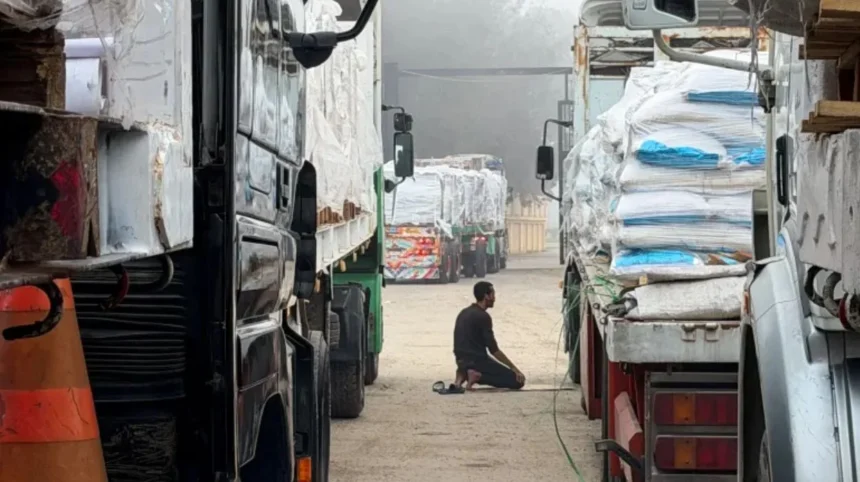
At the same time, Israel has closed the Rafah crossing on Gaza’s southern border with Egypt as part of operations carried out with the United States against Iran. In a statement, the Coordinator of Government Activities in the Territories (COGAT), the Israeli defence body responsible for policy in the occupied territories, said that “essential security modifications” included shutting Rafah and other crossings into Gaza “until further notice”.
Rafah is widely seen as a critical entry point for humanitarian aid and a key exit route for those requiring urgent medical treatment outside Gaza. It had reopened in February 2026 on a limited basis following earlier closures, allowing some patients and foreign nationals to leave and some relief supplies to enter. UN News reported that while the limited reopening sparked hope among residents and aid workers, there was also “massive trepidation” given the fragility of the arrangement and the scale of ongoing needs.
Israeli control and intermittent closures of Rafah since the escalation of violence in October 2023 have been closely linked to wider ceasefire negotiations and regional diplomacy. The latest shutdown coincides with the killing of Iran’s Supreme Leader in a joint US-Israeli operation and subsequent strikes, events that have prompted international calls for de-escalation.
Humanitarian consequences and allegations of collective punishment
Humanitarian officials and commentators have warned that linking Gaza’s crossings to wider regional military action risks turning the enclave’s population into what some describe as collateral victims of broader strategic confrontation. In the Al Jazeera opinion article, the author argues that the combination of the NGO ban and the closure of border crossings amounts to another form of collective punishment imposed on Palestinians in Gaza. This characterisation reflects the author’s assessment and has not been confirmed by an international court.
According to that account, the potential shutdown or downgrading of international organisations’ operations could jeopardise access to food parcels, medical care and employment for hundreds of thousands of people. The article contends that the measures are not solely about NGO registration compliance or narrow security concerns, but form part of a broader pattern of pressure on the population. These claims represent the writer’s analysis and could not be independently verified.
Existing humanitarian assessments indicate that Gaza’s basic infrastructure and living conditions have already been severely degraded by more than two years of conflict. UN-coordinated reports note widespread destruction of homes, schools, health facilities, water and sanitation systems and power infrastructure, with large numbers of people living in temporary shelters. International agencies say many residents face contaminated water, insufficient food and damaged agricultural land, with the risk of hunger remaining acute especially in northern areas.
Israeli government position on aid levels
While aid agencies emphasise the severity of needs inside Gaza, Israeli authorities have insisted that sufficient food has entered the territory during recent ceasefire periods. COGAT has stated that, since the start of the truce, quantities of food supplies entering Gaza have been enough to cover four times the nutritional requirements of the population. The defence body has also asserted that current stockpiles are expected to last for an extended period.
No detailed data was provided publicly in support of these claims, and international humanitarian bodies have continued to report obstacles in delivering aid to various parts of Gaza, including insecurity, logistical bottlenecks and access restrictions. The apparent discrepancy between official Israeli assessments and field reports from UN agencies and NGOs highlights the difficulty of independently verifying overall supply and distribution levels in a conflict zone. Aid workers say that even when adequate quantities cross into Gaza, restrictions on internal movement, fuel shortages and damage to roads and warehouses can prevent assistance reaching those most in need.
Broader regional context: Iran conflict and Gaza
The latest restrictions in Gaza are unfolding against the backdrop of an escalating confrontation between Israel, the United States and Iran. According to Al Jazeera’s reporting, joint strikes on Iranian targets and the killing of Iran’s Supreme Leader have raised fears of a wider regional war, with implications for Lebanon, Syria, Iraq and the Red Sea as well as the occupied Palestinian territories. Diplomatic efforts by the United Nations, European governments and regional powers have focused on preventing further escalation while addressing immediate humanitarian needs.
Within Gaza, the prospect of renewed border closures has revived memories of previous periods when the Strip was almost entirely sealed off, leading to severe shortages and, in some areas, famine-like conditions. Residents reportedly rushed to markets to stock up on basic goods following news of the latest measures, driving prices higher in a context of already limited incomes and employment. This information comes from Al Jazeera’s opinion account and could not be independently verified.
Legal and diplomatic debates
The NGO restrictions and border closures are likely to feed into ongoing legal and diplomatic debates about Israel’s obligations under international humanitarian law. Human rights organisations have previously argued that measures which block or severely limit the flow of essential supplies to civilians may contravene prohibitions on collective punishment in the Fourth Geneva Convention. Israeli officials have typically defended such policies as security-driven and consistent with their interpretation of international law; detailed official legal justifications for the latest moves had not been widely published at the time of writing.
At the diplomatic level, governments and multilateral bodies have repeatedly called for sustained, unimpeded humanitarian access to Gaza. UN agencies have urged all parties to ensure rapid, large-scale delivery of food, water, medical supplies, fuel and shelter materials, as well as the repair of critical infrastructure such as water pipelines and electricity networks. The International Rescue Committee and other large NGOs have warned that, despite some recent improvements in access, continuing restrictions and insecurity make it difficult to reach those facing the most severe deprivation.
Human impact and conditions on the ground
Reports from humanitarian organisations describe a population living largely in makeshift shelters, tents or overcrowded temporary accommodation, often with limited protection from extreme weather. Many households are said to be relying on intermittent aid distributions for food while coping with contaminated water sources and limited sanitation, factors that increase the risk of disease. Agricultural land and livelihoods have been heavily affected by conflict damage, further undermining local food production.
The Al Jazeera opinion article paints a picture of everyday life shaped by uncertainty about border openings and closures, fluctuating prices and anxiety about the future. According to the author, the prospect of losing what remains of international support threatens to deepen a sense of isolation among residents who have already endured repeated rounds of violence and displacement. These descriptions reflect the writer’s perspective and could not be independently verified.
Meanwhile, UN-coordinated casualty and impact figures indicate that hundreds of aid workers have been killed in Gaza since October 2023, underscoring the risks faced by those attempting to deliver assistance. Humanitarian agencies say that without predictable, safe access and administrative clarity, planning and sustaining programmes at scale becomes increasingly difficult.
What happens next
The immediate focus for aid organisations and diplomats is likely to be on clarifying the legal status of the 37 NGOs and whether the Israeli Supreme Court will ultimately uphold or overturn the government’s attempt to bar them from Gaza. Any ruling will have implications for the continuity of food distributions, health services and other programmes that depend on international funding and technical support.
Attention will also centre on whether and when the Rafah crossing and other entry points into Gaza are reopened for the movement of goods and people. Negotiations involving Israel, Egypt, the United States and other intermediaries are expected to address not only security concerns linked to the Iran conflict but also commitments made in previous ceasefire agreements regarding humanitarian access. For Gaza’s residents, the outcome of these legal and diplomatic processes will help determine whether the coming weeks bring some easing of restrictions or a further tightening of the constraints under which they live.