


Key Points
- Indian Prime Minister Narendra Modi is undertaking a two-day standalone visit to Israel from 25 to 26 February 2026, his second trip to the country as premier.
- The visit comes amid heightened tensions in West Asia, including open discussion by US President Donald Trump of possible military strikes on Iran and ongoing conflict in Gaza.
- Modi is scheduled to hold talks with Israeli Prime Minister Benjamin Netanyahu, address the Knesset, meet President Isaac Herzog, and sign a series of bilateral agreements.
- Opposition figures in India and some international commentators have questioned the political and diplomatic timing of the visit, given the volatile regional context and India’s traditional support for a two-state solution.
- Supporters of the trip argue that the timing reflects New Delhi’s confidence and a deliberate strategic signal of deepening partnership with Israel while maintaining its stated positions on Palestine and regional stability.
- The visit is expected to focus on defence and security cooperation, technology, trade, labour mobility, and connectivity initiatives such as the proposed India–Middle East–Europe Economic Corridor (IMEC).
- Analysts say the outcome could further anchor India–Israel ties, with implications for India’s relations with Iran, Arab states, and its broader diplomatic posture in a combustible region.
Core developments and itinerary
Indian Prime Minister Narendra Modi is paying a two-day official visit to Israel at a moment when West Asia is again on edge, with tensions involving Iran, conflict in Gaza, and a visible build‑up of United States military assets in the region. It is Modi’s second trip to Israel as prime minister, coming nine years after his landmark 2017 visit and following several postponed plans for Israeli Prime Minister Benjamin Netanyahu to travel to India in 2025.
- Key Points
- Core developments and itinerary
- Diplomatic context and regional backdrop
- India–Israel relations and the evolution of policy
- Controversy and questions over timing
- Balancing regional priorities and partnerships
- Security, defence and technology on the agenda
- Economic ties, labour and connectivity
- Domestic political considerations in India and Israel
- Humanitarian and legal sensitivities
- Reactions from Arab states and Iran
- Symbolism and strategic signalling
- What happens next
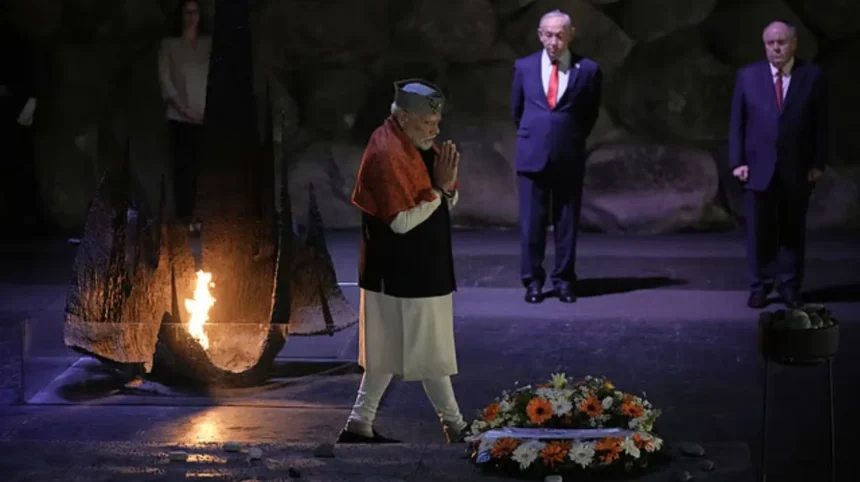
Modi is due to arrive at Ben Gurion International Airport near Tel Aviv on 25 February, where Netanyahu is expected to receive him before talks on bilateral and regional issues. The programme includes an address to the Knesset in Jerusalem, a visit to the Yad Vashem Holocaust memorial, meetings with President Isaac Herzog, and the signing of agreements before Modi’s departure on 26 February.
Diplomatic context and regional backdrop
The trip takes place against an unsettled backdrop in West Asia, with the Gaza conflict continuing to draw international scrutiny and concern over humanitarian conditions and regional spillover. Reports have also highlighted that US President Donald Trump has openly acknowledged he is considering military strikes on Iran, raising fears of a wider confrontation that could draw in Israel and affect regional shipping lanes and energy security.
Commentators note that maritime security in the Red Sea and surrounding waters has already been fragile, directly impacting Indian commercial interests that rely on these routes. Any escalation involving Iran, Israel and US forces could further disrupt trade, increase insurance and shipping costs, and test India’s efforts to maintain balanced ties with competing regional actors.
India–Israel relations and the evolution of policy
India only established full diplomatic relations with Israel in 1992, after decades of vocal support for Palestinian rights and opposition to the creation of the Israeli state in 1948. Since Modi took office in 2014, ties with Israel have deepened markedly, with cooperation expanding in defence procurement, intelligence sharing, agriculture, water management, cyber security and innovation.
Modi’s first visit to Israel in July 2017 was the first by an Indian prime minister and was widely viewed as a turning point, placing the relationship on an explicit strategic footing. At the same time, Indian officials have maintained that New Delhi continues to back a two‑state solution, support Palestinian statehood, and oppose unilateral changes on the ground, including settlement expansion in the occupied territories.timesofindia.
Controversy and questions over timing
The timing of the latest visit has drawn comment from political opponents in India and external analysts who see risks in Modi travelling to Israel during such a volatile period. The opposition Congress party has criticised what it portrays as a lack of transparency around key diplomatic decisions, including the scheduling of the trip and the way information about it has circulated internationally.timesofindia.
Separately, geostrategist Brahma Chellaney argued that the timing “is not a coincidence, but a deliberate signal”, noting that Netanyahu’s planned visit to India in 2025 had been postponed three times. According to Business Today, Chellaney said that Modi’s decision to travel to Israel while Trump is openly weighing military action against Iran amounts to a calculated strategic gesture rather than an accidental overlap with regional tensions.
Balancing regional priorities and partnerships
Supporters of the visit say it reflects India’s confidence that it can deepen its partnership with Israel without abandoning its long‑standing positions on Palestine or its widening engagement with Arab states and Iran. Analysts cited by Al Jazeera describe Modi’s broader approach as one of balancing relations with multiple regional powers, seeking to expand cooperation with Israel while continuing to engage Palestinian leaders and key Arab capitals.
India has in recent years intensified ties with the United Arab Emirates and other Gulf states on energy, investment and migrant labour, even as it strengthened defence and technology collaboration with Israel. This multi‑vector diplomacy is seen as central to New Delhi’s aim of securing sea lanes, ensuring energy supplies and expanding trade in a region that remains critical to India’s economic and security interests.
Security, defence and technology on the agenda
Defence and security cooperation is expected to be a major focus of Modi’s talks in Israel, including discussions on joint production, technology transfer and co‑development of systems such as air defence, drones and surveillance platforms. Israel has for years been among India’s top arms suppliers, with systems acquired for use by the Indian armed forces along the country’s land borders and coastlines.
Beyond defence, New Delhi and Tel Aviv are projected to highlight collaboration in emerging technologies including artificial intelligence, cyber security, agritech, water conservation and digital health. Israeli innovation ecosystems have already partnered with Indian states and private firms on irrigation, dairy, horticulture and desert agriculture projects, areas that Indian officials say will feature in the new agreements.
Economic ties, labour and connectivity
Trade and investment will form another pillar of the discussions, with both sides looking to build on a relationship that has grown to cover not only defence but also pharmaceuticals, information technology, agriculture and start‑ups. According to coverage of the visit, labour mobility and opportunities for Indian workers in Israel’s construction and care sectors are also expected to be part of the agenda.
The proposed India–Middle East–Europe Economic Corridor (IMEC) is likely to be discussed as part of broader connectivity plans linking India to Europe through the Gulf and the Mediterranean. While the initiative faces uncertainties amid regional instability and changing political priorities, Indian and Israeli officials have presented such corridors as potential drivers of trade diversification and logistical resilience.
Domestic political considerations in India and Israel
For Netanyahu, who has faced domestic challenges and had to postpone multiple trips abroad, hosting Modi offers an opportunity to underscore Israel’s partnerships beyond its traditional Western allies. The visit allows the Israeli leadership to showcase ties with a large democracy and fast‑growing economy at a time when Israel’s conduct in Gaza and the occupied territories remains under scrutiny in many international forums.
In India, the trip comes as Modi continues to project an image of a globally engaged leader, emphasising strategic partnerships and high‑profile diplomacy. Commentators quoted by NDTV say the visit is widely viewed as a milestone that signals deepening strategic trust between the two countries, though critics contend that such engagement must be weighed against India’s historical positions and regional sensitivities.
Humanitarian and legal sensitivities
India has joined more than 100 states in condemning Israel’s de facto expansion into the West Bank, reaffirming support for a negotiated two‑state solution and cautioning against unilateral changes that undermine prospects for peace. New Delhi has also backed calls for protecting civilians and upholding international humanitarian law in conflict zones, even as it maintains security and defence cooperation with Israel.timesofindia.
Human rights organisations and some international legal experts have raised concerns about the humanitarian impact of military operations in Gaza and the legal responsibilities of states supplying arms or providing political support. There is no indication from official Indian statements that New Delhi intends to alter its arms cooperation with Israel during this visit; this information could not be independently verified.
Reactions from Arab states and Iran
At the time of writing, there have been no major public diplomatic protests from key Arab partners over Modi’s decision to travel to Israel now, although regional media outlets have closely followed the visit and its messaging. Gulf governments have in recent years pursued their own pragmatic engagement with Israel, including normalisation agreements, while continuing to express support for Palestinian rights.
Iran, which has tense relations with both Israel and the United States, remains a central factor in the regional calculus, given the reported US consideration of potential strikes and Tehran’s influence over armed groups across the region. Analysts say any significant escalation involving Iran could complicate India’s attempt to sustain energy ties and connectivity projects linking it to Europe through Iranian or rival corridors.
Symbolism and strategic signalling
Chellaney and other commentators argue that Modi’s presence in Israel at a time of heightened tension sends a message of solidarity with Netanyahu’s government and of India’s willingness to be seen publicly alongside Israel in difficult moments. According to News18, opinion pieces have described the trip as an unusually assertive display of support that could temporarily deter Iran from actions that might risk an unmanageable diplomatic fallout.
Other analysts, quoted in outlets including Al Jazeera and The Indian Express, frame the visit as evidence of India’s belief that it can navigate a combustible region without being drawn into regional rivalries, by pairing closer ties with Israel with continued engagement with Arab states and support for Palestinian statehood. They caution, however, that the optics of timing may still carry costs in parts of the Arab world and among domestic audiences sensitive to the Palestinian cause.
What happens next
Attention will turn to the contents of the joint statement issued at the end of the visit, which is expected to outline new agreements in defence, technology, agriculture, labour and connectivity. Observers will scrutinise how the document addresses regional security, references to the Gaza conflict, and language on the two‑state solution and international law.
Subsequent diplomatic activity, including any follow‑up visits by Israeli or Arab leaders to New Delhi and India’s positions in multilateral forums, is likely to provide further clues about how New Delhi seeks to balance its relationships. Developments involving Iran, US regional posture, and the trajectory of the Gaza conflict will also heavily influence how Modi’s visit is judged in retrospect, both within India and across West Asia.