

A United Nations expert on the human rights to safe drinking water and sanitation has warned that Israel is using water as a weapon in Gaza, describing the deprivation of safe water and the destruction of critical infrastructure as a “silent but lethal bomb” contributing to a deepening humanitarian catastrophe in the enclave. The remarks, made as UN agencies and humanitarian organisations report the near-collapse of Gaza’s water and sanitation systems, have renewed focus on the conduct of Israeli operations and their compliance with international law.
- Scale of damage to water infrastructure
- Humanitarian impact on Gaza’s population
- UN legal concerns and calls for compliance
- Israeli position and security context
- Humanitarian access and international response
- Environmental and public health risks
- Legal debates and accountability efforts
- Regional and political implications
- What Happens Next
Pedro Arrojo-Agudo, the UN special rapporteur on the human rights to safe drinking water and sanitation, said that cutting off drinking water to Gaza’s population was comparable to “dropping a terrible silent bomb” on civilians, warning that the consequences for public health and survival could be more deadly than direct bombardment. He argued that water was being used “as a weapon, but not against another army or militia, but against the population,” and said the situation in Gaza risked becoming “a disaster without any precedent” in modern history.
Scale of damage to water infrastructure
International monitoring bodies and humanitarian organisations have reported extensive damage to Gaza’s water and sanitation network since the escalation of hostilities in late 2023. A World Bank–supported assessment cited by Human Rights Watch (HRW) estimated that by August 2024, around 84–89 per cent of water and sanitation infrastructure in Gaza had been damaged or destroyed during the fighting.
HRW said that Israeli forces had repeatedly struck wells, pipelines, desalination units, wastewater plants and water-utility warehouses, while restrictions on fuel and electricity had rendered many remaining facilities inoperable. In a detailed account, the organisation reported that four of Gaza’s six wastewater facilities were destroyed or badly damaged, and that strikes had killed water-sector workers attempting to carry out repairs.
Oxfam, in a separate report, stated that Israel had damaged or destroyed an average of five water and sanitation sites every three days since the start of the current war. According to the organisation, the combined effect of physical destruction, cuts to external supply and impediments to repair work had reduced available water in Gaza by 94 per cent, leaving residents with just 4.74 litres per person per day on average.
Humanitarian impact on Gaza’s population
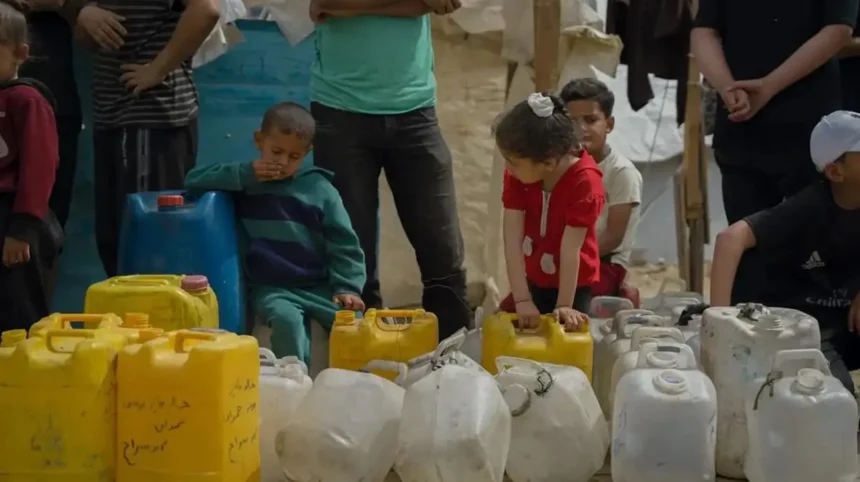
UN experts and humanitarian agencies say the collapse of water and sanitation services has had severe consequences for Gaza’s 2.1–2.2 million residents, most of whom are displaced and living in overcrowded shelters or informal camps. Arrojo-Agudo said that per capita access to water had fallen to around 5 litres a day, far below the 50–100 litres per person per day commonly regarded as necessary for a dignified life and basic hygiene.
Aid agencies have warned of growing risks of waterborne diseases, including diarrhoeal illnesses and skin infections, as families resort to unsafe sources such as contaminated wells or surface water. Human Rights Watch said it believed Israeli authorities’ deprivation of water and related services had “most likely contributed to thousands of deaths”, pointing to the combined effect of dehydration, illness, malnutrition and the disruption of health care.
Sanitation conditions have deteriorated sharply, with reports of widespread open defecation and limited access to basic hygiene items. Women and girls are reported to face acute challenges managing menstruation and maintaining privacy, while children and older people are identified as particularly vulnerable to disease and dehydration. UN agencies have repeatedly stressed that the situation undermines human dignity and creates what they describe as “unliveable” conditions.
UN legal concerns and calls for compliance
UN human rights mechanisms have framed the situation in Gaza’s water sector as a matter of international humanitarian law and international human rights law. Arrojo-Agudo reminded Israel that “consciously preventing supplies needed for safe water from entering the Gaza Strip violates both international humanitarian and human rights law,” citing obligations to protect civilians and ensure access to essential services.
In a joint statement titled “Thirst as a weapon”, a group of UN experts said they were alarmed by what they described as Israel’s deliberate withholding of access to safe drinking water from Palestinians in Gaza, warning that such acts could constitute crimes under the Rome Statute, including extermination, if carried out with intent and on a large scale. The experts said that 89 per cent of water and sanitation infrastructure had been damaged or destroyed and that over 90 per cent of households were now water insecure.
The UN Human Rights Office has also raised broader concerns about possible “ethnic cleansing” in both Gaza and the West Bank amid intensified violence and forced displacement, though it has not yet attached a formal legal determination to those concerns. UN bodies have urged all parties, including Palestinian armed groups, to accept ceasefire proposals, facilitate humanitarian access and comply with international legal obligations.
Israeli position and security context
Israeli officials have consistently stated that their military operations in Gaza are aimed at dismantling Palestinian armed groups, securing the release of hostages and preventing future attacks, and have rejected accusations that they are deliberately targeting civilians or conducting genocide. Soon after the outbreak of the conflict, senior Israeli leaders publicly declared that they would cut off electricity, fuel, food and water to Gaza as part of efforts to exert pressure on Hamas, drawing widespread criticism from UN officials and humanitarian organisations.
Israel has argued that restrictions on fuel, water-related materials and certain categories of aid are necessary to prevent diversion by armed groups and to limit the risk to its forces. Authorities say they have allowed some water and limited fuel supplies to enter Gaza through designated crossings and have worked with international partners to facilitate humanitarian deliveries, while emphasising that operations are conducted in line with international law. This information could not be independently verified.
Israeli officials also point to rocket fire from Gaza and tunnel networks as evidence of ongoing security threats, and accuse Hamas and other armed factions of embedding military infrastructure in civilian areas, which they say complicates efforts to avoid damage to civilian facilities. Human rights groups, however, argue that even in the presence of such challenges, parties to the conflict remain bound by the principles of distinction, proportionality and precaution in attack.
Humanitarian access and international response
The International Court of Justice (ICJ) and other international bodies have issued provisional measures and decisions requiring Israel to enable the provision of humanitarian aid, including water, food, fuel and medical supplies, to the civilian population in Gaza. Human Rights Watch reported that the World Court had called on Israel to ensure “unhindered provision” of essential assistance and to co-operate with the United Nations in delivering aid.
UN agencies and non-governmental organisations have warned that sporadic aid convoys and limited water deliveries are insufficient to meet basic needs given the scale of destruction and displacement. They have urged the opening of additional crossing points, the restoration of electricity and fuel supplies, and the removal of obstacles to bringing in spare parts, pipes, chemicals and other materials needed to restore water and sanitation services.
Donor governments and international financial institutions have begun planning for longer-term reconstruction, including large-scale rehabilitation of water networks, desalination plants and wastewater facilities. A United Nations Environment Programme (UNEP) assessment described the environmental impact of the conflict as severe, highlighting contamination of groundwater, coastal pollution and risks to the coastal aquifer, which is Gaza’s only natural freshwater source.
Environmental and public health risks
Environmental experts warn that the damage to Gaza’s water and sanitation infrastructure will have long-term consequences for both public health and the environment. Over-extraction from the coastal aquifer, combined with seawater intrusion and sewage contamination, has exacerbated salinisation and pollution, threatening the viability of the enclave’s main freshwater source.
The discharge of untreated or partially treated sewage into the Mediterranean Sea poses risks not only to Gaza’s shoreline but also to regional coastal ecosystems and neighbouring communities. UNEP has cautioned that rebuilding safe systems will require extensive decontamination, infrastructure investment and sustained access for technical personnel, in addition to a secure environment in which repair and maintenance can be carried out.
Public health specialists say that without a significant improvement in water quality and quantity, as well as sanitation and hygiene, attempts to restore health services and reduce disease in Gaza will continue to be undermined. They note that children, pregnant women, older people and those with chronic illnesses are particularly at risk of complications from unsafe water and poor sanitation.
Legal debates and accountability efforts
The use of water and other essential services in armed conflict has become a focal point in wider legal debates over the conduct of hostilities in Gaza. UN experts have linked the deprivation of water, food and medicine to possible violations of the Rome Statute, including extermination and other crimes against humanity, if such acts are found to be intentional and part of a broader policy.
Several states and civil society organisations have called for independent investigations into alleged attacks on civilian infrastructure, including water and sanitation facilities, and into decisions to restrict or block supplies needed to maintain these systems. Proceedings at the ICJ and the International Criminal Court (ICC), as well as domestic legal actions in various jurisdictions, are expected to examine whether parties to the conflict have complied with their obligations under international humanitarian and human rights law.
Human rights groups argue that the pattern of destruction and deprivation suggests systematic targeting or at least reckless disregard for the civilian population, while Israeli authorities maintain that they act within legal constraints and that any violations are investigated through internal mechanisms. Outcomes of these legal processes are likely to influence future policy on the protection of critical infrastructure in conflict zones and the interpretation of legal norms relating to “weaponisation” of water and other essential services.
Regional and political implications
The crisis in Gaza’s water sector has broader regional and political implications, particularly regarding relations between Israel, neighbouring states and international partners. Concerns about cross-border environmental impacts, refugee movements and security spillover have prompted calls for coordinated regional engagement in any future reconstruction or political settlement.
Diplomatic efforts led by the United Nations and key states have linked the restoration of basic services, including water and sanitation, to ceasefire negotiations and longer-term political arrangements. UN experts have stressed that sustainable peace will require not only an end to hostilities but also guarantees of access to essential resources and respect for the rights of Palestinians under international law.
Analysts say that how the international community responds to allegations of using water as a weapon in Gaza may set precedents for future conflicts, at a time when climate change and resource scarcity are increasing the risk of water-related tensions globally. The UN rapporteur’s warning is therefore seen as part of a wider push to reinforce norms around the protection of water infrastructure and prevent the instrumentalisation of basic services in warfare.
What Happens Next
In the immediate term, UN agencies and humanitarian organisations are expected to intensify appeals for unrestricted access to Gaza, including the delivery of fuel, repair materials and technical support to restore water and sanitation systems. The World Court’s calls for unhindered humanitarian aid are likely to remain a central focus of diplomatic engagement with Israel and other parties to the conflict.
Over the coming months, international legal bodies, including the ICJ and ICC, are set to continue examining allegations related to the conduct of hostilities, including the alleged use of water as a weapon and the broader impact on civilians. Reconstruction planning by UN agencies, donors and regional actors will hinge on the establishment of a durable ceasefire and assurances that essential infrastructure and personnel can operate safely.