


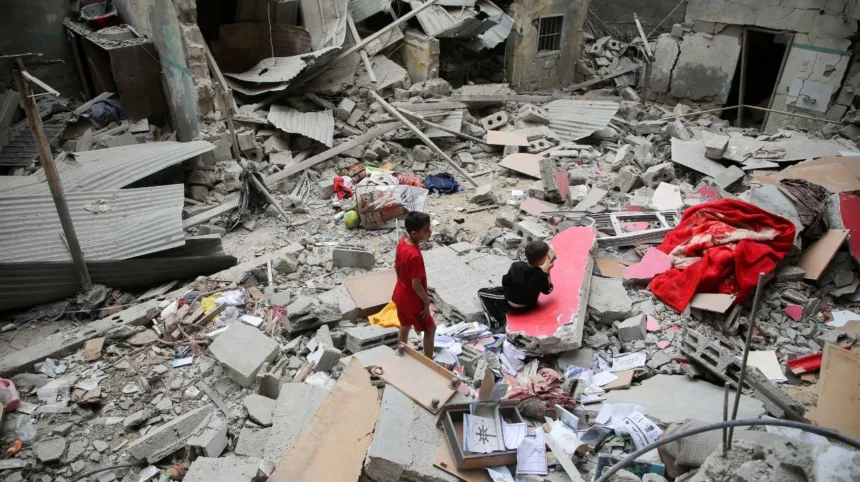
- Dozens of Palestinians have been reported killed in a series of Israeli air and artillery strikes on the southern Gaza city of Rafah, according to local health authorities and media.
- The attacks came despite a fragile ceasefire framework that has formally reduced large-scale ground operations but not halted all Israeli military activity in the enclave.
- The latest strikes were reported in late February 2026 in and around Rafah, near the border with Egypt, an area that has become a primary escape route and aid corridor for civilians.
- Gaza’s media office and Palestinian officials say the attacks hit residential areas and sites close to displaced people, though the Israeli military says it is targeting armed groups. This information could not be independently verified.
- Rafah remains the main civilian gateway in and out of Gaza, and its partial reopening earlier this month has seen just over 1,100 Palestinians cross in both directions, far below initial expectations.
- Hamas accuses Israel of violating agreed operating mechanisms at the Rafah crossing under a ceasefire arrangement, alleging mistreatment of travellers and delays for patients needing treatment abroad.
- Rights groups and humanitarian agencies warn that renewed strikes in Rafah, combined with limited movement through the crossing, risk worsening the humanitarian situation for hundreds of thousands of Palestinians sheltering in southern Gaza.
Israeli air and artillery strikes in and around the southern Gaza city of Rafah have left multiple Palestinians dead and injured, according to local health officials and Palestinian media, as the border crossing with Egypt struggles to handle limited two-way movement under a fragile ceasefire framework. The reported attacks, which occurred in late February 2026, targeted areas in one of the enclave’s most densely populated zones, where hundreds of thousands of displaced civilians have sought refuge.
Casualties and targets reported in Rafah
Gaza’s health authorities and local media outlets say the latest strikes in Rafah hit residential buildings and areas near where internally displaced people have been sheltering. Some of the reported casualties include families living in multi-storey homes and makeshift shelters erected after earlier evacuations from northern and central Gaza. This information could not be independently verified.
In separate incidents over recent months, Palestinian officials have reported deaths and injuries from Israeli strikes in both Rafah and nearby Khan Younis, including attacks on tents housing displaced people and gatherings close to aid distribution points. Medical staff at Nasser Medical Complex in Khan Younis have previously recorded fatalities from strikes on areas where civilians had assembled, underscoring longstanding concerns about the proximity of military activity to humanitarian sites.
The Israeli military has said its operations in and around Rafah are aimed at armed groups it accuses of violating ceasefire terms and planning or carrying out attacks on its forces. According to statements attributed to the Israel Defense Forces (IDF), troops and aircraft have targeted militants emerging from tunnel shafts in eastern Rafah and other locations, describing these as responses to what it calls “blatant violations” of the truce.
Ceasefire framework under strain
The latest reports from Rafah come against the backdrop of a ceasefire arrangement that has formally reduced the scale of Israeli ground operations in Gaza but has not halted all air and artillery strikes. In recent weeks, Palestinian officials and international media have documented continued Israeli fire in parts of northern and southern Gaza, including deadly incidents in which dozens of Palestinians were killed on a single day.
Al Jazeera correspondent Hani Mahmoud reported from Khan Younis in early February that Israeli forces struck a multi-storey residential building and other locations despite the ceasefire, noting that no casualties were recorded in that specific building hit but that attacks elsewhere had resulted in deaths and injuries. The Gaza Ministry of Health has said that hundreds of people have been killed and more than a thousand wounded in Israeli attacks since the US‑brokered ceasefire took effect in early October 2025.
Israeli officials maintain that the ceasefire has been repeatedly violated by Palestinian armed groups, citing incidents in which fighters allegedly emerged from underground tunnels to fire on Israeli troops near Rafah. The Times of Israel reported that the IDF said it struck Hamas operatives in Rafah in mid‑February after gunmen attacked troops in what the army described as a serious breach of the truce.
Rafah’s critical role as Gaza’s gateway
Rafah, situated on Gaza’s southern border with Egypt, has long been a strategic and symbolic crossing point for Palestinians seeking to leave or enter the blockaded enclave. The crossing’s status has shifted repeatedly over the past two years amid military operations and evolving ceasefire arrangements, with closures cutting off medical evacuations and the entry of humanitarian staff, and reopenings described as vital lifelines.
According to a statement from Gaza’s media office cited by Bernama, 1,148 Palestinians crossed the Rafah border crossing in both directions between its limited reopening on 2 February 2026 and Wednesday of the following week. Of these, 640 people were recorded as leaving Gaza, while 508 people returned during the same period. The authorities added that 26 Palestinians were turned back while attempting to depart, without any public explanation being provided.
Initial expectations had been that around 50 Palestinians, mainly patients and wounded individuals accompanied by relatives, would be allowed to leave Gaza each day, with a similar number permitted to return. The figures released by Gaza’s media office indicate that actual crossings have fallen significantly short of those projections, raising concerns among families waiting for medical evacuation and those seeking to reunite with relatives abroad.
Allegations over crossing procedures and treatment
Hamas has accused Israel of what it calls “blatant violations” of the operational mechanisms for Rafah set out in the ceasefire agreement. In a press statement reported by Bernama, the group said that, despite the crossing’s reopening, Israeli authorities were failing to comply with agreed daily quotas for departures and returns and were subjecting returning travellers to harsh interrogations and physical and psychological mistreatment.
Hamas claims that these practices are putting the lives of thousands of patients and wounded Palestinians at risk by delaying access to treatment abroad. The statement argues that the gaps between expected and actual numbers of crossings, combined with alleged intimidation at the border, have discouraged some would‑be travellers from attempting to leave. This information could not be independently verified.
Israel has not publicly detailed its handling procedures for individuals crossing through Rafah under the current arrangement but has insisted it retains security control over border points to prevent weapons transfers and the movement of individuals it considers security threats. International mediators have described the limited reopening as a trial phase, indicating that further adjustments may be made depending on security assessments and humanitarian needs.
Humanitarian concerns in southern Gaza
Humanitarian organisations say Rafah and its surrounding areas remain under severe strain, with large numbers of displaced Palestinians living in temporary shelters, tents and crowded accommodation. Repeated episodes of shelling and airstrikes, combined with constrained access through border crossings, have made the delivery of aid and medical services more complex and unpredictable.
Previous strikes on Rafah and nearby zones have hit homes, camps for displaced people, and sites close to aid distribution centres, according to Palestinian officials and medical staff. In one documented incident in 2025, at least seven Palestinians were reported killed when Israeli forces opened fire near humanitarian aid centres north of Rafah, while a separate strike on a tented area west of Khan Younis killed four people, including two children, according to medical sources at Nasser Medical Complex.
International agencies have warned that any escalation of military activity in Rafah could endanger civilians who moved south following earlier evacuation orders from northern Gaza. Aid groups have also raised concerns that continued insecurity near the crossing and its access roads could disrupt the movement of humanitarian convoys and further limit the flow of essential supplies, including food, fuel and medical equipment.
Regional and international context
The evolving situation in Rafah ties into broader diplomatic efforts to stabilise Gaza and maintain the ceasefire agreed under international mediation. The Rafah crossing has been explicitly defined in recent arrangements as a key route for civilian movement and aid, with its partial reopening seen as one step in implementing broader commitments.
According to background information on the Rafah Border Crossing, the crossing’s status has been shaped by a 2025 agreement and subsequent decisions by Israeli and Egyptian authorities regarding security control and inspection regimes. In October 2025, trucks were again allowed to enter Gaza through Rafah, but the crossing was later closed before reopening on 2 February 2026 under the current limited scheme.
Regional actors, including Egypt and Qatar, have continued to play roles in ceasefire maintenance and humanitarian coordination, although specific details of their engagements in the latest Rafah incidents have not been formally disclosed. International attention remains focused on whether the ceasefire can be sustained amid ongoing sporadic violence, including rocket fire, armed actions by Palestinian factions, and Israeli retaliatory strikes.
Legal and accountability discussions
Human rights organisations and legal experts have highlighted Rafah and southern Gaza in wider debates on international humanitarian law and the conduct of hostilities in densely populated areas. Reports of strikes near civilian structures and aid facilities have prompted calls for investigations into whether adequate precautions were taken to avoid or minimise civilian harm.
Palestinian officials and some international legal advocates argue that sustained operations in areas crowded with displaced civilians may breach protections afforded under the Geneva Conventions. Israeli officials, for their part, maintain that they act in accordance with international law, asserting that they target combatants and military infrastructure and that armed groups’ use of civilian areas complicates efforts to avoid collateral damage.
No international tribunal has yet issued a definitive legal judgment specifically on the latest strikes in Rafah, but ongoing inquiries into wider conduct in the Gaza conflict could eventually examine incidents in the city as part of broader case files. Legal observers note that reliable documentation, including independent verification of casualty figures and strike locations, will be critical to any future accountability processes.
What happens next
Further developments around Rafah are expected to hinge on whether the ceasefire framework can be reinforced and whether parties agree to adjust or expand the current crossing arrangements. Mediators are likely to push for more predictable departure and return quotas for patients and other civilians, as well as clearer procedures intended to address concerns about treatment at the crossing.
Humanitarian agencies are calling for increased access and additional guarantees for the safety of civilians and aid workers operating in southern Gaza, particularly if military activity continues in or near populated areas. Any new surge in violence in Rafah could prompt renewed international pressure for stricter adherence to ceasefire terms or for changes in the deployment of international observers at key crossings.
Regional actors and international organisations will also be watching whether the limited reopening of Rafah evolves into a more sustained and predictable system, which they say will be essential for longer‑term stabilisation, reconstruction planning and medical referrals. For residents of Gaza awaiting evacuation or return through Rafah, the immediate focus remains on whether the crossing will stay open and whether the security situation will allow safe passage in the days and weeks ahead.