


Key Points
- Officials linked to the US-led Board of Peace are exploring the creation of a US dollar‑pegged “stablecoin” for use in postwar Gaza, according to multiple reports.
- The initiative is reportedly being spearheaded by Israeli tech entrepreneur Liran Tancman, an unpaid adviser to the Board of Peace and veteran of Israel’s intelligence corps.
- Early-stage discussions envisage a digital token pegged to the US dollar as a means for Gazans to conduct digital transactions amid a severe shortage of physical cash and a devastated banking system.
- The proposed system would operate under the oversight of the Board of Peace and Gaza’s temporary technocratic administration, the National Committee for the Administration of Gaza (NCAG).
- Supporters say the move could help restore economic activity, reduce reliance on shekels and cash, and limit revenue streams for Hamas by “drying Gaza from cash.”
- Critics warn that a Gaza‑specific stablecoin could entrench US‑Israeli leverage over the enclave’s economy, deepen separation from the West Bank, and raise governance and infrastructure concerns.
- The project remains at a preliminary stage, with its design, regulatory status and rollout timeline still unclear; technical feasibility may depend on planned upgrades to Gaza’s mobile networks later in 2026.
Officials associated with the US‑backed Board of Peace, a body established to oversee Gaza’s reconstruction, are examining plans to introduce a US dollar‑pegged digital “stablecoin” in the territory, in a move proponents say could revive basic commerce but which has prompted questions over control, regulation and the future shape of the enclave’s economy.
Early-stage proposal for Gaza digital currency
According to reporting attributed to the Financial Times and summarised by several outlets, discussions about a Gaza‑focused stablecoin are at an early stage and may not yet have formal policy status. Officials have reportedly explored options for a cryptocurrency whose value would remain closely tied to the US dollar, positioning it as a digital payments tool rather than a new sovereign currency.
People described as familiar with the talks have been quoted as saying that the token would be intended “to allow Gazans to transact digitally,” rather than functioning as a “Gaza coin” or separate Palestinian currency. This information could not be independently verified.
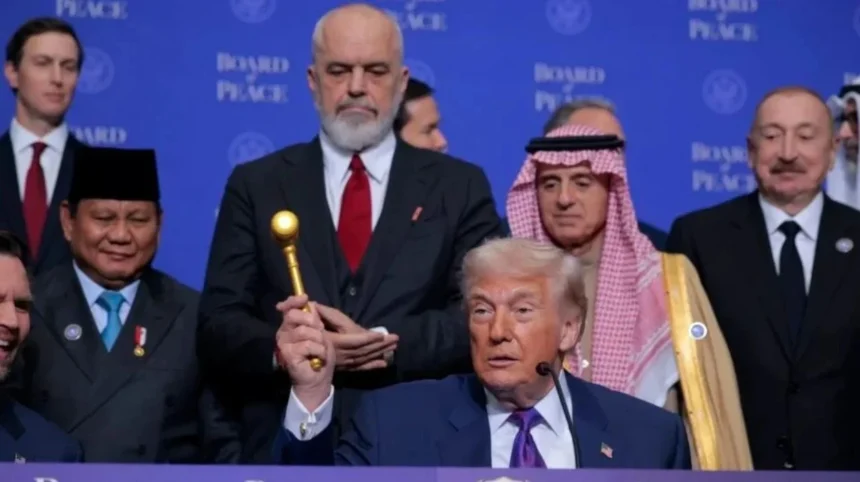
The Board of Peace, described in coverage as a US‑led initiative linked to President Donald Trump and focused on rebuilding parts of the Middle East, oversees the framework under which postwar Gaza is expected to be administered. Gaza’s technocratic body, the National Committee for the Administration of Gaza, is reported to be involved in the stablecoin discussions alongside the office of Nickolay Mladenov, a former UN official acting as the board’s representative for the territory.
Who is leading the project?
The proposed digital currency initiative is being led by Liran Tancman, an Israeli tech entrepreneur and co‑founder of Israel’s cyber command, who is serving as an unpaid adviser to the Board of Peace, according to media reports citing unnamed sources. Tancman has reportedly worked with senior US officials on Gaza‑related projects over the past year and presented the plans during an inaugural Board of Peace meeting in Washington DC on 19 February 2026.
Coverage also links Tancman to the Gaza Humanitarian Foundation, an aid organisation previously criticised by some observers for being dominated by US and Israeli interests and for security conditions at its distribution sites, where hundreds of Palestinians died while trying to access food before the group ceased operations. These accounts are based on media reporting and have not been independently corroborated.
Officials from Gaza’s temporary technocratic administration are said to be participating in the design phase, and sources have suggested that digital asset firms from Gulf Arab states and Palestinian entities may be invited to assist with implementation if the project proceeds. No detailed public governance framework has yet been published.
A response to cash shortages and banking collapse
Supporters of the plan argue that a dollar‑pegged stablecoin could help address acute liquidity and infrastructure problems in Gaza’s economy. Reports indicate that the enclave has faced severe shortages of Israeli shekels, with physical cash in short supply and much of the banking network destroyed or inoperable following the conflict.
One outlet, citing project documents, has stated that 98 per cent of Gaza’s banking infrastructure has collapsed, leaving only three of 94 ATMs functional in the territory. Backers believe that shifting to digital payments could allow salaries, aid transfers and small‑scale commerce to resume more reliably, particularly if supported by international partners.
Another source quoted in media coverage said the initiative aims to “dry Gaza from cash so Hamas can’t generate any,” suggesting an explicit security dimension to the financial redesign. Proponents contend that reducing the circulation of physical cash could limit avenues for tax collection, extortion or diversion of funds by armed groups. These claims reflect the stated rationale of those involved and are not independently confirmed.
Concerns over control, access and fragmentation
Critics of the emerging proposal have warned that a Gaza‑specific stablecoin could deepen external control over the enclave’s financial system and entrench its separation from the West Bank. Some analysts caution that anchoring local transactions to a US‑designed digital instrument, overseen by a US‑led board and advised by an Israeli entrepreneur, may consolidate leverage over how and where Gazans can spend money.
Those involved in the project have reportedly rejected the idea that the stablecoin would be used to split Gaza from the West Bank, where Palestinians also rely heavily on the shekel. They have argued that the token is intended as a technical solution to specific shortages rather than a step towards monetary separation. This information could not be independently verified.
Technical constraints also loom large. Gaza’s mobile networks have been limited to 2G connectivity, restricting the reliability of online transactions. Reports suggest that an upgrade to a higher‑generation network is scheduled for around July 2026, with officials indicating that any large‑scale rollout of digital payments would likely depend on that transition, as well as improvements in electricity supply and device access.
Regulatory questions and international context
The proposed Gaza stablecoin would be introduced against a backdrop of evolving global regulation of digital assets, including in the United States. Outlets monitoring the debate note that the US Congress is currently discussing broader stablecoin legislation that could shape how any dollar‑linked token for Gaza is structured and supervised.
Media summaries of the Financial Times’ reporting indicate that several models are under consideration, ranging from using an existing stablecoin to designing a new, closed‑loop instrument limited to specific wallets or merchants. It is not yet clear whether the project would fall under conventional banking rules, securities law, or a bespoke digital‑asset regime.
International aid agencies and financial institutions have not publicly announced formal roles in the initiative, and there has been no detailed public comment from Palestinian political factions about the plan. Reporting so far is based largely on anonymous sources and preliminary briefings, and key aspects of governance, data protection and dispute resolution remain unspecified.
What happens next
According to outlets that have reviewed planning documents, further technical work is expected in the coming months to assess infrastructure readiness, legal pathways and potential partners from the Gulf and within Palestinian business circles. Any launch would likely be contingent on improvements to Gaza’s telecommunications network, with the mooted mid‑2026 upgrade seen as a potential milestone.
In parallel, the 14‑member National Committee for the Administration of Gaza is reported to be working to assume broader governmental responsibilities in the Strip, which could include oversight of any digital payments regime. US lawmakers’ deliberations on stablecoin regulation are also being closely watched, as they may set parameters for how a Gaza‑focused dollar token can operate. Until more detailed, on‑the‑record plans are set out, the stablecoin initiative remains a proposal under discussion rather than a confirmed policy.