


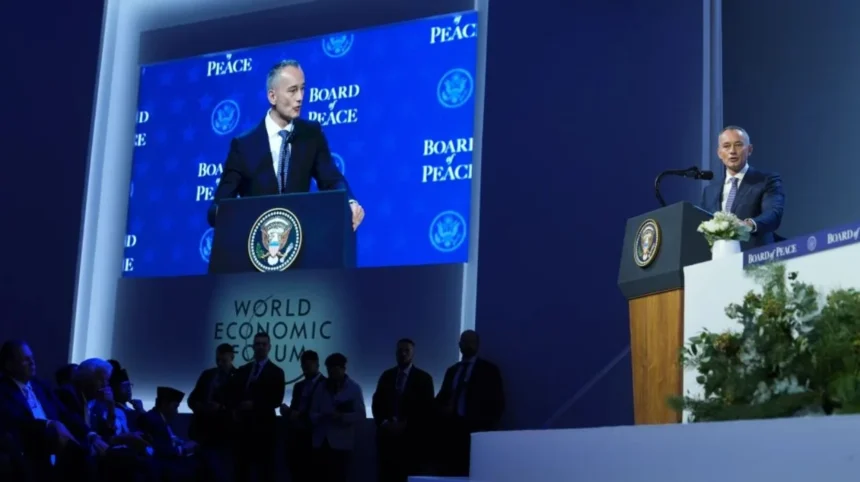
The Board of Peace Gaza initiative, launched by US President Donald Trump to oversee the enclave’s reconstruction and governance, is under close scrutiny from European Union governments and international observers. European foreign ministers met the board’s director, Nikolay Mladenov, in Brussels as they sought clarity on its mandate, structure and relationship with existing institutions, particularly the United Nations. While several EU member states participate directly in the Board of Peace Gaza framework, the European Commission and key capitals remain cautious, citing the absence of Palestinian representation and potential overlap with UN mechanisms. The meeting highlighted growing international debate over how the new body will affect Gaza’s ceasefire, reconstruction and long‑term political future.
- General context: what is the Board of Peace Gaza initiative?
- Why did EU diplomats meet the Board of Peace Gaza director?
- How are EU states and other actors reacting to the Board of Peace Gaza?
- Supporting details: funding pledges, peacekeeping forces and UN rivalry
- What are the implications and possible next steps for Gaza?
General context: what is the Board of Peace Gaza initiative?
As reported by Associated Press journalist Raf Casert, the Board of Peace Gaza project is a flagship foreign‑policy initiative of President Donald Trump, built around a 20‑point ceasefire and reconstruction plan for the war‑ravaged territory. The board was conceived as an international council of states that would coordinate efforts to stabilize Gaza, supervise a fragile ceasefire and channel billions of dollars in pledged reconstruction aid. Its first formal meeting was held in Washington about a month before the Brussels talks, drawing representatives from more than 40 countries.
According to AP, Trump has cast the Board of Peace Gaza as a vehicle not only to rebuild and govern Gaza “as a modern metropolis” but also to position the council as an alternative or challenge to the United Nations Security Council in managing conflicts. Over two dozen nations have joined as founding members, including Israel, regional states involved in ceasefire negotiations such as Qatar and Egypt, and other countries that either back Trump politically or see strategic advantage in joining.
AP’s earlier explainer on the Board of Peace Gaza notes that Trump has declared himself chairman for life of the body and claimed that member states have pledged around 5–7 billion dollars toward Gaza’s reconstruction, along with thousands of personnel for peacekeeping and policing. However, no detailed public list of financial commitments or a full agenda for the board’s work has been released, and Palestinians have objected that no representatives from Gaza or the Palestinian Authority were invited to participate.
Why did EU diplomats meet the Board of Peace Gaza director?
In the Brussels meeting, described by Casert, EU foreign policy chief Kaja Kallas and foreign ministers from across the 27‑nation bloc sat down with Nikolay Mladenov, the former Bulgarian foreign minister and ex‑UN special coordinator for the Middle East peace process, who now serves as director of the Board of Peace Gaza. The session took place alongside a broader EU foreign affairs agenda that also covered Russia’s war in Ukraine and possible new sanctions on Moscow.
According to AP, the purpose of the meeting was to allow Mladenov to brief EU governments on the board’s plans for Gaza, explain its governance model and respond to concerns about how it interacts with the United Nations and existing ceasefire arrangements. The European Commission has accepted invitations to attend Board of Peace Gaza activities as an observer, emphasizing its role as the largest donor to the Palestinian Authority and a key supporter of UN operations at Gaza’s Rafah crossing.
While the EU as an institution has decided to “engage” with the Board of Peace Gaza to maintain influence over reconstruction and peacekeeping debates, several member states remain skeptical. France, which was surprised by the Commission’s acceptance, said publicly that the EU “does not have the mandate to represent member states” within the board. French foreign ministry spokesperson Pascal Confavreux told reporters that, from Paris’s perspective, the Board of Peace Gaza “needed to recenter to focus on Gaza in line with a United Nations Security Council resolution” and that France would not participate until the mandate was clarified.
How are EU states and other actors reacting to the Board of Peace Gaza?
AP and related coverage indicate a mixed European response to the Board of Peace Gaza framework. Some EU member states and candidate countries have joined the board outright: Hungary and Bulgaria are full members, while EU candidates such as Albania are also participating. At the same time, twelve other EU nations, including Germany, Italy, the Netherlands and Greece, sent observers rather than full delegations to the inaugural meeting in Washington.
The European Commission, through spokesperson Paula Pinho, has defended its decision to attend Board of Peace Gaza talks, saying “it is in the remit of the Commission to accept invitations.” Officials in Brussels argue that by engaging, the EU can press for respect of international law, insist on UN‑charter compliance and shape reconstruction priorities in line with its long‑standing support for a two‑state solution and Palestinian self‑determination.
Beyond Europe, AP and other outlets report that several key US allies, such as France, Germany, Norway and Sweden, have thus far declined to join the Board of Peace Gaza as members, reiterating their preference to work through the United Nations. Criticism has also come from Palestinian circles, where political figures and civil society organizations object to the board’s composition and its decision to discuss Gaza’s future without Palestinian representation. Israeli commentators have expressed unease over the inclusion of countries like Qatar and Turkey, which maintain ties with Hamas, even as the board is tasked with consolidating a ceasefire.
Supporting details: funding pledges, peacekeeping forces and UN rivalry
In its explainer, AP notes that Trump used the first Board of Peace Gaza meeting in Washington to announce headline figures and political commitments. He said member states had pledged around 5 billion dollars, later reported by some outlets as 7 billion, for relief and reconstruction in Gaza—far below the estimated 70 billion dollars needed to rebuild the devastated territory but still a significant sum. He also said several countries had agreed to deploy troops as part of an International Stabilization Force to help police Gaza and secure ceasefire lines.
Reporting by Middle East Eye and other outlets, drawing on Israeli media, has suggested that Greece, Morocco and Albania are among the states likely to contribute to this stabilization force, alongside Indonesia, which has already indicated readiness to send personnel. The Board of Peace Gaza thus envisions a multinational security presence, operating parallel to or in coordination with existing UN missions, to monitor ceasefire arrangements and support local authorities.
These ambitions have raised questions about the board’s relationship with the United Nations. AP reports that Trump has described the Board of Peace Gaza as a body that can handle not only Gaza but also “world conflicts,” effectively positioning it as an alternative forum to the UN Security Council. Critics warn that such overlap could undermine the UN’s authority and fragment international responses, particularly if major powers or regional actors see the board as a venue to pursue their own interests outside established multilateral frameworks.
At the same time, the EU has stressed that it remains supportive of the UN mandate in Gaza, especially in areas such as border management at Rafah and coordination of humanitarian aid. In Brussels, officials have framed dialogue with the Board of Peace Gaza as a way to ensure that any new arrangements complement rather than replace the UN’s role, though this balance remains delicate and politically contested.
What are the implications and possible next steps for Gaza?
The AP report underscores that the Board of Peace Gaza initiative faces a series of practical and political challenges before it can deliver on Trump’s ambitious rhetoric. On the ground, progress toward even the more modest goals of the ceasefire has been limited: violence has flared periodically, reconstruction is slow and key issues such as security control, border management and governance structures remain unsettled. Without clear coordination with Palestinian stakeholders, the UN and major donors, turning pledged billions into effective projects will be difficult.
From a governance perspective, questions persist about how the Board of Peace Gaza will interact with any technocratic or interim administration in the Strip, how it will respect Palestinian political rights and whether its decisions will align with existing international legal frameworks. The absence of Palestinian representation in the board’s founding structure is likely to remain a central point of contention, potentially affecting local acceptance of its initiatives and the legitimacy of any security or reconstruction schemes it sponsors.
For the EU, the Brussels meeting with Mladenov is a step in a longer process of defining its relationship with the Board of Peace Gaza. Some member states may eventually decide to join as full participants, while others may continue to rely primarily on the UN and bilateral channels. The outcome of these internal debates will influence how much leverage the EU can exert over the board’s priorities, especially on issues such as human rights, rule of law and the political horizon for Palestinians.
Looking ahead, AP suggests that Trump’s broader vision of the Board of Peace Gaza as a global conflict‑management body may be tempered by realities on the ground. The sheer scale of destruction in Gaza, the complexity of its politics and the sensitivity of competing international mandates mean that the board’s immediate test will be whether it can help consolidate the ceasefire and deliver tangible improvements for Gaza’s roughly 2 million residents. The Brussels discussions mark an early attempt by the EU to shape that process, even as fundamental questions about representation, accountability and coordination remain unresolved.