


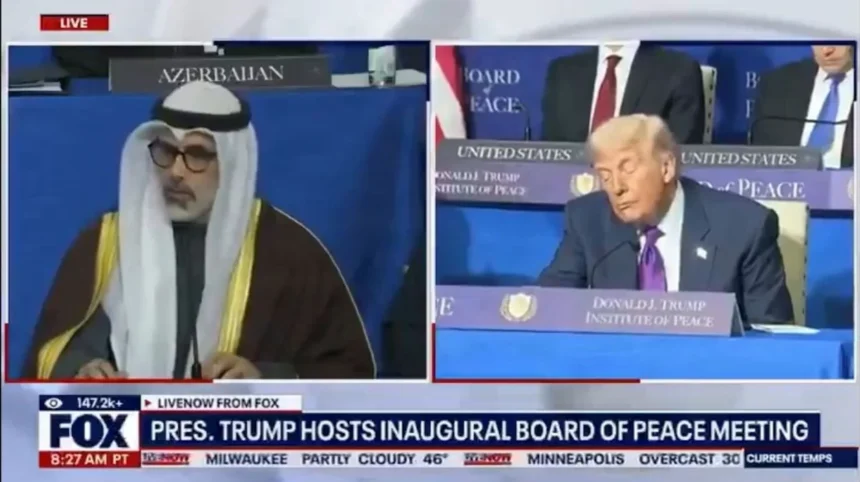
Washington (January 8, 2025) – President Donald Trump has outlined a Gaza reconstruction proposal built around a so-called Trump Gaza board of peace plan, combining security deployment and economic funding. The initiative centers on a 20,000-strong international force to patrol Gaza and oversee stability. An initial reconstruction fund of 7 billion dollars has been pledged by a range of participating countries. The plan has raised questions over representation, funding gaps and the exclusion of key international and Palestinian actors.
Executive summary of the plan
According to reporting on the Trump Gaza board of peace plan, the proposal seeks to tie large-scale reconstruction assistance to strict security arrangements in Gaza. The centerpiece is an International Stabilisation Force commanded by a United States general and including troops from several nations. Indonesia has reportedly pledged 8,000 soldiers, forming a substantial portion of the planned 20,000 troops. The success of the initiative is explicitly conditioned on the full disarmament of Hamas.
As reported, the plan also introduces a new governance and coordination body referred to as a “board of peace,” composed of regional and international members. This board would oversee the allocation of reconstruction funds, security coordination and broader political goals related to Gaza’s future. While the proposal sets an initial financial package of 7 billion dollars, estimates for Gaza’s full reconstruction rise to around 70 billion dollars, highlighting a substantial gap. Critics have focused on both the structure of the board and the limited financial scope relative to documented needs.
General context and background
As reported by journalists at The Independent, Trump’s Gaza proposal follows months of intense conflict and destruction in the territory, leaving housing, infrastructure and basic services in urgent need of repair. The Trump Gaza board of peace plan is framed as a comprehensive response that couples rebuilding with guarantees of long-term security. The International Stabilisation Force is described as a multinational deployment, but led by a United States officer, underlining Washington’s central role.
According to The Independent, Indonesia’s pledge of 8,000 troops would make it the single largest troop contributor within the 20,000-strong force. Other nations are expected to supply the remaining soldiers, though detailed national breakdowns have not been fully specified. The mission would be tasked with patrolling Gaza, assisting in maintaining order and supporting the implementation of disarmament commitments. The plan asserts that Hamas has agreed to disarm, a claim that is treated as a core premise of the overall framework.
The board of peace, as described, brings together a range of Middle Eastern and other participating states. Its mandate would include supervising reconstruction spending, coordinating with the stabilisation force and acting as a central decision-making hub for Gaza’s post-war trajectory. The Independent’s reporting notes, however, that Palestinian representatives are not included on this board. Major Western allies such as the United Kingdom, the European Union, France and Germany are also reported to be absent from the structure.
What reactions and concerns have emerged?
Reporting on the Trump Gaza board of peace plan highlights several concerns raised by observers, diplomats and analysts. One central criticism is the composition of the board of peace itself, which some view as having a top‑down, quasi‑colonial character. With Palestinians not represented within the board, questions arise about who will speak for Gaza’s population in decisions on reconstruction, security and governance. The absence of key Western partners traditionally involved in Middle East diplomacy further fuels debate over the board’s legitimacy and balance.
According to The Independent, the plan’s funding levels also draw scrutiny. The initial 7 billion dollar fund, while significant, falls far short of the roughly 70 billion dollars estimated for a full reconstruction of Gaza’s damaged housing, utilities and public infrastructure. This shortfall raises doubts about whether the plan can deliver the scale of rebuilding that humanitarian agencies and assessment teams deem necessary. Analysts also note that without clear commitments to bridge this gap, implementation may stall or deliver only partial recovery.
Another axis of reaction concerns the plan’s reliance on the disarmament of Hamas. The framework is predicated on the assertion that the group has agreed to give up its weapons, a precondition for both the deployment of the International Stabilisation Force and the release of reconstruction funds. Critics caution that any perceived lack of clarity or verification around disarmament could jeopardize the stability arrangements and undermine confidence in the plan. In addition, the deployment of 20,000 foreign troops in Gaza is itself contentious, with questions about rules of engagement, length of stay and interaction with the local population.
Supporting details and expert commentary
Coverage of the Trump Gaza board of peace plan emphasizes that the International Stabilisation Force would operate under a unified command, headed by a United States general. This reflects a model similar to other multinational operations where a lead nation provides command, logistics and planning capacity. The inclusion of Indonesia, a large Muslim-majority country with experience in peacekeeping missions, is seen as a move designed to bolster regional credibility and acceptance among some constituencies. The 8,000 Indonesian troops would account for nearly forty percent of the total deployment, making their commitment particularly notable.
As reported by The Independent, the plan’s financial architecture envisages contributions from multiple states to build the 7 billion dollar fund. These funds would be directed toward urgent reconstruction priorities such as housing, power generation, water systems, hospitals and schools. Experts cited in coverage of similar reconstruction efforts warn that such funds must be accompanied by transparent mechanisms to prevent mismanagement and to ensure that aid reaches civilian populations in need. The board of peace is intended to provide this oversight function, though its current composition raises questions about accountability to Palestinian communities.
Some analysts referenced in reporting suggest that the exclusion of key Western allies may reflect an effort to reposition the diplomatic center of gravity toward certain regional players aligned with Washington. Others argue that the absence of the United Kingdom, the European Union, France and Germany could complicate broader international buy‑in, especially from donors and institutions that typically play major roles in reconstruction. The structure has led some commentators to draw parallels with historical mandates or trusteeships, which are often criticized for limiting local agency.
The Independent’s article also underlines that the scale of destruction in Gaza, alongside the complex political and security environment, makes any reconstruction plan unusually challenging. Experts stress that long‑term stability is unlikely without local political inclusion, robust economic opportunities and guarantees for civilian protection. In this context, the Trump Gaza board of peace plan is seen as an attempt to craft a security‑first approach, pairing physical rebuilding with tightly controlled conditions on armed groups.
What are the implications and possible future developments?
If implemented as described, the Trump Gaza board of peace plan would mark one of the most extensive international security deployments in Gaza’s recent history. A 20,000-strong International Stabilisation Force, led by a United States general and heavily supported by Indonesian troops, would significantly alter the security landscape. This could, in theory, create space for reconstruction activity, humanitarian operations and the restoration of basic services. However, much depends on how local communities perceive the foreign troop presence and whether they view the mission as impartial and protective.
From a financial perspective, the initial 7 billion dollar reconstruction fund would offer a starting point for rebuilding critical infrastructure but would not, on current figures, cover the estimated 70 billion dollars needed for a full recovery. Future developments will likely hinge on whether additional donors step forward or whether the board of peace can secure further commitments. The gap between pledged resources and assessed needs may influence which sectors are prioritized and how quickly living conditions can improve.
Politically, the exclusion of Palestinian representatives from the board of peace is likely to remain a central point of contention. Any attempt to direct Gaza’s reconstruction and security arrangements without direct Palestinian participation could face resistance, both locally and from parts of the international community. Future adjustments to the board’s membership or the creation of parallel consultative bodies may become topics of negotiation as the plan evolves. The absence of several major Western allies also opens questions about how this initiative will intersect with broader diplomatic efforts on the Israeli-Palestinian conflict.
The plan’s dependence on Hamas disarmament as a foundational condition adds another layer of uncertainty. Verification mechanisms, timelines and enforcement tools for disarmament will be critical to the credibility of the Trump Gaza board of peace plan. Should disarmament stall or be contested, both the International Stabilisation Force and the disbursement of reconstruction funds could be delayed or disrupted. Observers will watch closely for concrete steps, agreements or monitoring arrangements that clarify how this central requirement will be met and sustained over time.
Summary of confirmed developments
In sum, the Trump Gaza board of peace plan sets out a vision in which a 20,000-strong International Stabilisation Force and a multi-billion-dollar reconstruction fund operate under a new, centralized governing board. Indonesia’s pledge of 8,000 troops stands out as a key component of the proposed security deployment. The initiative’s design links reconstruction assistance to Hamas disarmament and to oversight by a body that currently excludes both Palestinian representatives and several traditional Western partners. While the plan sketches a framework for Gaza’s rebuilding and security, its implementation, legitimacy and effectiveness will depend on how these political, financial and security challenges are addressed in the months ahead.