


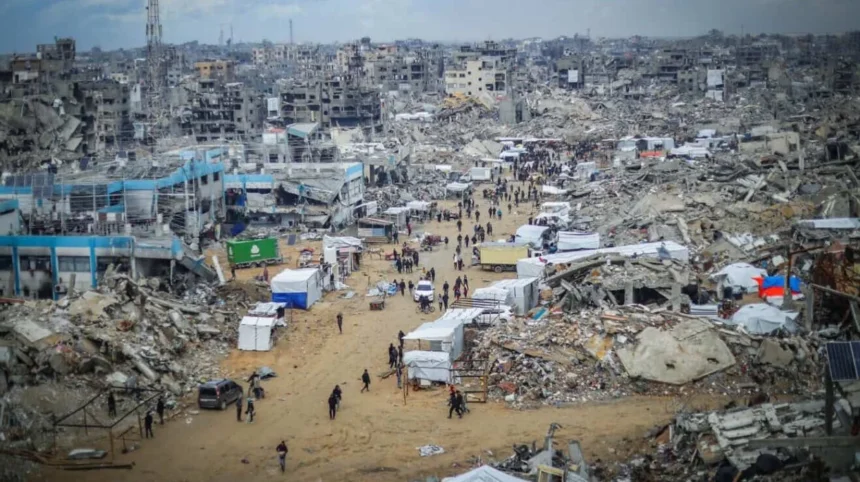
Israel’s economy minister has stated that Israel does not intend to finance the reconstruction of the Gaza Strip following the devastating war that began in 2023, reiterating that any rebuilding will depend on fundamental changes in the territory’s security and governance arrangements. The minister linked Israel’s position to the continued presence and capabilities of Hamas, indicating that reconstruction could only move forward once the enclave is demilitarized and no longer poses a security threat. His remarks come as international actors discuss large-scale funding frameworks for rebuilding Gaza’s civilian infrastructure, housing, and essential services in parallel with ceasefire and postwar governance proposals. The comments highlight a widening gap between Israel’s stated conditions and the expectations of foreign partners who are preparing multi‑billion‑dollar aid and investment packages.
General context and background
As reported by various regional and international outlets, Israeli officials have repeatedly tied Gaza’s reconstruction to strict security benchmarks since the outbreak of the war in 2023, including the disarmament of Hamas and the dismantling of militant infrastructure. According to coverage citing Israeli Economy Minister Nir Barkat, Israel “wants peace in Gaza” but has not committed to participating financially in the rebuilding of the enclave’s cities, neighborhoods, and critical infrastructure. Barkat’s stance reflects a broader position in the Israeli government that reconstruction must not restore or strengthen the military capabilities of armed groups in Gaza, particularly Hamas’s Qassam Brigades and associated networks.
According to international reporting, Israeli Prime Minister Benjamin Netanyahu has previously said that wide‑scale reconstruction will not be permitted before Gaza is demilitarized, underscoring that demilitarization remains a central strategic objective for Israel. This framing places the question of funding within a sequence of security requirements: first neutralizing Hamas’s military capacity, then establishing new security arrangements, and only then allowing substantial rebuilding programs to proceed. The stance has been reiterated in statements linking reconstruction to a “post‑Hamas” order in Gaza, including discussions on who will ultimately administer reconstruction funds and oversee projects on the ground.
At the same time, foreign governments and multilateral bodies have continued to advance reconstruction planning, including the creation of new financial mechanisms such as the US‑led Board of Peace, which was announced with the goal of mobilizing major resources for Gaza. According to The Jewish Chronicle, President Donald Trump told the inaugural meeting of this board that it would commit around 17 billion dollars to rebuilding Gaza, while emphasizing that Hamas would have to disarm before reconstruction could properly begin. In that framework, Israel’s refusal to allocate its own state budget for Gaza’s reconstruction is emerging alongside a parallel effort by international donors to finance civilian rebuilding under strict security and political conditions.
How have Israeli officials framed reconstruction and security?
As reported by outlets covering Israeli cabinet discussions, ministers have framed Gaza reconstruction predominantly as a security‑linked issue rather than a purely humanitarian or economic question. Statements attributed to Barkat and other senior figures stress that Israel is unwilling to “pay twice” by both bearing the burden of war and then financing reconstruction that might, in their view, enable militant groups to reconstitute themselves. According to these reports, the guiding principle is that any rebuilding efforts must be contingent on guarantees that funds, materials, and projects will not be diverted towards rebuilding tunnels, weapons factories, or other military infrastructure.
According to media coverage of Netanyahu’s remarks, the prime minister has linked the timing of reconstruction to a demilitarization process that would remove heavy weapons, rockets, and underground networks from Gaza. This linkage is presented by Israeli officials as a lesson drawn from previous rounds of conflict, in which large postwar injections of construction materials and aid were later accused of being used for tunnel construction and armament. As various outlets note, Israeli policymakers are now openly skeptical of models that provide extensive reconstruction funding without parallel enforcement mechanisms and monitoring.
As reported by The Jewish Chronicle, Trump’s comments at the Board of Peace also echoed Israel’s central demand that disarmament and the dismantling of Hamas’s military infrastructure must precede any full‑scale reconstruction program. The report describes how Trump warned that the Israel Defense Forces (IDF) would not further withdraw from Gaza until Hamas disarmed, reinforcing the idea that security objectives remain interlocked with the question of who pays for rebuilding. According to the same outlet, Israeli officials have argued that previous plans for Gaza “failed” because they did not address issues such as terror infrastructure, indoctrination, and the production of weapons.
What reactions and broader context surround Israel’s position?
According to regional and international media, Israel’s declaration that it will not fund Gaza reconstruction has unfolded in parallel with growing global debate over responsibilities for postwar rebuilding, the role of international donors, and the future governance of Gaza. Some foreign governments and organizations have signaled their willingness to mobilize large sums for reconstruction but insist that Israel, as the occupying and military power, bears a share of responsibility for facilitating humanitarian access and the rebuilding of civilian infrastructure. At the same time, Israeli officials have pushed back on characterizations that paint Israel as solely responsible for the enclave’s reconstruction, pointing instead to Hamas and regional actors they accuse of fueling the conflict.
The Board of Peace announcement highlighted by The Jewish Chronicle shows that certain international initiatives are proceeding on the assumption that non‑Israeli funding will carry the primary burden of reconstruction. Trump’s remarks, as reported by that outlet, framed reconstruction as part of a broader political and security package that also includes disarmament, changes in local governance, and safeguards intended to prevent renewed hostilities. According to the report, Israeli leadership welcomed aspects of this approach, particularly the emphasis on disarmament and external financing, while maintaining its own conditions on the timing and sequencing of reconstruction steps.
Media coverage has also pointed to domestic Israeli debates over the war’s aftermath, including the question of whether any long‑term Israeli administrative or security presence will remain in parts of Gaza. In this context, the insistence that Israel will not directly fund reconstruction is being read as part of a wider attempt to limit Israel’s long‑term economic and administrative exposure in Gaza, even as it maintains robust security control. Analysts cited in these reports note that the interplay between funding, security control, and governance structures will shape both the speed and scope of Gaza’s eventual recovery.
Supporting details and expert commentary
According to reporting on Israeli cabinet‑level and policy discussions, the government’s position sits within a broader strategy that seeks to combine military pressure on Hamas with external diplomatic and financial frameworks for the territory’s eventual recovery. Experts quoted in regional and international outlets have noted that Israel’s refusal to fund reconstruction does not necessarily mean it will block all reconstruction, but rather that it expects outside donors to assume financial responsibility while Israel retains significant control over security parameters and border flows.
The Jewish Chronicle’s coverage of the Board of Peace underscores that international actors are already designing mechanisms to channel substantial resources into Gaza, including infrastructure rehabilitation, housing, and economic development projects. According to the report, Trump described a vision of “straightening out” Gaza and making it “successful,” while simultaneously insisting that core security concerns such as terror infrastructure and indoctrination be addressed. This dual emphasis reflects an emerging consensus among some stakeholders that reconstruction must be tightly bound to reforms in security and governance, even as humanitarian needs remain urgent and extensive.
Analysts cited in media reports caution that implementing such a conditional reconstruction framework will be complex, particularly in light of Gaza’s extensive wartime damage, high civilian displacement, and the sheer scale of physical destruction. According to these assessments, major questions remain over who will administer reconstruction funds on the ground, how materials will be monitored, and whether a viable local authority acceptable to both Israel and international donors can be established. These uncertainties contribute to concerns that delays in funding decisions and security arrangements could hinder or slow reconstruction efforts, prolonging humanitarian hardship in Gaza.
What are the implications and possible future developments?
According to international coverage, Israel’s announcement that it will not fund Gaza reconstruction places greater pressure on foreign governments, multilateral institutions, and regional actors to fill the financial gap. If external donors proceed with large‑scale commitments such as the Board of Peace’s reported 17‑billion‑dollar pledge, the reconstruction process is likely to hinge on negotiations over disarmament, security guarantees, and the nature of Gaza’s postwar governing authority. In this scenario, Israel would continue to shape reconstruction indirectly by setting conditions for security, border control, and the entry of materials, even as the bulk of funding comes from abroad.
Future developments are expected to revolve around three main tracks identified in the reporting: ceasefire and security arrangements, including demilitarization benchmarks; the creation and operation of international funding and oversight mechanisms; and the establishment of a local governance structure in Gaza capable of managing reconstruction while meeting the conditions set by Israel and donors. According to analysts’ assessments, progress or setbacks in any one of these tracks will directly affect the others—for example, delays in disarmament or governance agreements could slow the disbursement of reconstruction funds, while stalled reconstruction could in turn complicate political negotiations.
Media outlets note that Israeli officials have indicated they will judge future steps by whether they reduce security threats from Gaza and prevent a repeat of previous conflict cycles. Given the scale of destruction and the depth of humanitarian needs, however, international actors are likely to continue pressing for swift reconstruction moves that can stabilize living conditions while broader political issues remain under negotiation. How these competing timelines and priorities are reconciled will help determine the pace and character of Gaza’s recovery in the coming years.
In sum, the cabinet minister’s assertion that Israel will not fund Gaza reconstruction crystallizes a policy line that links any rebuilding of the enclave to far‑reaching security and political changes, particularly the disarmament of Hamas and the demilitarization of Gaza. International initiatives such as the Board of Peace indicate that significant external funding may become available, but they also replicate many of Israel’s conditions by tying reconstruction to disarmament and the dismantling of militant infrastructure. The resulting framework places the future of Gaza’s reconstruction at the crossroads of security demands, diplomatic negotiations, and the willingness of external actors to underwrite the territory’s recovery on terms that address both humanitarian needs and long‑standing conflict dynamics.