


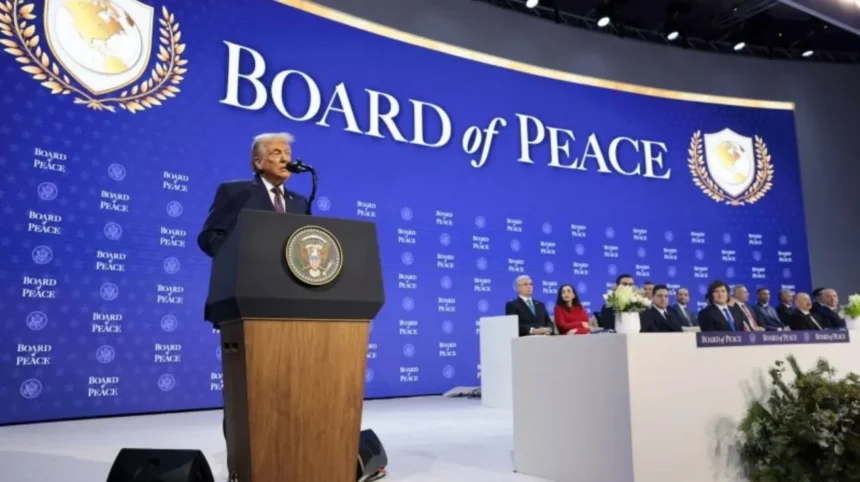
US President Donald Trump declared that the Gaza war “is over” during remarks at his Board of Peace meeting, even as he acknowledged that “violations” of the ceasefire continue. He framed the statement as a milestone in his administration’s attempts to move the conflict into a postwar phase.
- How did Trump describe the situation and what did he acknowledge?
- What is still happening on the ground in Gaza?
- What ongoing violations and attacks are being reported?
- How do these developments affect the perception of Trump’s “Gaza war” claim?
- Supporting details on the Board of Peace and the Gaza war
- What are the implications and possible future developments?
According to News.az, Trump made the comments while addressing delegates gathered to discuss reconstruction funding and security arrangements for Gaza under the Board of Peace framework. He pointed to the release of Israeli hostages and a significant reduction in large‑scale military operations as evidence that the Gaza war had ended, despite ongoing incidents on the ground.
News.az notes that Trump’s declaration comes roughly four months after a US‑brokered ceasefire, mediated with the help of Qatar and Egypt, formally halted full‑scale hostilities between Israel and Hamas. The ceasefire agreement underpins Trump’s broader Gaza plan, which combines demilitarization steps, new governance structures and major reconstruction pledges.
How did Trump describe the situation and what did he acknowledge?
As reported by News.az, Trump told the Board of Peace gathering: “The war in Gaza is over.” He went on to concede that there are still “violations” of the truce but insisted these do not change his assessment that the war itself has ended.
He described the ceasefire as “holding,” despite what he characterized as limited breaches, and argued that the focus must now shift to rebuilding Gaza and implementing the postwar framework. Trump used the declaration to underscore his claim that his administration has delivered where others failed by securing both a ceasefire and a structure for long‑term stabilization.
According to News.az, Trump also tied his statement about the Gaza war to his political messaging, portraying the Board of Peace and related pledges of billions of dollars for reconstruction as proof of his international leadership. He urged participating states to see the conflict as entering a new chapter, with the Gaza war in the past and a reconstruction phase under way.
What is still happening on the ground in Gaza?
What ongoing violations and attacks are being reported?
News.az reports that, despite Trump’s declaration, Israeli attacks on Gaza have continued since the ceasefire went into effect. It cites recent incidents in which Israeli airstrikes and artillery fire killed and wounded Palestinians, including children, in various parts of the Strip.
The outlet notes that Palestinian sources and international observers have documented repeated ceasefire violations by Israeli forces, including deadly shootings near buffer zones, targeted strikes and ground incursions. These incidents have been reported even after formal combat operations were said to have ended.
News.az also highlights figures from Gaza’s authorities indicating that thousands of Palestinians have been killed in the months following the ceasefire, although at a lower intensity than during the peak of the war. Large areas of Gaza remain in ruins, with displaced families sheltering in damaged buildings or makeshift camps.
How do these developments affect the perception of Trump’s “Gaza war” claim?
According to News.az, critics and local observers argue that ongoing lethal attacks and the absence of a political settlement call into question Trump’s assertion that the Gaza war is over. For many residents, the continuation of airstrikes, raids and restrictions on movement means that conditions still feel like a prolonged conflict rather than a postwar environment.
The discrepancy between Trump’s statement and daily realities on the ground has become a point of contention in regional commentary. Analysts cited by News.az suggest that, while large‑scale offensives have ceased, the pattern of violence and instability fits more with a low‑intensity war or militarized occupation than with a fully “postwar” situation.
Supporting details on the Board of Peace and the Gaza war
News.az explains that Trump’s declaration came as he hosted the inaugural high‑level meeting of the Board of Peace, an international body he created to manage postwar Gaza. The board’s agenda includes securing billions of dollars in reconstruction funding, organizing an international stabilization force and overseeing the implementation of a postwar governance framework.
The outlet notes that Trump has promoted the Board of Peace as central to his 20‑point Gaza plan, which envisions full demilitarization of Hamas, the installation of a technocratic Palestinian administration and the creation of a large police and stabilization force. The president has repeatedly highlighted pledges from member states and his own promise of $10 billion from the United States as key to turning the page on the Gaza war.
At the same time, News.az reports that the board’s progress is unfolding against a backdrop of continued hardship in Gaza. International agencies have estimated that more than 70 billion dollars will be needed to rebuild the territory, and basic infrastructure such as water, electricity and healthcare remains heavily compromised.
News.az further notes that, while Trump and his team present the Board of Peace as evidence that the Gaza war is over, many Palestinians see little change in their day‑to‑day reality. Demolished neighborhoods, ongoing raids and the absence of a political horizon feed skepticism about whether the conflict can really be considered finished.
What are the implications and possible future developments?
How might Trump’s statement affect diplomacy and reconstruction?
Trump’s assertion that the Gaza war is over could influence how international actors frame their engagement with the territory. For supporters of his plan, the statement serves as a political marker that justifies shifting diplomatic and financial energy toward reconstruction and governance rather than ceasefire negotiations.
However, as News.az highlights, sustained ceasefire violations and continued Israeli operations risk undermining confidence in the idea of a true postwar phase. Donors and participating states in the Board of Peace may weigh these realities when deciding how quickly and under what conditions to release funds and deploy personnel to Gaza.
If violence escalates again, Trump’s claim could appear premature, complicating his efforts to present the Board of Peace as a successful model. Conversely, if incidents gradually decrease and reconstruction takes hold, his “Gaza war is over” declaration could be retrospectively seen as an early political framing of a long transition.
What comes next for Gaza and the Board of Peace?
News.az indicates that the Board of Peace will continue to meet and develop mechanisms to implement Trump’s Gaza plan, including the rollout of reconstruction projects and security deployments. The success of these efforts will depend on cooperation among participating states, local Palestinian actors and Israel, as well as on the trajectory of ceasefire violations.
In the near term, monitoring and verification of attacks and breaches will be critical to assessing the gap between Trump’s statement and conditions on the ground. International organizations, media and human rights groups will likely continue documenting incidents that shape perceptions of whether the Gaza war is truly over or simply entering another phase.
For Gaza’s population, the key issue is whether Trump’s words translate into meaningful changes—safe neighborhoods, functioning infrastructure, and an end to the constant threat of violence. Until those changes materialize, Trump’s declaration that “the Gaza war is over” will remain in tension with persistent reports of ongoing violations and the enduring impact of years of conflict.