


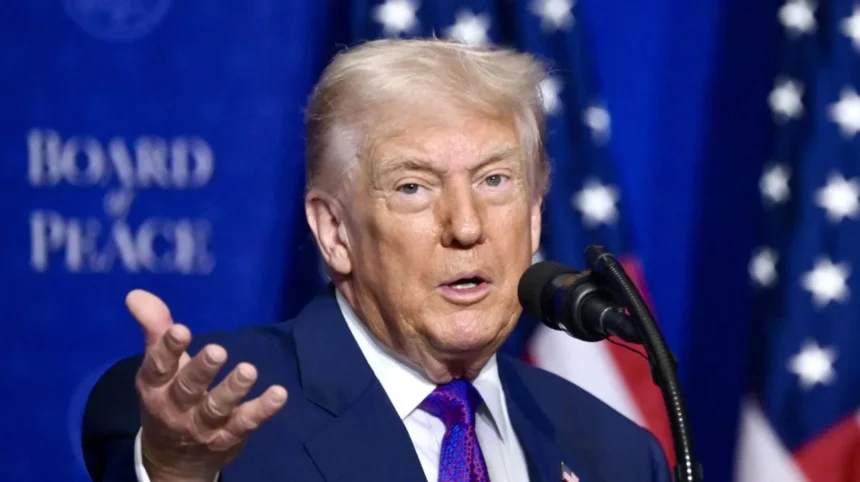
As reported by The Guardian, US President Donald Trump convened the first full meeting of his Board of Peace in Washington, D.C., with securing troops for Gaza and money for reconstruction at the top of the agenda. The gathering focused on building an International Stabilization Force for the Gaza Strip and consolidating financial pledges for postwar recovery.
According to reporting relayed by France 24, Trump used the meeting to reiterate a US commitment of 10 billion dollars to the Board of Peace and to showcase billions in additional pledges from other member states for Gaza. The session follows a ceasefire deal brokered by the Trump administration with Qatar and Egypt, aimed at ending more than two years of destructive conflict in the territory.
France 24 notes that Muslim‑majority countries, including Qatar, Saudi Arabia and the United Arab Emirates, have each committed at least 1 billion dollars to the Board of Peace’s Gaza fund. The White House has said that, excluding the US pledge, member states’ contributions exceed 6.5 billion dollars, although this remains far below international estimates of Gaza’s total reconstruction needs.
Al Jazeera’s coverage of the Washington meeting underscores that Trump portrayed the Board of Peace as a new global forum that will “assist Gaza” and “put it on the right path,” while also hinting at plans to replicate its model in other conflict zones. The meeting brought together representatives from more than two dozen nations, though several key European allies stayed away or participated only on the margins.
What was agreed on troops and money for Gaza?
As reported by Military.com and Al Jazeera, Trump announced that nine member states of the Board of Peace had collectively pledged 7 billion dollars toward a Gaza relief and reconstruction package. These pledges are in addition to the separate 10 billion dollar commitment Trump says will come from the United States.
According to Reuters and France 24 summaries, Qatar and Saudi Arabia each pledged 1 billion dollars, with additional contributions from countries such as the United Arab Emirates, Kazakhstan, Azerbaijan, Bahrain and Uzbekistan. The funds are earmarked for rebuilding critical infrastructure, humanitarian assistance and supporting the broader postwar Gaza framework developed under the Board of Peace.
On the security side, Military.com reports that five countries—Indonesia, Morocco, Kazakhstan, Kosovo and Albania—have agreed to send troops to an International Stabilization Force for Gaza. Egypt and Jordan, meanwhile, have committed to training police officers who will form part of Gaza’s new security structures under the postwar framework.
Al Jazeera notes that Indonesian President Prabowo Subianto told the meeting his country was ready to send up to 8,000 troops to “make this peace work,” a figure that represents almost half of the envisaged 20,000‑strong stabilization force. Major General Jasper Jeffers, the American commander of the force, said Indonesia would provide his deputy commander and that Morocco, Kazakhstan, Kosovo and Albania were also contributing personnel.
France 24’s report highlights that the overall objective is to assemble 20,000 troops for the International Stabilization Force, with initial deployments expected in southern Gaza, particularly Rafah, before expanding to other areas. The force’s mandate, as framed by Trump’s 20‑point plan, is to help enforce the ceasefire, support demilitarization efforts and secure reconstruction corridors.
How are governments and observers reacting to Trump’s Board of Peace?
How are supporters presenting the Board of Peace agenda?
France 24 reports that Trump framed the Board of Peace as one of the “most consequential” initiatives of his presidency, saying it would “achieve peace” in Gaza and be replicated in “other places” around the world. He held up folders of pledge documents as his campaign‑era theme song played, casting the meeting as both diplomatic event and political showcase.
According to Al Jazeera’s analysis segment, supporters at the meeting described a “bright future” for Gaza, emphasizing pledges of money, troops and investment. They portrayed the Board of Peace as a dynamic alternative to existing mechanisms, with Trump promising to keep the United Nations “viable” while positioning the board as a more flexible and results‑oriented partner.
Regional backers, including some Muslim‑majority states, used the meeting to spotlight their role in reconstruction and peacekeeping. Coverage from outlets such as Daily Sabah notes that countries like Kazakhstan, the UAE, Morocco, Bahrain, Qatar, Saudi Arabia and Uzbekistan framed their financial contributions as part of a broader commitment to stabilize Gaza and support its population after years of devastation.
What concerns and questions are being raised?
France 24 and Al Jazeera both highlight questions about the Board of Peace’s legitimacy, transparency and relationship to the United Nations. Critics in several governments worry that the new body could undermine or bypass the UN’s role in peacekeeping and reconstruction, particularly if it evolves into a rival power center with its own funding streams and security deployments.
Domestic critics in the United States, cited in US local affiliates carrying national reporting, have also questioned Trump’s 10 billion dollar pledge. They point out that major foreign spending commitments require congressional approval and note that the administration has not provided detailed explanations of how the funds would be used or over what time frame.
Human rights advocates and analysts interviewed by Al Jazeera have raised concerns over the heavy emphasis on security and troop deployments compared with the scarcity of clear political arrangements. They argue that pledging troops and money without robust accountability mechanisms and a political roadmap risks entrenching external control over Gaza rather than empowering its residents.
Supporting details on the Gaza stabilization force and postwar framework
Military.com and other outlets report that the International Stabilization Force emerging from the Board of Peace discussions is conceived as a multinational formation operating under an international mandate. With up to 20,000 troops, it is expected to focus on securing ceasefire lines, protecting key infrastructure, escorting aid and supporting the disarmament of armed groups.
Al Jazeera’s coverage notes that, while troop pledges from Indonesia, Morocco, Kazakhstan, Kosovo and Albania are significant, uncertainties remain about the final composition of the force, its rules of engagement and how it will coordinate with Israeli forces and Palestinian institutions. Egypt and Jordan’s role in training police suggests a layered security architecture combining international troops with a revamped local police presence.
France 24 recalls that the Board of Peace follows a ceasefire deal that ended two years of large‑scale conflict triggered by Hamas’s 7 October 2023 attack on Israel and the subsequent Israeli offensive. Under Trump’s 20‑point plan, the postwar framework includes demilitarizing Hamas, establishing new governance structures in Gaza and tying reconstruction funding to progress on disarmament.
Parallel reporting from Anadolu Agency and other regional outlets on the same week’s Board of Peace meetings describes the unveiling of a postwar Gaza framework that includes a new Office of the High Representative for Gaza and a National Committee for the Administration of Gaza. These bodies are designed to support a technocratic transition government and coordinate with the stabilization force and donor states.
The Guardian, in separate investigative reporting highlighted by Democracy Now!, has also revealed contracting files that show plans for a 5,000‑person military base in southern Gaza intended to host the International Stabilization Force. That plan, while not the focus of the main meeting agenda, underscores the scale of the envisioned foreign military footprint that would accompany the Board of Peace’s reconstruction and governance efforts.
What are the implications and possible future developments?
Will the money and troop pledges be enough for Gaza’s needs?
France 24 and Al Jazeera stress that, although the sums announced in Washington are substantial, they represent only a fraction of what is needed to rebuild Gaza. International institutions estimate the cost of reconstruction at roughly 70 billion dollars, far exceeding the 7 billion dollars pledged by Board of Peace members and the 10 billion dollars promised by the United States.
Whether the Board of Peace can close that gap will depend on future pledging conferences, private investment and continued political will among member states. Trump and his team are likely to use subsequent board meetings and global events to push for more funding, but donor fatigue and competing priorities could limit how much additional money is mobilized.
On the security side, assembling and sustaining a 20,000‑strong stabilization force will require significant logistical, financial and political support. Contributing countries will have to address domestic concerns about deploying troops to a highly volatile environment, while planners will need to define a clear mission, exit strategy and coordination arrangements with local actors.
How might the Board of Peace reshape international engagement in Gaza?
Al Jazeera’s analysis suggests that Trump’s Board of Peace could mark a shift toward more ad hoc, leader‑driven coalitions in conflict zones, operating alongside or in partial competition with UN frameworks. If it succeeds in channeling substantial funds and assembling a credible stabilization force, it may set a precedent for similar structures elsewhere.
However, the body’s success will be judged not only by pledges but by concrete outcomes in Gaza: rebuilding homes and infrastructure, ensuring security, and enabling a political environment in which Palestinians can exercise meaningful agency. Persistent questions about representation, transparency and the balance between security and civilian priorities will shape how Palestinians and the wider region perceive the Board of Peace.
In the months ahead, observers will watch whether the pledges announced in Washington are translated into appropriated funds, signed troop deployment agreements and on‑the‑ground projects. The interaction between the Board of Peace, the United Nations, regional mediators and Israeli and Palestinian actors will be critical in determining whether the promised money and troops can move Gaza from ceasefire toward a more stable and livable postwar reality.