


As reported by Sam Metz and Samy Magdy of the Associated Press, President Donald Trump has positioned his newly created Board of Peace as a vehicle to help resolve global conflicts, starting with the immense challenge of stabilizing and rebuilding Gaza after the latest war with Israel.
According to the Associated Press, Trump has portrayed the Board of Peace as an international coalition that can both administer reconstruction and eventually tackle broader disputes beyond the Middle East, suggesting it could one day rival or even supplant the United Nations Security Council’s influence over conflict resolution.
Metz and Magdy report that Trump serves as the self-appointed chairman of the Board, which brings together a group of participating countries and institutions that he says are prepared to mobilize funding, security personnel and technical expertise for Gaza and, ultimately, for other conflict zones worldwide.
As outlined in reporting summarized by outlets carrying the Associated Press story, Trump’s ambitions for the Board extend from governing and rebuilding Gaza as a “futuristic metropolis” to challenging existing multilateral frameworks, even as basic cease-fire and stabilization goals in the enclave remain fragile and incomplete.
According to analysis from the Arab Center Washington DC, the Board’s charter, ratified at Davos in January 2026, assigns it a central role in setting the framework and handling the funding for Gaza’s redevelopment until the Palestinian Authority is deemed capable of securely and effectively taking back control, with the aim of creating governance structures that can attract investment and deliver services.
The Gaza-focused mandate is nested within a broader Trump administration peace initiative that also includes an International Stabilization Force, or ISF, envisaged as a multinational deployment to support Palestinian policing and facilitate an eventual Israeli withdrawal from remaining parts of Gaza.
Gaza today: fragile cease-fire and limited progress
As reported by Metz and Magdy for the Associated Press, the reality on the ground in Gaza stands in stark contrast to the Board of Peace’s sweeping promises, with limited progress so far toward even the narrower objectives of the cease-fire agreement.
According to the Associated Press account, Palestinians, including many civilians, continue to be killed in near-daily Israeli strikes that the Israeli military says are targeting militants who threaten or attack its forces, underscoring how unstable the security environment remains.
The same reporting notes that Hamas has not disarmed, and no international stabilization forces have deployed inside Gaza, despite earlier expectations that foreign contingents would help enforce the cease-fire and back up local Palestinian security structures.
Metz and Magdy write that a Palestinian technocratic committee, envisioned as a body to eventually take over governance from Hamas in Gaza, is currently stuck in neighboring Egypt, unable to enter the enclave and assume its planned administrative role.
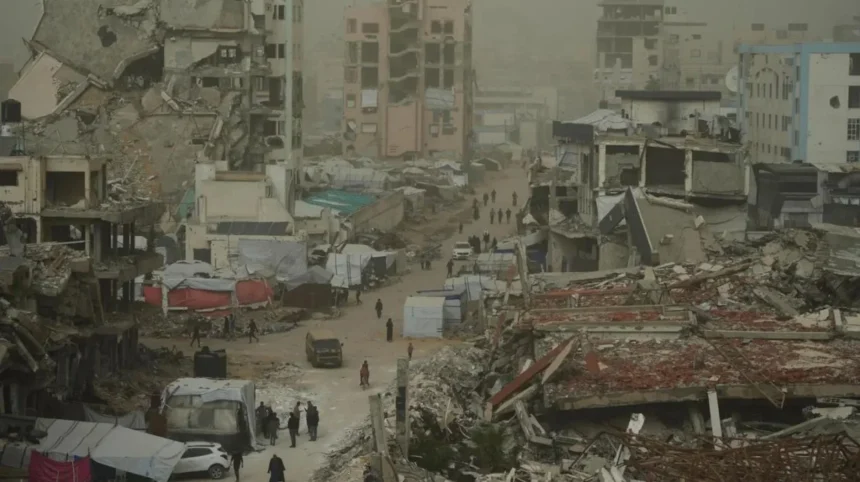
According to the Associated Press, reconstruction in devastated neighborhoods has barely begun, and large swaths of Gaza remain in ruins, with humanitarian agencies warning that the pace of clearance and rebuilding is far below what is required to meet urgent civilian needs.
Analysts cited in regional policy commentary have pointed out that the Board of Peace’s Gaza plans are unfolding amid lingering disputes over security control, border arrangements and the sequencing of political reforms, all of which complicate efforts to translate high-level pledges into tangible recovery on the ground.
How is the Board of Peace supposed to work?
According to the Arab Center Washington DC’s description of the Board of Peace’s charter, the body is designed to set overall strategy, coordinate funding streams and apply “best international standards” to the redevelopment of Gaza, with the stated aim of establishing “modern and efficient governance” that serves residents and encourages investment.
The charter, as summarized by the Arab Center, envisages the Board overseeing Gaza until the Palestinian Authority completes a reform program and can “securely and effectively” regain control, making the body a temporary but powerful actor in shaping postwar political and economic structures.
As reported in coverage of Trump’s peace plan, the Board is expected to work in tandem with the ISF, which would deploy to Gaza to support a Palestinian police force and enable Israel to step back from areas it still occupies, creating a security environment conducive to reconstruction.
According to this analysis, the Board’s remit extends beyond bricks-and-mortar rebuilding to encompass governance design, regulatory frameworks and long-term economic planning, effectively putting it at the center of how Gaza will be administered in the coming years.
Metz and Magdy report that Trump has pitched the Board as a unique international venue that can move more quickly and decisively than existing multilateral bodies, arguing that its streamlined structure and direct White House backing will help unlock large-scale investments and security contributions.
However, policy experts cited in regional commentary note that the mechanisms for decision-making inside the Board, the balance of power between member states and the degree of consultation with Palestinian political actors remain unclear, raising questions about accountability and local ownership.
What has Trump promised for Gaza so far?
As reported by the Associated Press, Trump told reporters this week that member countries of the Board of Peace have pledged 5 billion dollars for Gaza’s reconstruction and will contribute “thousands” of personnel for peacekeeping and policing roles in the territory.
According to the Associated Press story carried by multiple outlets, Trump has not released a detailed breakdown of the purported 5 billion dollars in commitments, and no financial pledges or formal agenda for the Board’s upcoming meeting have been made public.
In a statement quoted by Metz and Magdy, Trump said, “We want to make it successful. I think it has the chance to be the most consequential board ever assembled of any kind,” while repeating his criticism of the United Nations’ record in resolving international disputes.
Coverage of Trump’s social media activity notes that he has hinted at “significant announcements” tied to the Board’s first formal gathering, including the alleged billions in aid for Gaza and the deployment of personnel for a stabilization force, though these claims have yet to be matched by publicly confirmed contributions from specific states.
According to reporting on preparations for the Board’s inaugural meeting, participating countries have been told they will have limited speaking time to present their positions, and Trump may call on certain governments to give updates or outline what they are prepared to offer in terms of funding or security assets.
Regional analysts have observed that Trump has framed the Board’s Gaza initiative as the first step in showing that his preferred model of conflict management can deliver results, treating the enclave’s reconstruction as an early test case for the Board of Peace’s credibility.
Context and reactions: how is the Board viewed?
As reported by the Associated Press, Trump has suggested that the Board of Peace could eventually “solve world conflicts,” describing it as a body that will reach “far beyond Gaza” and presenting it as an alternative venue for international diplomacy.
According to coverage carried by outlets such as the Winnipeg Free Press, Trump has repeatedly contrasted the Board with the United Nations, accusing the UN Security Council of failing to resolve conflicts and implying that his new body can do better by concentrating decision-making among willing partners.
Reporting on diplomatic reactions notes that some governments and international officials are wary that the Board is being constructed as a counterweight to the UN, potentially undermining existing mechanisms for collective security and conflict resolution.
According to Al Jazeera’s account of UN deliberations, the UN Security Council even moved the timing of a Gaza meeting to avoid a direct clash with the Board of Peace’s gathering, highlighting the sensitivity around perceived competition between the two institutions.
Analysts quoted by regional policy centers have raised concerns that the Board’s top-down design, combined with Trump’s central role as chair, risks sidelining broader international consensus and may complicate coordination with existing UN agencies that are central to humanitarian work in Gaza.
At the same time, some participating states have indicated that they see the Board as a potential platform to leverage additional funding and political attention for Gaza, provided that its work is aligned with international law and coordinated with established multilateral entities.
Supporting details and expert commentary
According to the Gaza peace plan overview, Trump used the World Economic Forum in Davos in January 2026 to press Hamas to disarm and release all remaining hostage remains “within weeks,” warning that otherwise it would be “blown away very quickly,” an ultimatum that underscored the security-first approach underlying the broader initiative.
Policy experts cited in that analysis argue that the Board of Peace is intended, at least in part, to offer an alternative framework for mediating Gaza’s future that is less dependent on UN-led processes, giving the Trump administration greater control over timelines and benchmarks.
According to the Arab Center’s description of the charter, the Board’s “comprehensive plan” includes commitments to apply international standards of governance to Gaza’s administration and to design institutions that can attract foreign investment, suggesting a strong emphasis on economic liberalization alongside political restructuring.
Experts note that this approach implies significant conditionality, with the Palestinian Authority required to complete a reform program before it can take back control, potentially giving the Board influence over internal Palestinian politics and institutional design.
Coverage of the planned ISF indicates that the force, endorsed by a UN mandate as part of the Trump plan, is envisioned as a key enabler for the Board’s work, providing security support to Palestinian police and creating conditions in which reconstruction projects and governance reforms can proceed.
However, as Metz and Magdy point out, the absence so far of any deployed international forces in Gaza underscores the gap between plans on paper and operational realities, with continued violence and unresolved political issues impeding the implementation of the Board’s vision.
Implications and future developments: can the Board of Peace deliver?
According to the Associated Press reporting, Gaza remains the first and most immediate test of whether the Board of Peace can translate ambitious rhetoric and headline figures into concrete progress on the ground, from improving security to restarting basic services and rebuilding homes.
Diplomatic reporting suggests that the success or failure of the Gaza initiative will shape how other governments judge the Board’s relevance, influencing whether they view it as a serious forum for addressing future crises or as a largely symbolic project centered on Trump’s foreign-policy brand.
Analysts cited by regional think tanks argue that if the promised 5 billion dollars in reconstruction funding does not materialize in verifiable, disbursed contributions, the Board’s credibility will be quickly called into question, potentially weakening its ability to attract further support.
According to available reporting, the Board’s inaugural meeting in Washington is expected to focus on clarifying member commitments, defining the timeline for deploying any stabilization forces and outlining a more detailed roadmap for Gaza’s reconstruction and governance transition.
Future UN deliberations, including those by the Security Council, will likely intersect with the Board’s activities, and the degree of coordination—or rivalry—between the two institutions may prove decisive for the coherence of international efforts in Gaza.
Experts also note that developments inside Gaza, including any shifts in Hamas’s posture, the formation and movement of the Palestinian technocratic committee and Israel’s stance on withdrawals, will heavily influence the space in which the Board of Peace can operate.
The Board of Peace now sits at the center of Trump’s attempt to reshape how conflicts like Gaza are managed, but the continuing violence, lack of visible reconstruction and unanswered questions about funding and authority underscore how much work remains before the body can claim to have delivered even on its first mandate.