


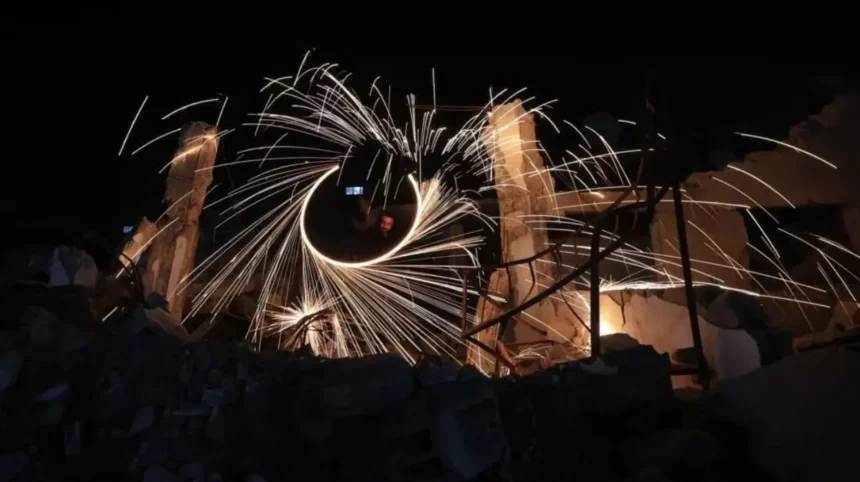
The first Ramadan after the truce in Gaza has opened with a mix of fragile joy and deep grief among residents still living amid widespread destruction. According to AFP, small Ramadan lanterns and strings of decorative lights have appeared in streets lined with crumbled buildings and debris in Gaza City, offering a rare sense of relief since the October ceasefire.
As reported by AFP, worshippers gathered at the Omari mosque in Gaza City for the first fajr, or dawn, prayer of Ramadan, many walking barefoot on the carpet and wrapped in heavy coats to ward off the winter cold. A local resident identified as Abu Adam told AFP that despite “the devastation of mosques and schools” and the destruction of homes, worshippers were determined to come to the mosque under difficult circumstances.
A security official in Gaza told AFP that artillery fire struck eastern areas of Gaza City on Wednesday morning, and shelling was also reported in a refugee camp in central Gaza. AFP noted that Israel bars foreign media from entering the Gaza Strip, which prevents AFP and other outlets from independently verifying casualty figures. This first Ramadan after the truce is therefore unfolding under a continued sense of insecurity, layered over an already devastated urban landscape.
In southern Gaza, tens of thousands of people remain in tents and temporary shelters while they wait for reconstruction to begin following the ceasefire brokered by the United States in October. AFP reported that many of these displaced residents are experiencing Ramadan in extremely precarious conditions, with limited resources and ongoing humanitarian needs. For many families, the first Ramadan after the truce is marked not only by ritual observance but by the absence of relatives killed, missing, detained or displaced during the conflict.
Economic disruption and infrastructure damage have severely affected the local market and food supply during this Ramadan period. AFP reported that residents face high prices and shortages, leaving many increasingly dependent on humanitarian assistance for basic items. With all crossing points into the territory under Israeli control, United Nations and aid agencies cited by AFP say the flow of goods has not been sufficient to bring prices down or stabilize access to essential products.
How are residents reacting in this first Ramadan after truce?
One displaced resident, named by AFP as Nin Ahmed and living in a tent in the Al‑Mawasi area of southern Gaza, described mixed emotions as the first Ramadan after the truce began. He told AFP that the holy month is “filled with mixed emotions,” explaining that the joy of Ramadan feels constrained by the memory of those who were killed, are still missing, detained or have left.
According to AFP, Ahmed contrasted the abundance of past Ramadan meals with his current struggle to prepare even a simple spread. He said that the Ramadan table once “used to overflow with delightful dishes,” bringing together all of the family’s loved ones, but now he can hardly manage a main dish and a side because of high prices. He added that because of the cost of food he cannot invite others for iftar, the evening meal to break the fast, or for suhoor, the pre‑dawn meal before fasting begins.
Another displaced resident, 37‑year‑old Maha Fathi, was quoted by AFP as saying that Ramadan remains meaningful despite the conditions. Fathi, who was displaced from Gaza City and now lives in a tent west of the city, told AFP that “even with the ruins and hardship in Gaza, Ramadan retains its significance.” She observed that people, after focusing on their own survival during the conflict, have begun to reconnect with each other’s struggles as Ramadan progresses.
Fathi explained to AFP that her family and neighbors are attempting to revive communal traditions by cooking together for suhoor and decorating their tents for the holy month. She said that seeing Ramadan decorations and busy markets, even in limited form, gives residents a sense of hope that daily life might eventually return to something closer to normal. This illustrates how, for many, the first Ramadan after the truce is as much about community and resilience as it is about religious observance.
Along the beach in the area of Gaza’s Rimal neighborhood, an artist identified as Yaze Abu Jar contributed to the Ramadan atmosphere through public art, AFP reported. On the sand by the Mediterranean Sea, he wrote “Welcome Ramadan” in elaborate Arabic calligraphy, drawing the attention of children from a nearby tent encampment. This gesture, as described by AFP, shows how symbolic expressions of celebration have taken on particular importance in a setting where material resources remain scarce.
According to AFP, nearly all of Gaza’s 2.2 million residents have been displaced at least once during the two‑year conflict between Israel and Hamas. The agency reported that the war followed a major Hamas attack on Israel on October 7, and the subsequent fighting and bombardment left large sections of Gaza in ruins. In this context, the first Ramadan after the truce is not only a religious period but also a marker of how deeply the conflict has reshaped daily life.
Supporting details and daily realities
AFP reported that many families in Gaza are observing the first Ramadan after the truce from within tented camps set up across the territory. One resident, 43‑year‑old Mohammed al‑Madhoun, lives in a tent west of Gaza City and described his hopes for the future to AFP. He said he wished this would be the last Ramadan his family would spend in tents, expressing a sense of powerlessness when his children ask for lanterns or dream of a full iftar table with their favorite dishes.
Al‑Madhoun told AFP that he and other displaced residents still try to find moments of happiness despite their circumstances. He recounted how neighbors gathered for the first Ramadan evening, sharing the pre‑fast meal and praying together. According to his account, the children felt as though they were on a picnic, highlighting how families are trying to create positive memories for their children even in conditions of displacement and scarcity.
AFP’s reporting emphasized that shortages and high prices are shaping the way Ramadan is practiced this year in Gaza. With the territory’s economy severely weakened and infrastructure damaged, many households cannot afford a traditional variety of foods for iftar and suhoor. Residents like Ahmed and al‑Madhoun described to AFP how they must adjust expectations, simplifying meals and limiting invitations to relatives or neighbors.
Aid agencies cited by AFP say that humanitarian assistance remains critical for many families to secure basic foodstuffs and other necessities during the first Ramadan after the truce. The limited flow of goods into Gaza, controlled by Israel at all access points, continues to constrain both supply and affordability. This situation leaves Gaza’s displaced population heavily reliant on external aid at a time when religious customs place additional emphasis on community meals and generosity.
In addition to food and shelter challenges, AFP reported that the destruction of mosques and religious sites has influenced how residents mark the holy month. Worshippers like Abu Adam told AFP that they return to places such as the Omari mosque even after damage and nearby strikes, underscoring the central role of prayer spaces in Ramadan observance. Their determination to attend prayers despite security concerns reflects how the first Ramadan after the truce has become a moment of spiritual affirmation as well as recovery.
Overall, the first Ramadan after the truce, as described in AFP’s reporting from Gaza, is characterized by a blend of resilience and hardship. Decorations, communal meals and acts of art offer symbolic comfort, while tents, shortages and ruined neighborhoods serve as constant reminders of the recent conflict. This contrast shapes the daily experience of Ramadan for families trying to preserve core traditions amid ongoing uncertainty.
What are the implications and possible future developments?
According to AFP, the continuing reliance on tents and temporary shelters underscores the scale of reconstruction that still lies ahead in Gaza following the truce. The fact that tens of thousands of people remain displaced as the first Ramadan after the truce begins indicates that rebuilding homes and infrastructure will likely be a prolonged process. Until that process advances, many families may continue to observe major religious events like Ramadan in makeshift conditions.
The situation described by AFP also highlights how economic recovery will be central to any long‑term improvement in living conditions. With high prices and shortages limiting Ramadan meals and gatherings, enhanced access for goods and sustained humanitarian support will be vital to easing daily hardship. Aid organizations cited by AFP suggest that without greater and more consistent flows of supplies into Gaza, shortages and high prices will remain a constraint on residents during and beyond Ramadan.
AFP’s account of residents’ hopes, such as those expressed by al‑Madhoun for a future Ramadan in permanent homes, points to a wider desire for stability and normalcy after years of conflict. Families’ efforts to decorate, cook together and send children to watch beach calligraphy indicate that social and cultural life continues despite the damage. The first Ramadan after the truce may therefore be seen by residents as a test of whether conditions are gradually improving or whether hardship will persist.
The security incidents reported by a Gaza security official to AFP, including artillery fire in eastern Gaza City and shelling of a central refugee camp, show that risks remain despite the truce. Because international media are barred from independently verifying casualty numbers, uncertainties about the full impact of such incidents persist. Any escalation could affect both humanitarian operations and the ability of residents to safely attend prayers, gather for meals and move around during Ramadan.
For now, AFP’s reporting depicts a population trying to reclaim religious and communal routines in an environment still shaped by recent conflict and displacement. The first Ramadan after the truce, with its mix of modest celebrations and ongoing deprivation, illustrates both the resilience of Gaza’s residents and the scale of the challenges that remain. How reconstruction, humanitarian access and security conditions evolve in the coming months will likely determine whether future Ramadans are observed in tents or in rebuilt homes.
As documented by AFP, the first Ramadan after the truce in Gaza has brought a limited but noticeable “flicker of joy” through decorations, communal prayers and shared meals, even in tented camps and ruined streets. Residents quoted by the agency describe constrained celebrations, marked by grief for the dead and missing and by the high cost of food, yet they continue to emphasize the spiritual importance of the month. With large parts of the population still displaced, dependent on aid and facing ongoing security risks, this Ramadan underscores both the endurance of religious and social traditions and the long path ahead for reconstruction and recovery after the conflict.