


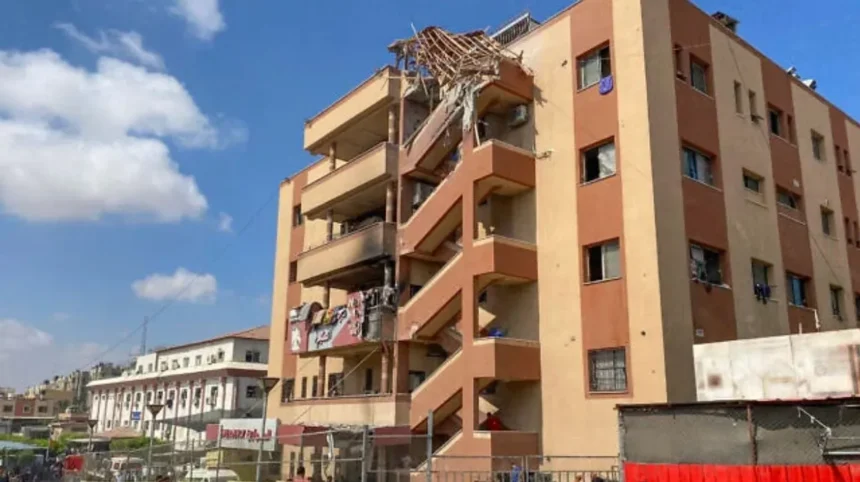
The Israeli military has alleged that Hamas used Nasser Hospital in southern Gaza as a headquarters for senior operatives. According to The Times of Israel, the allegation came shortly after Doctors Without Borders announced it was suspending nonessential medical activities at the facility due to the presence of armed men.
As reported by The Times of Israel, the Israel Defense Forces (IDF) said it has intelligence indicating that Hamas operatives were using the hospital site as a command location. In an English-language statement, the military reiterated long-standing concerns about what it describes as the “cynical use” of medical and humanitarian infrastructure by armed groups in Gaza.
The hospital, located in Khan Younis in southern Gaza, has been one of the main remaining functioning medical centers in the area during the ongoing conflict. According to The Times of Israel, Doctors Without Borders, also known as Médecins Sans Frontières (MSF), said it pulled or halted nonessential staff and services after reporting the presence of armed men at the hospital.
The IDF framed the MSF decision as significant in light of its previous warnings. The Times of Israel reports that the military called the move “an important decision, but one that comes too late,” arguing that it reinforces its position regarding Hamas’s alleged use of civilian and medical sites for military purposes.
The latest statement from the IDF is part of a broader pattern of accusations against Hamas regarding its use of hospitals and other protected facilities. According to The Times of Israel, the army said it and the wider defense establishment have for more than two years been warning about armed groups in Gaza using hospitals and humanitarian shelters as cover for their activities.
What reactions and context surround the hospital and Hamas allegations?
The announcement by Doctors Without Borders that it was suspending nonessential activities at Nasser Hospital drew attention because the organization has been one of the main international medical actors operating in Gaza during the conflict. According to The Times of Israel, MSF said the decision was driven by security concerns arising from the presence of armed men on the hospital premises.
The IDF quickly linked MSF’s move to its long-stated concerns over the militarization of medical facilities. As reported by The Times of Israel, the military said the suspension of services by MSF serves as further evidence of the risks posed by what it describes as Hamas’s use of hospitals as shields for its operations.
In its English-language statement, the IDF highlighted that it had previously warned about hospitals and humanitarian shelters being exploited by terrorist organizations in Gaza. According to The Times of Israel, the military said this practice turns patients, medical staff, and displaced civilians into human shields and complicates efforts to differentiate between military and civilian sites.
Doctors Without Borders has historically emphasized the neutrality of medical facilities and the need to protect them under international humanitarian law. While the brief report cited by The Times of Israel focuses on the presence of armed men and the suspension of nonessential services, it underlines the challenges humanitarian organizations face when operating in conflict zones where military and civilian infrastructures may overlap or be contested.
The timing of the IDF statement following MSF’s partial withdrawal of staff from Nasser Hospital underscores how developments on the ground can quickly feed into wider narratives about the conduct of parties to the conflict. According to The Times of Israel, the IDF argued that the situation at Nasser Hospital strengthens its case for the disarmament of Hamas, which Israel designates as a terrorist organization.
Supporting details and additional reporting
The brief report from The Times of Israel outlines the core elements of the IDF’s position but does not provide detailed intelligence or visual evidence in the excerpt cited. According to the outlet’s summary of the army’s statement, the IDF maintains that it has “intel proving” Hamas used Nasser Hospital as a headquarters for senior figures, without elaborating in that segment on the nature or sources of the intelligence.
The Israeli military’s statement fits within a broader pattern of claims that Hamas embeds its infrastructure within civilian areas, including hospitals, schools, and UN facilities. The Times of Israel notes that the army has, “for over two years,” publicly warned about such alleged practices, arguing that they are intended to shield fighters and command centers from attack by exploiting the protections afforded to medical and humanitarian sites.
Doctors Without Borders’ decision to suspend nonessential activities, as reported by The Times of Israel, indicates that the organization assessed the security environment at Nasser Hospital as no longer compatible with its normal operations. While the specific details of the armed presence are not expanded upon in the brief, the move reflects MSF’s operational protocols, which require a minimum level of safety and neutrality for staff and patients.
The IDF’s description of MSF’s step as “an important decision, but one that comes too late” signals its view that international actors should act earlier when signs emerge that armed groups may be present in protected facilities. According to The Times of Israel, the military presented this event as supporting its longstanding calls for the disarmament of Hamas, linking the situation at Nasser Hospital to wider security concerns.
This development also highlights the pressure on Gaza’s healthcare system, which has faced repeated strikes, access issues, and resource shortages during the conflict. While the report from The Times of Israel limits itself to the specific case of Nasser Hospital and the competing claims surrounding it, the suspension of medical activities at a major facility inevitably carries consequences for civilians seeking treatment.
What are the implications and possible future developments?
The IDF’s allegation that Hamas used Nasser Hospital as a headquarters, combined with Doctors Without Borders’ partial suspension of activities, is likely to intensify international scrutiny of how medical facilities are being used and protected in Gaza. According to The Times of Israel, the Israeli military has framed the episode as further justification for its insistence on disarming Hamas and preventing the use of civilian infrastructure for military purposes.
If additional details or evidence are released by the IDF, they could shape diplomatic discussions over the conduct of hostilities, the responsibilities of armed groups, and the obligations of states under international humanitarian law. The brief report notes the military’s reliance on “intel” but does not elaborate; any future disclosures would be examined closely by international organizations, governments, and legal experts.
For humanitarian organizations such as Doctors Without Borders, the situation at Nasser Hospital may influence how and where they can operate safely in Gaza. According to The Times of Israel’s account, the decision to suspend nonessential activities reflects the risks posed by the presence of armed men in a medical facility. Similar security assessments at other hospitals or clinics could lead to further reductions in services, affecting access to care for civilians.
The Israeli military’s statement that this episode reinforces the need to disarm Hamas suggests that it may be used in future policy arguments and public messaging. As reported by The Times of Israel, the IDF has presented the alleged use of hospitals as command centers as a central reason why it views Hamas as a threat that must be neutralized. How this narrative evolves may influence debates over ceasefires, post-conflict arrangements, and international oversight mechanisms.
At the same time, conditions in Gaza’s medical system will remain a critical indicator of the humanitarian situation. Any prolonged disruption at Nasser Hospital, as implied by the suspension of some MSF activities, could have a tangible impact on patient care. While the brief report does not project specific scenarios, it underscores that security developments and military allegations can have immediate consequences for health services and the civilian population.
The latest claims by the Israeli military about Hamas’s alleged use of Nasser Hospital in southern Gaza as a headquarters come at a moment when humanitarian operations there are already under severe strain. According to The Times of Israel, the IDF has asserted that it possesses intelligence proving the facility served as a command site, while Doctors Without Borders has suspended nonessential medical activities due to the presence of armed men. The episode reinforces long-standing Israeli allegations that Hamas embeds itself in civilian and medical infrastructure, and it has been cited by the IDF as further evidence supporting its call for the group’s disarmament. At the same time, the partial withdrawal of MSF services at a key hospital highlights the immediate humanitarian impact when medical facilities become entangled in security and military disputes, with consequences likely to be felt by patients and health workers across the area.