

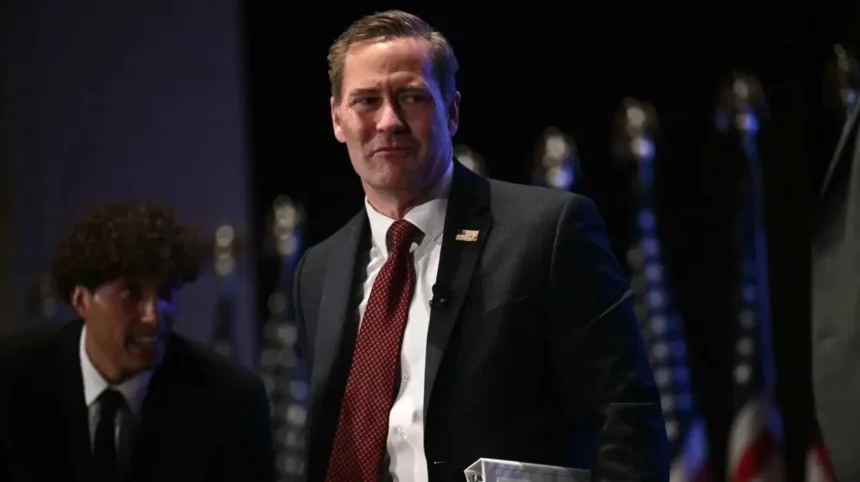
The US Permanent Representative to the United Nations, Michael Waltz, has said the newly established Board of Peace remains primarily focused on Gaza but is flexible enough to address other conflicts around the world. As reported by Shafaq News, Waltz described the body as “currently fully focused on the situation in Gaza” while stressing that its structure allows it to “resolve other global issues” if member states decide to expand its agenda.
According to Shafaq News, Waltz spoke in New York and framed the Board of Peace as part of President Donald Trump’s effort to stabilize a series of crises that have unfolded over the past 18 months, including the wars in Gaza and Ukraine, tensions with Iran, Houthi attacks in the Red Sea, and migration pressures in South America. He argued that the administration is seeking to “return the world from the brink” and reaffirm US support for multilateral institutions and international stability, even as it promotes new formats like the Board of Peace.
The Board of Peace was created as an international framework to oversee the ceasefire and reconstruction process in the Gaza Strip after months of war between Israel and Hamas. According to CNN, the United Nations Security Council endorsed the Board in a resolution last year, with its initial mandate centered on managing the Gaza reconstruction process and implementing elements of the ceasefire agreement. Trump signed the Board’s founding charter in January during meetings on the sidelines of the World Economic Forum in Davos, formalizing its structure and leadership.
As reported by Shafaq News, Trump presented the Board as a platform aimed at “advancing peace and preventing future conflicts,” positioning it as a vehicle for postwar governance and economic recovery in Gaza. He said dozens of world leaders had been invited to join, indicating the body is intended as a broad coalition rather than a narrowly US–Israeli initiative. CNN has noted that the White House later unveiled a founding Executive Board that includes senior US officials and international figures.
According to CNN’s reporting on the charter, Trump will serve as chairman of the Board of Peace for an indefinite period, with his tenure ending only through voluntary resignation or a unanimous vote of the Executive Board declaring incapacity. A future US president will be able to appoint or designate another US representative to sit on the Board alongside Trump, underscoring Washington’s central role in the new body.
The Board’s initial focus is the reconstruction of Gaza and implementation of the ceasefire arrangements, but several accounts indicate its mandate has already broadened. CNBC reported that under the vision set out at Davos and codified in the charter, the Board of Peace has been given authority “to address conflicts everywhere, not just in Gaza,” extending well beyond the scope envisaged in the UN Security Council resolution that originally endorsed it.
How Is the Board Structured and Who Is Involved?
According to CNN, the White House announced a “founding Executive Board” that includes senior US officials and prominent international figures, reflecting the political and financial weight behind the new structure. CNN’s reporting notes that the Executive Board comprises figures such as US Secretary of State Marco Rubio, special envoy Steve Witkoff, and former UK Prime Minister Tony Blair, among others.
The Board’s membership model is also designed to draw significant financial commitments from states seeking a long-term role. CNN reported that members serve three‑year terms and that countries wanting a permanent seat must make a contribution of around 1 billion dollars, though US officials stressed this is not a formal entry fee and does not constitute a binding funding obligation for each state. Instead, it is described as a benchmark for “significant contributions” for countries that wish to remain closely involved in projects and governance.
CNBC’s coverage indicates that 23 heads of state signed the US‑drafted charter in Davos, with four more joining later, highlighting an effort to give the Board broad international backing beyond the immediate parties to the Gaza conflict. The United Nations Security Council’s earlier endorsement of the concept provided formal multilateral backing, but much of the Board’s operational power and funding is expected to come from participating states and donors.
Although Israel did not have a representative at the Davos signing, CNBC reported that Israeli Prime Minister Benjamin Netanyahu is expected to take part in the Board’s work. Mohammed Mustafa, Prime Minister of the Palestinian National Authority, told journalists he hopes to cooperate with the Board and its committees to ensure effective reconstruction and governance efforts in Gaza, emphasizing the need for practical results on the ground.
In a separate speech transcribed by Rev, a senior Palestinian official involved in Gaza’s interim administration said that the success of the current transition depends on delivering “real tangible improvements” in daily life for Gazans, including restoring order, rebuilding institutions, and creating opportunities under the principle of “one authority, one law and one weapon.” He linked the Board of Peace’s work to broader efforts to consolidate governance and avoid competing armed structures in the territory.
What Reactions and Concerns Has the Initiative Drawn?
Reactions to the Board of Peace have ranged from cautious support to skepticism about its broader ambitions. According to CNN, analysts and diplomats have warned that any attempt to position the Board as an alternative to the United Nations in conflict resolution would likely face resistance from many member states. One US‑based expert told CNN that whether the Board acquires a future as a wider conflict‑resolution mechanism will depend on what it “can accomplish in Gaza.”
The International Crisis Group, in an analysis of the Davos initiative, argued that the White House has attached “grander plans” to the Board than originally envisioned in the UN resolution. As reported by the Crisis Group, the charter unveiled in Switzerland explicitly gives the Board a mandate to “address conflicts everywhere,” highlighting the administration’s desire to build a standing mechanism for crisis management that can be deployed beyond Gaza.
Supporters of the initiative point to the possibility of faster decision‑making and targeted funding compared with traditional multilateral forums. According to CNBC, the Board’s design is meant to leverage the political capital of its founding members, many of whom have extensive experience in diplomacy, economic policy, and post‑conflict reconstruction. Advocates argue that this concentration of influence could help unblock stalled negotiations and accelerate recovery projects in Gaza.
At the same time, some observers have raised questions about representation, transparency, and accountability. CNN’s reporting notes concern among UN diplomats that the Board’s structure — with a powerful Executive Board, significant financial thresholds for permanent seats, and an indefinite chairmanship for the US president — could create perceptions of a parallel architecture dominated by a small group of wealthy states. Critics worry that this might weaken existing institutions rather than reinforce them.
Regional actors have also responded with caution. CNBC reported that Palestinian leaders have publicly welcomed cooperation with the Board while insisting that reconstruction efforts and governance reforms must ultimately serve Palestinian self‑determination rather than entrenching external control. Israel has not yet articulated a detailed position on the Board’s long‑term role, but Israeli officials have emphasized the primacy of security considerations in any postwar arrangement in Gaza.
Supporting Details: Ceasefire Oversight and Reconstruction Challenges
The Board of Peace has emerged as Gaza navigates a fragile ceasefire and an extensive reconstruction agenda. US special envoy Steve Witkoff has previously outlined elements of a ceasefire‑hostage framework in public interviews, describing arrangements that would trade partial hostage releases for temporary truces leading to broader negotiations on ending the war. While those talks pre‑dated the formal launch of the Board, they illustrate the diplomatic environment in which the new body will operate.
According to Shafaq News, Waltz characterized the Board as an instrument for keeping the Gaza ceasefire on track and coordinating international assistance. He linked it to the administration’s broader goal of supporting the global order in the way he said the United States has done since the end of World War II, but with a renewed emphasis on “getting the United Nations back to basics.”
The Board’s work will intersect with longstanding debates over Gaza’s political future. The Rev transcript of Trump’s Board of Peace charter ceremony includes remarks by a Palestinian official stressing the need for consolidated security structures and effective governance under a single authority. That approach aligns with international calls to avoid a fragmented security landscape, which many analysts see as contributing to previous cycles of violence in the territory.
International Crisis Group’s analysis underscores that the Board will confront significant political and logistical obstacles when it convenes in Washington and other capitals. According to the group, the Board must translate political commitments into concrete projects such as rebuilding critical infrastructure, restoring basic services, and enabling private investment in Gaza’s economy, all while coordinating with existing UN agencies and humanitarian organizations on the ground.
In parallel, regional actors including Egypt and Qatar have continued to play a role in ceasefire mediation and border arrangements. An AAP News report noted that US envoys and Israeli leaders have been pressed to move Gaza’s ceasefire into subsequent phases, including opening crossings like Rafah and addressing security concerns tied to demilitarization. These ongoing talks will likely shape the operational environment for the Board’s efforts in Gaza.
What Are the Implications and Possible Next Steps?
The US envoy’s remarks that the Board of Peace is “open to addressing other global challenges” point to a potentially significant shift in how Washington and its partners approach conflict management. As reported by TASS, Waltz said the Board is “flexible enough” to deal with issues beyond Gaza, even though its “priority” remains the situation in the Strip. That framing suggests the body could evolve into a standing mechanism for responding to crises in other regions if members agree.
International Crisis Group has highlighted that any expansion of the Board’s mandate will hinge on its initial record in Gaza. According to the group’s assessment, success will likely be measured by the stability of the ceasefire, the pace and inclusiveness of reconstruction, and the extent to which governance reforms reduce the risk of renewed large‑scale violence. A failure to deliver early results, the group warned, could undercut the Board’s credibility and dampen support for using it in other conflicts.
CNN’s reporting also stresses that the Board’s future as a global conflict‑resolution mechanism is uncertain and dependent on its performance. Diplomats quoted in the coverage argue that if the Board is perceived as duplicating or undermining the UN, many states may resist expanding its role, whereas tangible improvements in Gaza could persuade skeptical governments to see it as a complementary tool.
Upcoming meetings in Washington and at the UN will provide early tests of the Board’s operational capacity. According to the Crisis Group, when the Board convenes in Washington, it is expected to review progress on Gaza reconstruction, set funding priorities, and refine its working methods for engaging with regional actors and multilateral agencies. Those decisions will shape how quickly projects move from pledges to implementation on the ground.
For now, US officials are emphasizing a dual message: that the Board of Peace is first and foremost a mechanism to stabilize Gaza and support its recovery, and that its design allows for a broader remit if the international community decides to employ it elsewhere. The extent to which that potential is realized will depend on developments in Gaza over the coming months and on how states balance their support for the new body with their commitments to existing international institutions.
The US envoy’s comments therefore capture both the immediate and longer‑term stakes of the initiative. In the short term, the Board’s success will be judged on its ability to uphold the Gaza ceasefire, coordinate reconstruction, and support credible governance structures. Over time, its performance in Gaza may determine whether it remains a conflict‑specific framework or evolves into a more widely used instrument for addressing crises beyond the Strip.