


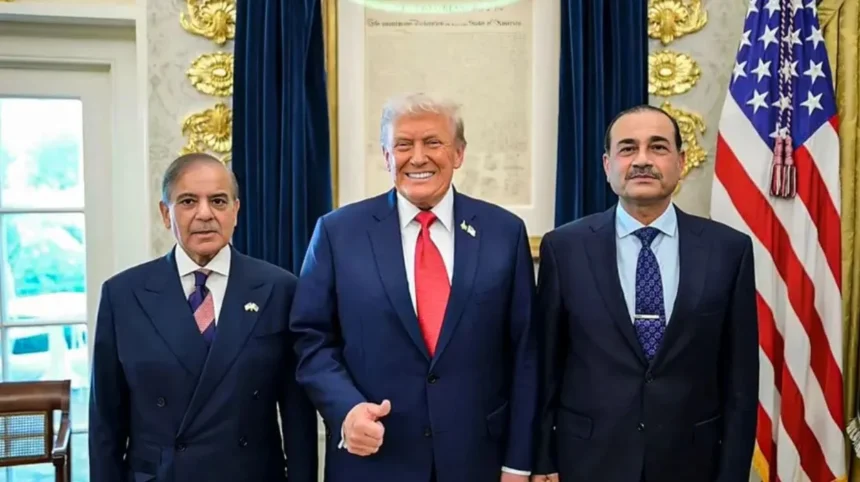
Pakistan has confirmed that Prime Minister Shehbaz Sharif will travel to Washington, DC, to attend the first meeting of the Gaza-focused Board of Peace later this month. According to reporting by Deccan Herald, the gathering will take place in the US capital and will center on Gaza, including issues related to Palestinian statehood and reconstruction.
At a weekly press briefing in Islamabad, Foreign Office spokesperson Tahir Andrabi said the prime minister had accepted the invitation to attend the meeting. As reported by Deccan Herald, Andrabi added that the exact composition of Sharif’s delegation was still being finalized.
According to Reuters, Andrabi told reporters that Sharif would be present at the upcoming Board of Peace session scheduled for next week in Washington. Reuters also reported that Pakistan’s foreign minister, Ishaq Dar, will accompany the prime minister for the meeting.
Arab News has similarly reported that Pakistan views the meeting as part of a broader Islamic diplomatic effort focused on the Gaza Strip. According to Arab News, the session is planned for February 19 and is positioned within a joint initiative in which several Muslim-majority states are expected to participate.
General context on the Board of Peace and Gaza initiative
The Board of Peace is a newly created body linked to United States President Donald Trump’s Gaza initiative. According to Reuters, the board was established under Trump’s plan as a mechanism to oversee interim governance arrangements in Gaza.
Arab News has reported that the Board of Peace and countries cooperating with it were authorized by a United Nations Security Council resolution adopted in mid-November. The resolution enables the creation of an international stabilization force in Gaza, where a ceasefire framework has been in place under the Trump plan.
As reported by Arab News, the Trump initiative envisages multiple phases, with an initial focus on halting hostilities, increasing humanitarian assistance, and addressing hostages and detainees. Later phases are expected to concentrate on governance reforms, demilitarization measures, and early steps in reconstruction.
International Crisis Group has described the Board of Peace as entering Gaza at a particularly complex moment, following a first phase that aimed to consolidate a ceasefire and scale up aid deliveries. According to analysis cited by International Crisis Group, the second phase is expected to address questions of local administration, security arrangements, and the longer-term rebuilding of the territory.
What is Pakistan’s stated objective in joining the Gaza peace board?
Pakistan’s public messaging frames its participation as support for international efforts to stabilize Gaza and move toward a political settlement. In a press remark published by Pakistan’s Ministry of Foreign Affairs, spokesperson Tahir Andrabi said the prime minister had received an invitation from the US president to join the Board of Peace on Gaza and that Pakistan would remain engaged with international efforts for peace and security in Gaza in line with UN resolutions.
Arab News has reported that Islamabad sees the meeting as part of a “joint Islamic diplomatic initiative” on Gaza, suggesting coordination with other Muslim-majority countries also represented on the Board of Peace. The outlet notes that the Washington gathering is expected to focus on Gaza’s reconstruction as well as broader political issues.
Coverage in Dawn has highlighted that Andrabi’s confirmation followed earlier reports indicating that Sharif was likely to visit Washington on February 18 and attend the inaugural Board of Peace meeting on February 19. According to Dawn, the session is slated to take place at the US Institute of Peace, underscoring the formal diplomatic and multilateral setting of the talks.
In public comments amplified on official channels, Andrabi has stated that Pakistan’s “basic objective” in engaging with the Board of Peace is to help consolidate and sustain the ceasefire in Gaza and support steps that lead toward a durable solution of the Palestinian question. Those remarks align with Pakistan’s long-standing official position backing Palestinian statehood based on internationally recognized parameters.
How are other actors and observers viewing the Board of Peace?
The Board of Peace has drawn mixed reactions from analysts and rights advocates, reflecting broader divides over external involvement in Gaza’s governance. According to International Crisis Group, one of the central tests for the board will be whether it can advance what the Trump plan describes as “phase two” of the process, which includes governance, demilitarization, and reconstruction.
Dawn has reported that critics, including some human rights advocates and academics, have questioned the board’s design and mandate. According to Dawn’s coverage, these critics argue that a US-led body managing aspects of Gaza’s governance risks resembling a “colonial” arrangement, particularly in the absence of direct Palestinian representation at the core decision-making level.
Al Jazeera, citing a report by the news site Axios, has noted that the inaugural meeting in Washington is also expected to serve as a fundraising platform for Gaza’s reconstruction. The report, as summarized by Al Jazeera, indicates that the event is scheduled for February 19 but that plans remain subject to change.
Axios, as referenced by Al Jazeera’s coverage, also reported that the Washington meeting is timed to follow a visit by Israeli Prime Minister Benjamin Netanyahu to the White House. If Netanyahu were to attend the Board of Peace gathering, Al Jazeera notes, it would mark his first encounter with several Arab and Muslim leaders since the start of Israel’s major military operations in Gaza in October 2023.
International Crisis Group has further observed that some of the states that signed on to the Board of Peace charter, particularly from the Middle East, see the body as a vehicle to press for a “just and lasting peace” grounded in Palestinian self-determination and statehood under international law. The organization has suggested that these countries may judge the board’s success largely by its performance in advancing the second phase of the Trump plan.
Supporting details and broader diplomatic context
The Board of Peace has been formalized through a charter signed at a high-profile international gathering. International Crisis Group has reported that the United States unveiled an expanded vision for the board at the World Economic Forum meeting in Davos, where 23 heads of state signed a US-drafted charter in January and several more joined later.
According to International Crisis Group’s account, the charter extends the board’s role beyond Gaza, giving it a mandate to work on conflicts globally. This broader framing suggests that while Gaza remains the immediate focus, Washington and participating states may seek to use the board as a platform for addressing other crises over time.
Arab News reports that the Gaza Board of Peace meeting in Washington is designed to build on a fragile ceasefire that took hold in the enclave under the Trump initiative’s first phase. The outlet notes that the board’s work is tied both to stabilizing the situation on the ground and to mobilizing resources for reconstruction.
Dawn has underlined that Pakistan’s decision to attend comes amid ongoing international debates over the balance between humanitarian and political tracks in Gaza. According to Dawn’s reporting, Islamabad’s participation places it among a group of states that have endorsed the Trump initiative in the UN Security Council context, while also voicing support for Palestinian statehood and emphasizing adherence to international law.
From Pakistan’s side, official statements maintain that engagement with the Board of Peace does not change its longstanding diplomatic posture on Palestine. The Foreign Office’s public remarks refer to UN resolutions and the pursuit of a “lasting solution” to the Palestinian question as core guiding principles, indicating that Islamabad sees its role as consistent with its prior votes in multilateral forums.
What are the implications and possible next steps?
The Washington meeting is expected to clarify how the Board of Peace will operate in practice and what role participating countries, including Pakistan, will play in Gaza-related decisions. Reuters has reported that the February 19 gathering is the board’s first formal session, making it a key moment for setting priorities and procedures.
If the meeting proceeds as reported by Arab News and Al Jazeera, participants are likely to discuss both immediate stabilization and longer-term reconstruction priorities for Gaza. According to Al Jazeera’s summary of the Axios report, the event is also envisioned as a fundraising platform, suggesting that financial commitments and pledges may be part of the agenda.
International Crisis Group has argued that the board’s effectiveness will be measured against concrete progress in advancing the second phase of the Trump plan. That includes the establishment of agreed governance arrangements in Gaza, demilitarization steps, and visible movement on rebuilding essential infrastructure and services.
For Pakistan, Dawn notes that participation in the Board of Peace could reinforce its position as an active player in multilateral diplomacy on Palestine. The paper indicates that Islamabad’s involvement aligns with its declared support for a two-state solution and with its efforts to coordinate with other Muslim-majority nations on regional crises.
Future developments will depend on decisions taken at the Washington session and on how key regional actors respond to the board’s proposals. Dawn has stated that further official updates on Pakistan’s role and on subsequent Board of Peace activities are expected as plans evolve and follow-up meetings or mechanisms are discussed among participating states.
In the immediate term, Pakistan’s confirmation that Prime Minister Shehbaz Sharif will attend the inaugural Board of Peace meeting signals Islamabad’s intention to engage directly in the emerging framework for Gaza. Official statements and media reporting indicate that Pakistan aims to use this platform to back efforts to sustain the ceasefire in Gaza, support reconstruction, and advocate for a political path anchored in Palestinian statehood and UN resolutions.