


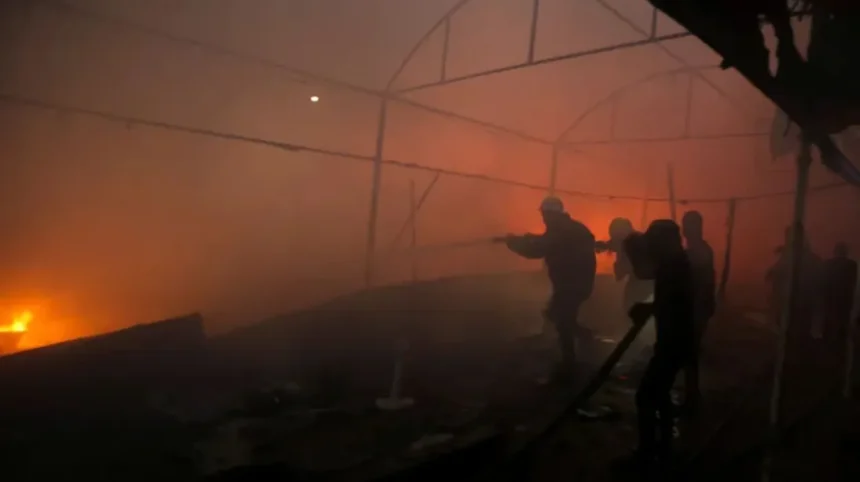
As reported by Al Jazeera on February 10, 2026, an in-depth investigation alleges that Israel used US-supplied thermal and thermobaric munitions in Gaza that effectively “evaporated” thousands of Palestinians, leaving little or no trace of their bodies. The feature details how Gaza’s Civil Defence and medical authorities have documented at least 2,842 people classified as missing after bombardments, in cases where witnesses say victims were present but only blood stains or small tissue fragments were later found. According to Al Jazeera’s investigation, these disappearances are linked to specific high-heat weapons whose blast effects can incinerate human bodies within seconds.
The report explains that these munitions, sometimes described as vacuum or aerosol bombs, can generate fireballs at temperatures exceeding 3,500 degrees Celsius, enough to burn soft tissue to ash. Experts cited in the investigation say that under such conditions, bodies at or near the epicenter of the blast can be reduced to microscopic particles, leaving only traces on surrounding surfaces. The investigation frames these findings in the context of more than 72,000 Palestinians reported killed in Gaza since October 2023, with thousands still unaccounted for.
According to Al Jazeera, the findings are based on months of field documentation, including visits to strike sites, analysis of bomb fragments, and interviews with survivors, civil defense teams, medics, and weapons experts. Gaza Civil Defence responders describe repeatedly arriving at homes, shelters, or schools where multiple people had taken refuge, only to recover a fraction of the expected bodies. In many such cases, responders say they found only partial remains, such as a scalp or pieces of bone, alongside blast damage consistent with high‑temperature explosions.
What Reactions and Testimonies Does the Investigation Highlight?
The Al Jazeera feature presents testimony from families who say their relatives “disappeared” after Israeli strikes. One father, identified as Badran, recounts searching repeatedly for his children after their home was bombed, saying that four of them “just evaporated” and that not a single piece of their bodies could be found. Such testimonies are used to illustrate the human toll of weapon effects that leave families without remains to bury and without closure.
Civil Defence officials describe similar scenes across Gaza. Mahmoud Basal, spokesperson for Gaza’s Civil Defence, is quoted as saying that teams often arrive at a targeted building knowing that a specific number of people were inside, but recover only a portion of the bodies. He describes cases where, out of five known occupants, only three bodies are recovered while the others appear to have “vanished,” with only blood or tissue traces left behind on walls or rubble. These accounts underpin the claim that thousands of people are missing because their bodies were destroyed beyond recognition.
The investigation also includes reactions from legal and human rights experts. International law professor Tariq Shandab is quoted as saying that the international justice system has “failed the test of Gaza,” arguing that ongoing bombardment, siege conditions, and restricted access to food and medicine amount to crimes against humanity. He notes that even after a ceasefire agreement in October, hundreds more Palestinians have been killed, reinforcing calls for accountability and scrutiny of the weapons being used.
Supporting Details and Expert Commentary
The Al Jazeera investigation identifies several specific US-manufactured munitions allegedly used by Israel in strikes where bodies were reported to have disappeared. Among them is the MK-84, a 2,000‑pound unguided bomb filled with tritonal, which weapons experts say can generate heat of around 3,500 degrees Celsius upon detonation. According to experts cited in the report, such temperatures are capable of instantly vaporizing bodily fluids and incinerating soft tissue, leaving only tiny fragments or ash.
Another weapon highlighted is the BLU-109 bunker-buster bomb, which has a hardened steel casing and a delayed fuse that allows it to penetrate structures before exploding. The investigation links this munition to an attack on al-Mawasi, an area Israel had designated a “safe zone” in September 2024, where 22 people were reportedly killed. Experts say the bomb’s explosive mix and detonation pattern can create an intense fireball in confined spaces, incinerating everything nearby while leaving substantial structural damage.
The report also focuses on the GBU-39 small-diameter bomb, a precision glide weapon using AFX‑757 explosive, which was allegedly used in an attack on al-Tabin school. A weapons specialist cited by Al Jazeera explains that the GBU-39 is designed to keep a building’s external structure largely intact while devastating its interior through pressure waves and extreme heat that destroy soft tissue. Gaza Civil Defence teams say they have recovered GBU-39 wing fragments from several sites where bodies were missing, including residential buildings and shelters.
Medical experts interviewed in the investigation attempt to explain the “science of obliteration.” One physician, Munir al-Bursh, describes how exposure to energies above 3,000 degrees Celsius can cause the rapid vaporization of bodily fluids and combustion of tissue. He notes that while water boils at 100 degrees Celsius, temperatures in the thousands, combined with pressure and oxygen, can turn human bodies to ash or dust almost instantaneously, leaving little that is visible to the naked eye.
What Are the Implications and Possible Next Steps?
The Al Jazeera investigation raises questions about potential violations of international humanitarian law and the responsibility of states that supply weapons used in such conditions. By tracing the munitions to US manufacturers, the report highlights the role of arms transfers and the obligations of supplier states to ensure their weapons are not used in ways that may constitute war crimes. Legal experts quoted in related rights reports have argued that systematic use of munitions that cause indiscriminate destruction or disproportionate civilian harm could trigger international investigations.
Rights advocates have previously called for formal inquiries into Israel’s alleged use of banned or controversial weapons in Gaza, including thermobaric and other high‑explosive munitions capable of causing extreme burns and disintegration of bodies. The findings described by Al Jazeera are likely to intensify these demands, particularly from organizations documenting the thousands of Palestinians listed as missing or whose remains are incomplete. Any future international investigation would need to examine bomb fragments, satellite imagery, medical records, and testimony from survivors and first responders.
The investigation also underscores the long-term humanitarian and psychological impact on Gaza’s population. Families who cannot recover or identify the bodies of loved ones face ongoing trauma, while civil and medical authorities struggle to maintain accurate casualty records in the absence of remains. If international mechanisms are activated, next steps could include forensic missions to blast sites, expert assessments of weapon residues, and legal reviews of targeting decisions.
As of now, the Al Jazeera report adds to a growing body of documentation alleging that certain types of high‑temperature weapons have been used in densely populated areas of Gaza with devastating effects on civilians. How governments, international organizations, and courts respond to these findings will shape future debates over arms transfers, battlefield conduct, and accountability for the disappearance of thousands of Palestinians whose bodies, witnesses say, simply “evaporated” in the blasts.