


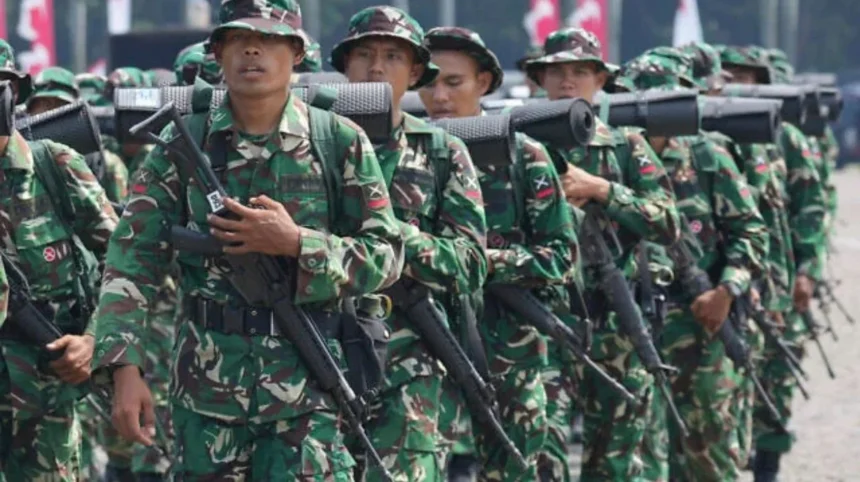
Several thousand Indonesian troops are expected to deploy to southern Gaza as part of an International Stabilization Force in the coming weeks, according to Israel’s Kan public broadcaster, as reported by the Times of Israel. Kan’s report, cited by journalist staff at the outlet, said the Indonesian contingent would be the first foreign force to arrive in Gaza under the new security arrangement.
According to the Times of Israel, the troops are slated to be based in the southeast of Rafah, with offices and living quarters to be built in the designated zone. The report noted there is no fixed date yet for the deployment, and Israel’s Prime Minister’s Office has not publicly commented on the details.
Kan’s account, relayed by regional platforms including SadaNews, said preparations are under way to accommodate what is described as “several thousand” Indonesian soldiers in an area between Rafah and Khan Younis. The area is being readied with residential and operational facilities expected to take several weeks to complete.
The Indonesian troops are expected to serve under the International Stabilization Force, or ISF, which has been envisioned in diplomatic plans for Gaza’s post‑war security. Reporting in outlets such as The National and Stories from Indonesia has described the ISF as a multinational force expected to include contingents from Egypt, Turkey, Azerbaijan, and Indonesia under a UN‑backed mandate.
How Are Officials and the Public Responding?
Indonesian leaders have previously signaled readiness to contribute to such a force. As reported by Anadolu Agency, President Prabowo Subianto told the UN General Assembly that Indonesia was prepared to send up to 20,000 peacekeepers to help secure peace in Gaza or elsewhere in Palestine, contingent on a UN Security Council mandate.
According to Antara News, Indonesia’s military (TNI) has trained thousands of personnel, with an emphasis on medical services and construction engineering units, to support any potential Gaza mission. Officials quoted by Antara said the deployment would require approval from both the Indonesian government and the United Nations before troops could be sent.
Regional reporting also highlights debate over the political and ethical implications of the ISF role in Gaza. An analysis by Middle East Monitor argues that participation in the stabilization force could draw Indonesia into complex dynamics around Gaza’s occupation and post‑war governance, reflecting wider public and expert scrutiny of the proposed mission.
Israeli and regional media suggest the deployment is being closely watched by governments and observers across the Middle East. Coverage in outlets like The National and Kan indicates that Egypt is expected to take a leading role in coordinating the broader stabilization force, underscoring the multinational and politically sensitive nature of the initiative.
Supporting Details and Expert Commentary
According to a report in The Jerusalem Post, Indonesia is expected to be the first country to provide troops under the second phase of the ceasefire framework, contributing to the International Stabilization Force tasked with supervising ceasefire lines and related security arrangements. The Post notes that Indonesian soldiers are likely to mobilize near Khan Younis and Rafah in southern Gaza.
The National reported that the ISF is envisioned as a roughly 4,000‑strong deployment drawn from Egypt, Azerbaijan, Turkey, and Indonesia, with Egypt expected to lead the force under a UN Security Council resolution. Sources cited by The National said the ISF would initially focus on limited areas and expand as Israeli forces withdraw under the agreed plan.
Stories from Indonesia, citing Indonesian foreign ministry officials, reported that Jakarta’s participation is being prepared in line with President Prabowo’s pledges at the UN, and that coordination with international partners is under way. The outlet noted that the force is expected to work alongside several thousand Palestinian personnel appointed by the Palestinian Authority, who would handle intelligence and preventive security in Gaza.
SadaNews, translating Kan’s Hebrew‑language report, added that discussions are already under way with Jakarta over finalizing the deployment, though no precise timetable has been confirmed. Its account stressed that construction of residential buildings and support facilities in southern Gaza would be necessary before the Indonesian troops could fully deploy.
What Are the Implications and Next Steps?
If confirmed and completed, the Indonesian deployment would mark the first large foreign military presence in Gaza as part of the post‑war stabilization plan. As outlined in reports by The National and The Jerusalem Post, the ISF’s mandate is expected to focus on supervising ceasefire lines, supporting local security structures, and helping create conditions for longer‑term reconstruction.
Indonesian officials have emphasized that any mission would prioritize health, humanitarian, and infrastructure roles. Statements reported by Antara and Reuters indicate that training for medical support, engineering, and peacekeeping tasks is already under way, suggesting that Indonesia aims to frame its involvement around civilian protection and rebuilding efforts.
Diplomatically, the move could deepen Indonesia’s role in Middle East peace efforts while testing its ability to operate in a highly sensitive conflict zone. Analysts quoted in regional outlets point out that the effectiveness and perception of the ISF will depend on clear international mandates, coordination with local authorities, and the conduct of participating troops on the ground.
For Gaza, the arrival of Indonesian forces as part of the ISF would coincide with a phased withdrawal of Israeli troops from certain areas, as described in planning documents reported by The National and other media. The coming weeks are expected to clarify the force’s final composition, rules of engagement, and the timeline for Indonesian soldiers to take up positions in southern Gaza.
The emerging plan for Indonesian troop deployment underscores a significant shift toward an international security presence in Gaza’s south, centered around Rafah and Khan Younis. While key details, including the exact start date and final mandate, remain under negotiation, the reported deployment signals an evolving international approach to stabilizing Gaza after years of conflict and recent ceasefire arrangements.