


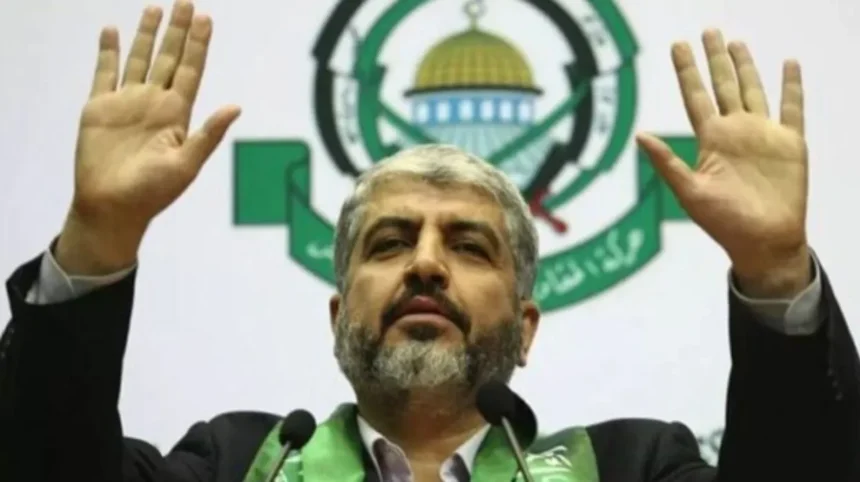
A senior Hamas leader has declared that the group will not surrender its weapons or accept any form of foreign administration in the Gaza Strip, despite international calls for disarmament. The comments come as a multi-phase plan backed by US President Donald Trump moves into a stage that envisions disarming Hamas and withdrawing Israeli forces from Gaza.
As reported by Gazeta Express, Khaled Meshaal, a former head of Hamas’s political bureau who now oversees the group’s diaspora office, spoke at a conference in Doha about the movement’s stance on armed resistance. Meshaal framed Hamas’s arsenal as inseparable from what he described as legitimate resistance to Israeli occupation in the Palestinian territories.
According to the same outlet, Meshaal rejected efforts to “criminalize” Hamas’s weapons and those who use them, arguing they are central to the group’s role in confronting Israel. His remarks underscore the gap between international disarmament expectations and Hamas’s strategic position as Israel and the United States press for a different security arrangement in Gaza.
What has Hamas said about weapons and governance?
At the Doha conference, Meshaal stated that Hamas would not give up its weapons as long as what he called occupation persists, describing resistance as a right of occupied peoples and a source of national pride. He emphasized that attempts to strip the group of its arms are unacceptable from Hamas’s perspective.
Meshaal also addressed the question of who should rule Gaza, insisting that the enclave must remain under Palestinian governance rather than any foreign authority. “Palestinians should be governed by Palestinians. Gaza belongs to the people of Gaza and Palestine. We will not accept foreign rule,” he said, rejecting scenarios that would place Gaza under external control.
While disarmament is treated as a red line, Gazeta Express reported that Hamas has not entirely ruled out the possibility of handing over its weapons to a future Palestinian authority. This nuance suggests that Hamas links any potential change in its military posture to broader political arrangements and recognition of Palestinian self-governance.
Supporting details and international framework
According to Gazeta Express, the current process follows the implementation of a ceasefire on October 10, after which Donald Trump’s plan to end the war between Israel and Hamas entered its second phase in mid-January. This phase reportedly includes provisions for Hamas’s disarmament and the gradual withdrawal of the Israeli army from Gaza.
The same reporting notes that Israeli officials estimate Hamas still has about 20,000 fighters and tens of thousands of weapons in the enclave. These figures highlight the scale of the disarmament challenge embedded in the plan and the extent of Hamas’s armed infrastructure.
Under the proposed framework, governance of Gaza in a transitional period would be assigned to a committee of 15 Palestinian technocrats. This body would operate under the oversight of Donald Trump’s “Peace Council,” an entity designed to supervise political and reconstruction efforts in the territory.
What are the implications and possible next steps?
Meshaal called on the “Peace Council” to adopt what he described as a balanced approach that would facilitate Gaza’s reconstruction and the flow of humanitarian aid. His appeal indicates that Hamas is seeking assurances on reconstruction and relief even as it rejects foreign domination and enforced disarmament.
The refusal to surrender weapons, combined with a hard line against foreign rule, sets up a potential clash between Hamas and the disarmament and governance elements of Trump’s plan. How this tension is resolved will likely shape the pace and extent of Israeli military withdrawal, the effectiveness of any technocratic governing committee, and the broader prospects for stability in Gaza.
In summary, Hamas, through Khaled Meshaal’s remarks, has drawn clear red lines against disarmament and foreign control of Gaza while signaling conditional openness to future arrangements involving a Palestinian authority. The unfolding implementation of Trump’s plan and the response from Hamas and other stakeholders will determine whether these positions can be reconciled in practice.