


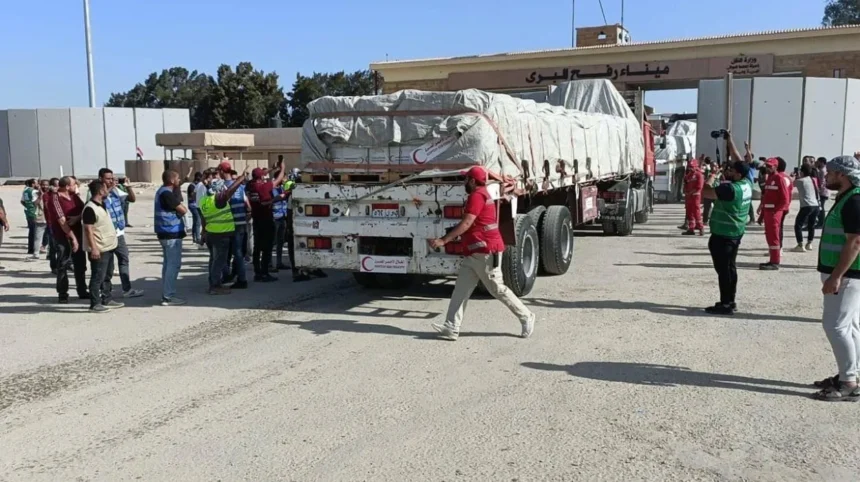
As reported by the Palestinian News and Information Agency (WAFA), the United Nations has warned that opening the Rafah crossing for people alone, without allowing humanitarian aid into the Gaza Strip, does not change the worsening humanitarian reality on the ground. The UN emphasized that ending the deepening catastrophe in Gaza requires the unrestricted opening of all crossings for the delivery of aid.
According to WAFA, the UN underlined that the current approach, which permits limited movement of individuals while keeping large quantities of relief supplies blocked, fails to address the scale of civilian suffering. The situation remains critical despite intermittent adjustments to crossing arrangements.
UNRWA spokesperson Jonathan Fowler said that humanitarian supplies bound for Gaza remain stuck in Egypt and Jordan. He noted that Israel has been blocking the entry of these supplies into the enclave since March 2025, sharply limiting assistance to the population.
Fowler stressed that allowing the passage of people only, while preventing the flow of aid, does nothing to alleviate the severe humanitarian conditions in Gaza. He added that the continued obstruction of relief supplies is one of the main reasons the suffering of civilians continues.
He explained that the humanitarian situation saw only a very limited and marginal improvement during the summer of 2025 compared with the peak of the crisis. Even then, the slight increase in aid and commercial goods was far from compensating for what he described as a man‑made humanitarian disaster and the massive destruction it caused.
What are the reactions and wider context?
According to WAFA’s reporting, Fowler said that children in Gaza continue to suffer from hunger, while medical supplies remain insufficient to meet overwhelming needs in hospitals and clinics. Disease outbreaks persist amid the collapse of water and sewage systems and an acute shortage of shelter materials for displaced families.
Fowler noted that at least 600 aid trucks per day are needed to sustain the population in Gaza. He warned that any figure below that threshold effectively means the continuation of the crisis, especially given restrictions on the type of aid allowed in and the limited operating hours at available crossings.
The UN official highlighted that even during periods when more trucks were permitted to enter, the volume and type of goods fell short of what is needed to support basic living conditions. He pointed out that the combination of physical destruction, service collapse, and ongoing restrictions has prevented any meaningful recovery.
Fowler’s comments reflect broader concerns within the humanitarian community that partial or symbolic measures at crossings, such as opening Rafah to people without cargo, risk masking the depth of the crisis. Humanitarian actors have repeatedly called for full, predictable, and sustained access for aid convoys.
Supporting details and expert concerns
In his remarks, Fowler described the crisis as a man‑made humanitarian disaster, underscoring that the scale of damage and deprivation is the result of deliberate policies and ongoing restrictions. He said that the limited improvements seen in mid‑2025 did not reverse the accumulated impact of months of severe shortages and infrastructure collapse.
He added that the continued ban on the work of the United Nations Relief and Works Agency for Palestine Refugees in the Near East (UNRWA) in Gaza after the ceasefire represents a political choice. According to WAFA, Fowler stressed that this ban targets the largest humanitarian organization operating in the Strip, despite UNRWA’s readiness and long‑standing experience.
Fowler underlined that UNRWA possesses extensive operational capacity to deliver aid at scale if allowed to resume full activities. He argued that sidelining such an organization in a context of acute needs further undermines efforts to stabilize living conditions for civilians.
The UNRWA spokesperson also warned that restrictions imposed on civil society organizations appear aimed at confining humanitarian work to selected actors. He said these actors may be more willing to overlook violations, raising concerns about the erosion of independent humanitarian space.
Fowler stressed that adherence to humanitarian principles must remain non‑negotiable. He specifically referred to the need to respect international humanitarian law as a core condition for credible and effective humanitarian action in Gaza.
What are the implications and future developments?
The UN’s position suggests that, without a significant change in access arrangements, the humanitarian situation in Gaza is likely to remain dire. Fowler’s estimate that at least 600 aid trucks per day are required sets a clear benchmark for any future assessment of whether conditions on the ground are improving.
If current restrictions on aid volumes, types of supplies, and crossing hours persist, humanitarian agencies warn that hunger, disease, and displacement will continue at high levels. The continued blockage of supplies in Egypt and Jordan, as reported by WAFA, indicates that substantial capacity to assist still exists but remains unused.
The ongoing ban on UNRWA’s work in Gaza after the ceasefire raises questions about who will fill the gap in large‑scale service provision and relief. Without a change in policy, many of the core functions UNRWA previously carried out for the population may remain unaddressed.
Fowler’s warning about restrictions on civil society and selective authorization of humanitarian actors also points to potential long‑term implications for accountability and oversight. Humanitarian groups are likely to continue pressing for full access, respect for international humanitarian law, and the reinstatement of established agencies.
Ultimately, the UN’s message is that opening Rafah crossing for people only, without allowing in substantial humanitarian aid, does not alter the fundamental trajectory of the crisis in Gaza. Ending the worsening reality, according to UN officials, will require a comprehensive lifting of restrictions on aid and a restoration of independent humanitarian operations across the Strip.