


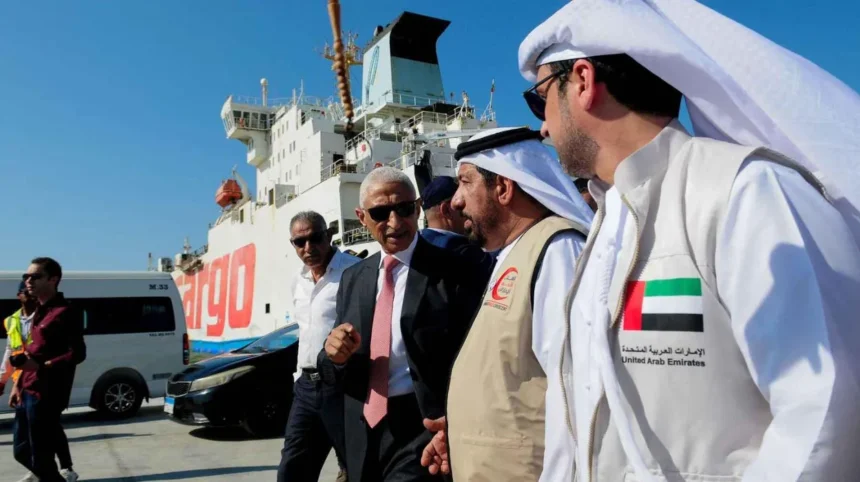
The United Arab Emirates has prepared plans for a major housing compound in southern Gaza aimed at sheltering thousands of displaced Palestinians, positioning itself at the forefront of early reconstruction efforts in the enclave. According to Reuters, planning documents and a map reviewed by the agency show the proposed “UAE Temporary Emirates Housing Complex” in an area of Rafah that is currently under Israeli military control. As reported by Reuters, the compound would be built in a corridor cleared by the Israeli army stretching from the Mediterranean coast toward Rafah, once a city of around 250,000 people that has been heavily damaged and largely depopulated during the war.
According to Reuters, the map indicates that the planned housing site lies close to the so‑called “yellow line,” a demarcation agreed in an October ceasefire that separates zones controlled by Israel from those under Hamas administration. Diplomats familiar with the plans told Reuters that the project is intended as temporary accommodation for displaced civilians rather than a permanent resettlement scheme. In response to questions from Reuters, an Emirati official said the UAE “remains committed to scaling up its humanitarian efforts to support Palestinians in Gaza,” but did not confirm or deny the specific housing proposal.
What reactions and concerns have emerged?
Reactions to the reported plan reflect both hope for improved living conditions and concern over the political and security framework in which the housing would be built. According to Reuters, diplomats briefed on the initiative said it resembles a United States proposal for “planned communities” or “alternative safe communities” in parts of Gaza that remain under Israeli control. These diplomats told Reuters that the Israeli military has already cleared a large area in southern Gaza for temporary housing projects, indicating coordination at a security level, though no public political framework has yet been announced.
As reported by Reuters and summarized by outlets including Daily Sabah and the Jerusalem Post, the proximity of the planned compound to the “yellow line” has raised questions among observers about long‑term access, governance, and security for residents. Diplomats cited by Reuters stressed that any such housing initiative would depend on broader ceasefire arrangements holding and on guarantees for humanitarian access and basic services. Publicly, Emirati officials have framed their Gaza engagement in humanitarian terms, emphasizing relief and reconstruction support without elaborating on the details of this particular project.
Supporting details and wider reconstruction efforts
According to Reuters, the planned UAE complex is envisioned as a large, organized settlement providing basic services to Palestinians who have been displaced multiple times by the conflict. Sources familiar with the project told Reuters that the area identified near Rafah could host thousands of residents once built, though exact capacity figures and timelines have not been formally disclosed. The Jerusalem Post, citing the same planning map seen by Reuters, reported that defense sources believe temporary residential facilities of this type could be operational within several months of a formal green light from Israeli authorities and international partners.
Diplomats quoted by Reuters said the UAE initiative appears to dovetail with a wider international discussion on stabilizing parts of Gaza through controlled, serviced communities that can be supplied and secured. According to Reuters, the plan was presented in international coordinating forums that include the US‑led Civil‑Military Coordination Center, which has been involved in planning humanitarian corridors and potential post‑war arrangements in the territory. While detailed architectural designs and service plans have not been made public, Reuters reporting indicates that the compound is conceived as temporary housing with basic infrastructure rather than full urban reconstruction at this stage.
What are the implications and possible next steps?
The reported UAE housing project highlights how Gulf states and international partners may take an early lead in Gaza’s reconstruction, even as political negotiations over the territory’s future remain unresolved. According to Reuters, the project’s location in an Israeli‑controlled zone and its dependence on security clearances mean progress will hinge on continued coordination with the Israeli military and on the durability of the October ceasefire lines. Diplomats quoted by Reuters suggested that, in a best‑case scenario, the UAE complex could become one of several such sites forming part of an interim stabilization plan for southern Gaza.
However, Reuters reporting also underscores that the initiative remains at a planning stage, with no formal public announcement of construction start dates, funding levels, or management arrangements. Future developments will likely depend on further diplomatic negotiations, including discussions among the UAE, Israel, the United States, and other international donors about governance, security responsibilities, and the rights and movement of Palestinian residents within and beyond the compound. According to Reuters, Emirati officials maintain that their priority is to expand humanitarian support, positioning the UAE as a prominent actor in any emerging framework for Gaza’s reconstruction.
The reporting to date indicates that the UAE is preparing a substantial, structured response to Gaza’s displacement crisis by planning a large housing project in Israeli‑controlled southern Gaza, while key operational and political details remain subject to ongoing negotiations and security assessments.