


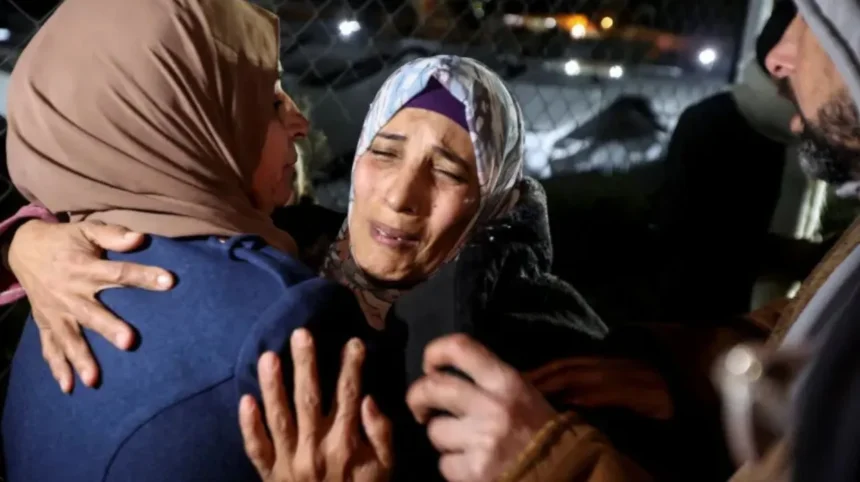
According to Al Jazeera, a third group of Palestinians has returned to the Gaza Strip through the Rafah border crossing with Egypt following its partial reopening under a limited ceasefire arrangement. The group of 25 people arrived in Gaza at about 3am local time after a journey of more than 20 hours from the Egyptian city of El Arish and was taken to Nasser Hospital in Khan Younis for processing and medical checks.
As reported by Al Jazeera, the Rafah crossing, Gaza’s main gateway to Egypt and the outside world, had been largely closed by Israel for most of the war and was reopened this week for restricted two‑way movement as part of a United States-mediated deal. The agreement envisages daily returns of Palestinians who left Gaza during the conflict and the evacuation of patients needing urgent treatment abroad, though current numbers remain far below planned levels.
Al Jazeera reports that, shortly after the latest group of returnees arrived, 13 Palestinian patients were moved by bus from a medical facility in Gaza towards the Rafah crossing, accompanied by family members and World Health Organization officials, to travel for treatment outside the enclave. Palestinian health officials and humanitarian agencies say around 20,000 patients in Gaza are in need of care that is no longer available in the territory’s severely damaged health system.
What are the conditions and reactions around Rafah?
According to Al Jazeera, many of the Palestinians returning through Rafah described a difficult journey marked by extensive Israeli security procedures, including interrogations and searches that they characterized as humiliating and abusive. Returnees interviewed on camera said they were exhausted after long hours of waiting, repeated checks, and transport under strict military control between Egyptian and Israeli authorities before reentering Gaza.
Al Jazeera cites testimonies from earlier groups of returnees, including Palestinian women who said they had their hands bound and eyes covered during security processing and underwent full‑body searches. The International Commission to Support Palestinian Rights has criticized these measures, arguing that Israel is using Rafah more as an instrument of control than as a humanitarian passage for civilians and patients.
In its reporting from Khan Younis, Al Jazeera’s Hani Mahmoud notes that the emotional scenes at the crossing combine relief at returning home with shock at the scale of devastation inside Gaza. One returnee told Reuters, cited by Al Jazeera, that she felt both joy at reuniting with family and sorrow at seeing her homeland in ruins, saying she had never imagined the destruction would be so extensive.
Supporting details and medical evacuations
According to Al Jazeera and previous reports on the reopening of Rafah, Israel and mediators had envisioned that up to 50 patients per day, each accompanied by up to two relatives, would be allowed to leave Gaza for treatment abroad. However, Al Jazeera reports that only about 30 patients have been evacuated in the first days since the partial reopening, well below the stated target and far short of the estimated medical need in the territory.
As reported by Al Jazeera, Mahmoud said that at the current rate it could take years to evacuate all patients needing specialized care, a timeframe he described as unacceptably long for people requiring urgent treatment. The outlet notes that Gaza’s health system has been severely degraded during the conflict, with more than 20 hospitals out of service and large numbers of medical staff killed, according to the Palestinian Ministry of Health.
Al Jazeera’s coverage also places the movement at Rafah against the backdrop of continuing Israeli military operations across the Gaza Strip. On the day before the latest group of returnees arrived, Israeli strikes in several areas, including east of Deir el‑Balah, Khan Younis and Gaza City’s Tuffah neighborhood, killed 23 Palestinians, making it one of the deadliest days since the current ceasefire began.
What are the implications and what happens next?
According to Al Jazeera, the limited reopening of Rafah has left many Palestinians feeling trapped between the need to move for safety or treatment and the reality of strict Israeli controls on who can leave or reenter Gaza. Only Palestinians who left during the war and obtained security clearance are being allowed back, while those seeking to exit for medical care face tight quotas, unpredictable delays, and sudden suspensions of evacuation procedures.
Al Jazeera reports that Israel has, at times, briefly halted coordination for evacuations through Rafah before resuming it, creating further uncertainty for patients and families who receive last‑minute notifications to prepare for travel. Humanitarian organizations warn that, without a more consistent and expanded evacuation mechanism and improved access for aid, thousands of patients will continue to face life‑threatening delays in receiving treatment outside Gaza.
As Al Jazeera notes, continued Israeli air strikes and military operations around southern Gaza complicate both the return of Palestinians through Rafah and the movement of medical convoys to and from the border. Residents interviewed by the outlet say they feel they must choose between remaining near areas of Israeli military presence or moving again within Gaza, risking further displacement amid ongoing attacks.
In sum, the article describes a narrow and tightly controlled reopening of Gaza’s main external crossing that has allowed small numbers of patients and civilians to move, while ongoing Israeli strikes, damaged infrastructure, and strict security procedures continue to limit broader relief for the territory’s besieged population.