


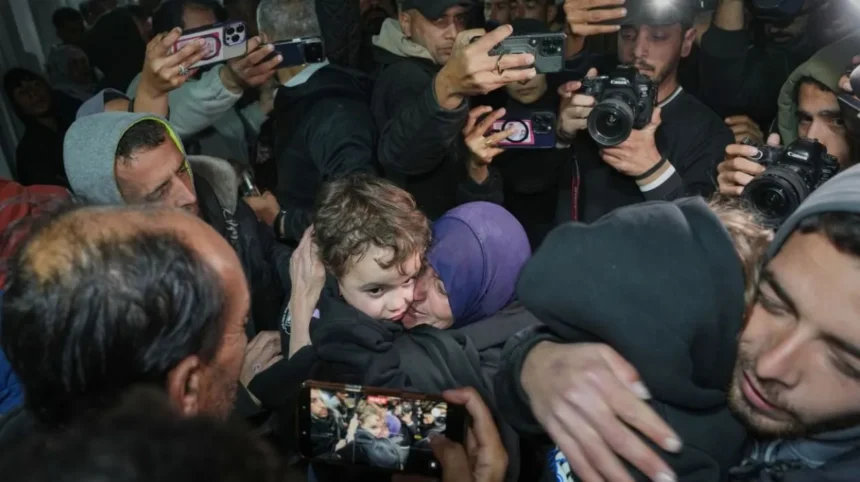
As reported by The Associated Press, Palestinians gathered on both sides of the Rafah border crossing on Tuesday, seeking passage between Gaza and Egypt after a troubled first day of reopening the key gateway. The crossing had been largely closed during months of war, and its limited reopening is tied to the implementation of a fragile, U.S.-backed cease-fire between Israel and Hamas. According to AP, the first day of renewed operations on Monday was marked by long delays and confusion over procedures and lists of those allowed to travel.
AP reported that on the Egyptian side, a group of Palestinian patients who had been treated in Egypt after leaving Gaza earlier in the war arrived at Rafah hoping to return home with their families. On the Gaza side, Palestinians needing medical treatment unavailable in the enclave were transported by bus by the Palestinian Red Crescent, with many waiting for confirmation that they could cross for evacuation. According to AP, officials had initially said that 50 people would be allowed to cross in each direction daily, but the first day fell short of that number.
According to AP, only about a dozen Palestinian returnees and a small group of medical evacuees were ultimately able to cross on Monday after more than 10 hours of delays. The first limited crossings are seen by officials as symbolic steps that do not yet meet the needs of tens of thousands seeking to leave Gaza for treatment or to return home. AP noted that, at this stage, the crossing is open only to people, not goods, leaving Gaza’s wider humanitarian and reconstruction needs unaddressed.
How are Palestinians and officials reacting?
AP reported that the reopening raised hopes among Palestinians, but also frustration over the slow pace and uncertainty over who qualifies to cross. Many of those waiting described long hours with little information and anxiety about whether their names would appear on approved lists. According to AP, the volume of people seeking to cross far exceeds the limited daily slots currently being processed.
One Palestinian woman, Iman Rashwan, told AP she waited for hours in Khan Younis for her mother and sister to return from Egypt, saying she hoped others would soon be reunited with their relatives. “God willing, the crossing will open for everyone, for all the sick and for all the wounded,” she said, adding that people wanted life “to return to normal as they were before the war.” Her comments reflect the broader desire among Gaza residents for more predictable and inclusive access through Rafah.
AP also reported accounts of restrictions on Palestinians crossing back into Gaza, including limits on what they could carry. One returnee, Rotana Al-Regeb, said authorities “didn’t let us cross with anything,” and that travelers were allowed only the clothes they wore and a single bag per person. These accounts highlight how tightly controlled the crossing remains despite its formal reopening.
Supporting details on Rafah and the cease-fire
According to background reporting by AP, Rafah is the main route for Gaza’s residents to reach Egypt and from there the wider world, making it a crucial access point during and after conflict. The crossing’s reopening follows months of appeals from aid organizations and is part of the second phase of a cease-fire arrangement aimed at easing movement for civilians, particularly medical evacuees. Security officials from Egypt and Israel told AP that operations are being carried out under strict regulations with oversight from multiple parties.
AP reported that officials have emphasized the initial nature of the reopening, with only a small, vetted number of Palestinians being allowed to cross each day. Health officials in Gaza have said that about 20,000 Palestinians, including children and adults in need of medical assistance, are hoping to exit through Rafah, while thousands outside Gaza are waiting to return. The limited numbers allowed so far illustrate the gap between expectations and current capacity.
According to AP, no commercial goods are yet permitted through Rafah under the present arrangements, meaning most humanitarian supplies and reconstruction materials must still enter by other routes. The continued restriction on goods keeps pressure on Gaza’s already strained health system and infrastructure despite the cease-fire. Authorities from Israel, Egypt, and international partners are still working out practical mechanisms for scaling up crossings while maintaining security controls, AP reported.
What are the implications and what might happen next?
AP’s reporting indicates that the early days of Rafah’s reopening will serve as a test of whether the cease-fire framework can translate into meaningful relief for Palestinians needing medical care or family reunification. If daily quotas remain low and procedures remain slow, the backlog of people seeking to cross is likely to persist, prolonging hardship for those waiting on both sides. Officials have not announced a firm timeline for when or whether the number of daily crossings will increase.
According to AP, the symbolic nature of the first crossings underscores that broader issues—such as large-scale medical evacuations, returns, and the flow of aid and reconstruction materials—remain unresolved. Any expansion of Rafah operations will depend on ongoing coordination between Egypt, Israel, Palestinian authorities, and international actors overseeing the cease-fire’s implementation. Security and political considerations are expected to shape how quickly and how far the crossing’s capacity can be expanded.
For now, the scene of Palestinians lining up at Rafah after a rocky first day of reopening captures both renewed hope and continued uncertainty. Limited but significant movements through the crossing mark an initial step in reconnecting Gaza’s residents with essential medical care and family members abroad. Whether that step leads to a broader easing of restrictions will depend on future decisions by the parties managing this critical border point.