


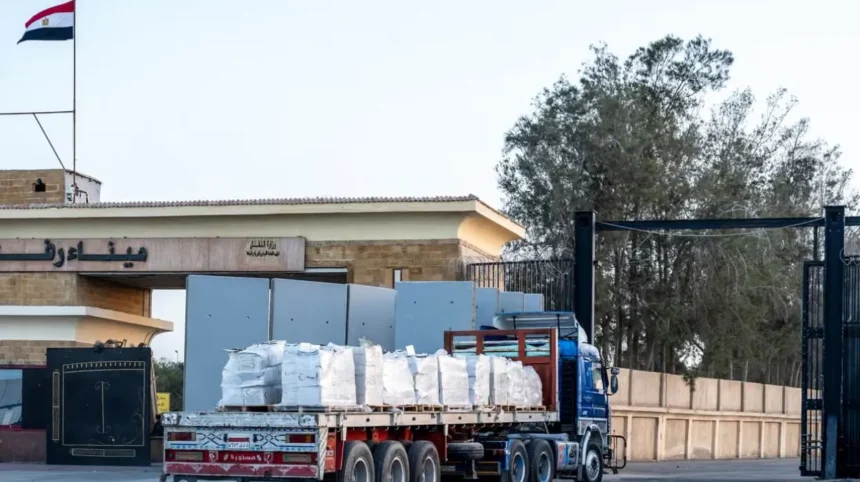
Preparations are under way to fully reopen the Rafah border crossing between Gaza and Egypt after nearly two years of severe restrictions and closure, officials from Israel, Palestinian authorities and international missions have indicated. According to Reuters, the crossing is expected to open for Palestinian foot traffic in both directions as early as Monday, with technical and security arrangements still being finalized by all sides.
As reported by Reuters, the Rafah crossing was for years the main gateway for Gaza’s population to reach the outside world and a critical channel for humanitarian supplies before being largely shut since May 2024 amid the conflict between Israel and Hamas. According to Anadolu Agency, Israel’s decision to reopen the crossing forms part of a ceasefire arrangement that envisages limited movement of people at first, followed by a broader reopening once operational tests are completed.
Israeli authorities said the military body responsible for civilian coordination, COGAT, has notified counterparts that the crossing will be accessible in both directions for Gaza residents, with its operation coordinated with Egypt and the European Union mission that previously helped monitor the site. A European official linked to the EU mission confirmed that preparations for a full resumption of operations are in progress, while Palestinian officials said they anticipate the crossing to open for regular travelers on Monday following a trial phase.
What are the reactions and on-the-ground preparations?
According to Reuters, COGAT stated that “all parties involved are undertaking a series of preliminary arrangements to enhance readiness for its full operation,” adding that the actual movement of residents in both directions will start once those preparations are complete. A European official cited by Reuters verified that the EU mission is involved in these readiness steps, while a Palestinian official said the expectation is for the crossing to begin processing travelers on Monday, though final timing remains contingent on security and technical checks.
As reported by Anadolu Agency, Gaza’s National Committee for the Administration of Gaza has publicly signaled that Rafah would see a limited reopening on Sunday as a trial day, before a planned full opening on Monday. In reporting from other outlets, including CNN and Deutsche Welle, officials described ambulances and security personnel moving through the area and queues forming on the Egyptian side, indicating the start of practical tests of new procedures at the crossing.
Local health authorities have emphasized the urgency of the reopening, noting to Reuters that around 20,000 patients are waiting to leave Gaza for treatment abroad, many of them seriously ill or injured. Officials expect that a significant proportion of those initially crossing will be medical cases and their escorts, though Israel has stressed that only vetted travelers will be allowed to pass under strict security screening.
Supporting details and security framework
According to Reuters, Israel has said Rafah will operate under “rigorous security measures,” allowing Palestinians who wish to exit the enclave and those who left earlier in the conflict to return, subject to coordination with Egyptian and Palestinian authorities. An Israeli defense official told Reuters the crossing could initially handle between 150 and 200 people in both directions per day, with the likelihood that more people will depart than return during the early stages because each patient may be accompanied by relatives or medical escorts.
As reported by Anadolu Agency, Egyptian and Palestinian officials have worked on lists of travelers which are being submitted in advance and reviewed by Israel as part of the screening process. According to Deutsche Welle, COGAT has framed the reopening as part of a broader second phase of a US-brokered ceasefire arrangement between Israel and Hamas, under which movement through Rafah will expand as infrastructure and security checks are deemed sufficient.
Regional media cited by Anadolu Agency report that Gaza’s administrative committee head Ali Shaath has said the decision to proceed with the reopening followed completion of “necessary arrangements” among the parties, including agreements on how the crossing will be managed day to day. Other outlets, including Al Jazeera, have noted that the United Nations and humanitarian organizations have repeatedly called for Rafah’s reopening to ease a severe humanitarian crisis, particularly for displaced civilians needing food, shelter and medical care.
What could the reopening mean in the coming days?
According to Reuters, the reopening of Rafah is a central element of the initial stage of a broader plan backed by the United States that links eased movement for civilians and humanitarian aid to steps aimed at consolidating a fragile ceasefire between Israel and Hamas. Deutsche Welle reports that COGAT has described current activity at Rafah as part of preparations for a “full operation” under the ceasefire’s next phase, suggesting that flows of people could increase once authorities are satisfied with security and logistics.
Al Jazeera and other outlets say humanitarian agencies view any reopening as a critical test of whether the ceasefire can translate into tangible relief for Gaza’s population, which has faced repeated disruptions to aid deliveries and medical evacuations. Officials and diplomats quoted by Reuters and other agencies caution, however, that ongoing violence and political disagreements could still affect how quickly and how widely movement through the crossing expands beyond the initial, tightly controlled phase.
In sum, officials from Israel, Palestinian bodies, Egypt and international partners have confirmed that concrete steps are now under way to resume operations at Rafah for the first time since mid-2024, starting with limited, medically focused movements and scaling up as preparations allow. The timing, scale and durability of that reopening will depend on how security, political and humanitarian considerations evolve over the coming days under the current ceasefire framework.