


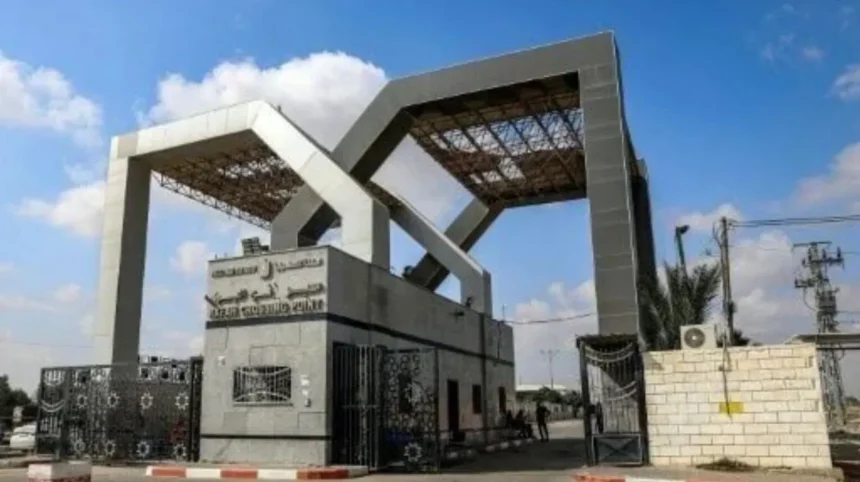
As reported by an Agence France-Presse (AFP) team in Gaza, with Adel Zaanoun in Cairo and Jay Deshmukh in Jerusalem, Israel has begun a partial reopening of the Rafah crossing between the Gaza Strip and Egypt after months of appeals from humanitarian organizations and mediators. According to AFP, Israeli authorities say the move currently applies only to the movement of people and does not include a large-scale resumption of aid deliveries through the crossing.
According to Israel’s Coordinator of Government Activities in the Territories (COGAT), the defence ministry body responsible for Palestinian civilian affairs, Rafah was opened on Sunday for the “limited passage of residents only,” with broader movement of residents in both directions expected to start on Monday. COGAT described the reopening as an “initial pilot phase” coordinated with the European Union and Egypt, with all crossings subject to Israeli security clearance and EU supervision.
As reported by CNN, the partial reopening of Rafah forms part of the first phase of a United States-mediated ceasefire agreement, which links the resumption of controlled movement at the crossing to the return of all Israeli hostages, living and deceased. Israel had previously indicated it would not reopen Rafah until the remains of the last Israeli hostage held in Gaza, Ran Gvili, were recovered; his body was returned and buried in Israel in the days before the announcement.
How are parties reacting to the limited reopening?
According to AFP, Palestinian health authorities in Gaza say around 200 patients are waiting for permission to leave the territory for treatment once the crossing becomes fully operational for passenger traffic. A Palestinian official told AFP, on condition of anonymity, that about 40 Palestinians affiliated with the Palestinian Authority have gathered on the Egyptian side of Rafah, awaiting Israeli authorization to enter Gaza as part of arrangements linked to the ceasefire framework and future administration of the crossing.
As reported by CNN, an Israeli security official said that, under current plans, up to 150 Palestinians per day may be allowed to exit Gaza via Rafah, while about 50 people per day would be allowed to enter, though these figures have not been publicly codified in a final agreement. CNN also notes that the crossing has been largely shut since Israeli forces took control of it in May 2024, making the current step a significant but tightly controlled change in movement for civilians trapped in the enclave.
According to AFP, the Palestinian group Hamas has urged mediators and guarantor states of the ceasefire agreement to closely monitor Israeli actions at Rafah to prevent what it described as the risk of a new siege on Gaza. Humanitarian organizations have long argued that Rafah is a vital gateway not only for patients and other civilians but also for large-scale humanitarian aid, and many groups continue to press for a full reopening that would allow substantial flows of food, fuel, and medical supplies.
Supporting details from officials and agencies
According to AFP and other outlets, COGAT has emphasized that the present stage focuses exclusively on residents’ passage and has not announced any immediate change to the volume of aid entering Gaza through Rafah. COGAT described the current arrangements as part of “preliminary preparations aimed at increasing readiness for full operation of the crossing,” indicating that further steps will depend on security assessments and coordination with Egypt and the European Union monitoring mission.
As reported by CNN, the Rafah reopening is one component of a broader, multi-point ceasefire and hostage-release framework brokered by the United States and other mediators, which envisions phased changes on the ground in Gaza, including governance and security arrangements at key crossings. According to AFP, Israeli forces continue to control more than half of the Gaza Strip, while the remaining areas are under Hamas authority, a situation that shapes how and when any broader opening of Rafah or other crossing points can occur.
What are the implications and possible next steps?
According to AFP, the current “pilot phase” does not yet include a substantial increase in humanitarian aid, leaving many international agencies concerned that Gaza’s deep humanitarian crisis will persist unless Rafah and other crossings are opened more widely to goods. Humanitarian groups have stated that they see the partial reopening as a limited but important test of whether sustained civilian movement and, eventually, larger aid flows can be restored under the ceasefire arrangements.
As reported by CNN, the Rafah move marks the completion of the initial stage of the US-mediated ceasefire plan, with subsequent phases expected to address longer-term issues such as governance in Gaza, reconstruction, and security guarantees for Israel and neighboring states. Future developments at Rafah will depend on the implementation of these phases, the durability of the ceasefire, and ongoing negotiations among Israel, Palestinian actors, Egypt, the European Union and other international stakeholders over how to manage and secure the crossing.
In sum, Israel’s decision to partially reopen Gaza’s Rafah crossing currently allows for limited, security-screened movement of people under international supervision, while leaving the status of large-scale aid deliveries and a full reopening unresolved. The step fulfills one condition of the current ceasefire framework but remains subject to political, security, and humanitarian pressures that will shape how—and whether—the crossing moves from a restricted pilot phase to full operation.