


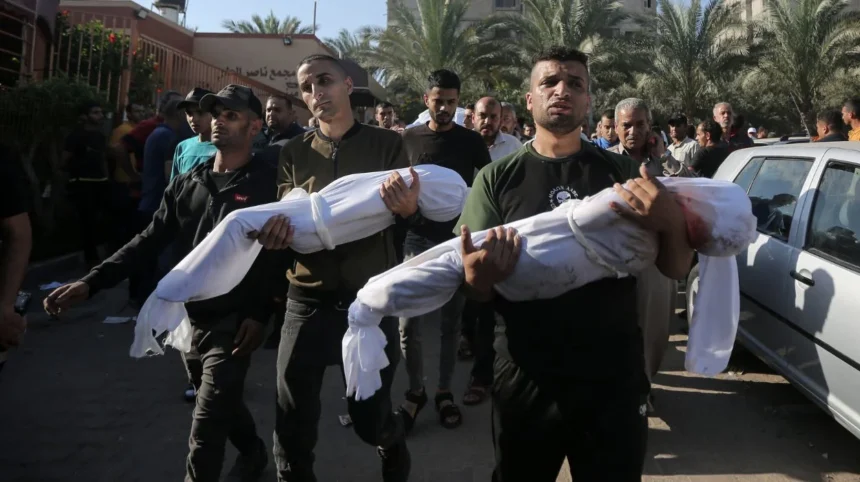
After more than two years of war, the death toll in the Gaza Strip has reached tens of thousands, with local health authorities and international agencies reporting that a large share of those killed are women and children. According to Gaza’s Health Ministry, more than 70,000 people have been killed since the conflict began in October 2023, a figure that has increasingly been acknowledged by Israeli officials and referenced by humanitarian organizations. International monitors say entire neighborhoods have been flattened, essential services have collapsed, and large parts of the enclave remain uninhabitable. The scale of civilian casualties, coupled with mass displacement, has turned Gaza into one of the world’s most severe humanitarian crises.
As reported by journalists at major international outlets, the war was triggered by the Hamas-led attacks on southern Israel on October 7, 2023, which killed about 1,200 people and led to the capture of more than 200 hostages. Israel responded with sustained airstrikes and a ground offensive, saying its objective was to dismantle Hamas and prevent future attacks. Over time, aid agencies and rights groups have expressed concern that the intensity and duration of the campaign have exacted an extraordinary toll on civilians in one of the world’s most densely populated territories. According to the United Nations and other agencies, repeated strikes on residential areas, refugee camps, and public facilities have driven civilian casualties higher and raised questions about compliance with international humanitarian law.
Regional and international diplomacy has struggled to keep pace with developments on the ground. As reported by correspondents covering the United Nations and major capitals, efforts led by the United States, Qatar, and Egypt produced temporary pauses in fighting and limited prisoner–hostage exchanges, but have so far failed to deliver a durable ceasefire. The conflict has also disrupted already fragile Israeli–Palestinian talks and overshadowed other regional initiatives, including normalization efforts between Israel and Arab states. Analysts and diplomats say the mounting civilian death toll has become a central obstacle to any broader political arrangement.
How Are Regional Actors Reacting?
Across the Middle East, governments and populations have reacted strongly to the rising civilian death toll in Gaza, with some leaders warning that continued bloodshed could destabilize the wider region. According to regional media and wire services, large demonstrations have taken place in countries including Jordan, Egypt, Lebanon, Iraq, and Turkey, where protesters have condemned the killing of civilians and demanded stronger action from their governments. In some cases, domestic political opposition has seized on public anger over Gaza to criticize ruling authorities, complicating internal politics in states that maintain security ties or diplomatic relations with Israel.
Arab governments have used regional and international forums to highlight the humanitarian impact of the war. As reported by correspondents covering the Arab League and the Organization of Islamic Cooperation, member states have issued repeated statements calling for an immediate and permanent ceasefire, unimpeded humanitarian access, and renewed efforts toward a two-state solution. Several leaders have warned that images of civilian deaths in Gaza are fueling radicalization and undermining moderates who favor diplomatic engagement. According to diplomatic reporting from United Nations headquarters, Arab and Muslim-majority countries have also pressed for stronger Security Council action, including resolutions demanding a halt to hostilities and protection of civilians.
Reverberations have extended to countries that were exploring or had begun normalizing relations with Israel. According to major international outlets, Saudi Arabia has linked any further progress on normalization to steps toward an independent Palestinian state and an end to large-scale attacks on civilians. Other states that already signed normalization agreements, such as the United Arab Emirates, Bahrain, and Morocco, have faced public pressure and have publicly criticized the humanitarian situation in Gaza while maintaining their diplomatic ties. Analysts quoted by regional and Western media say that civilian deaths have made it more difficult for leaders to justify closer relations with Israel without visible progress on Palestinian rights.
Supporting Details and Expert Commentary
Humanitarian agencies and rights organizations have repeatedly emphasized that civilians in Gaza bear the brunt of the conflict. According to United Nations agencies and international NGOs, hundreds of thousands of people have been displaced multiple times, moving between overcrowded shelters and makeshift camps as front lines shift. Health officials and aid workers say that beyond deaths directly caused by airstrikes and shelling, many civilians are dying from preventable diseases, lack of medical care, and hunger as the health system and basic services collapse. Experts on international law quoted by major media outlets have raised alarm about attacks near hospitals, schools, and UN facilities sheltering displaced civilians.
International legal bodies and monitoring groups have opened or expanded investigations into alleged violations of international humanitarian law. As reported by correspondents covering The Hague, the International Court of Justice has heard arguments related to allegations that Israel’s conduct in Gaza breaches its obligations under the Genocide Convention, while Israel denies such accusations and says it acts within the law while targeting Hamas. The International Criminal Court prosecutor has signaled that alleged crimes by all parties, including Palestinian armed groups’ attacks on Israeli civilians, fall within the scope of ongoing investigations. Legal experts interviewed by global outlets stress that establishing individual criminal responsibility will require lengthy, evidence-based proceedings.
The conflict has also affected security dynamics beyond Gaza. According to defense and security analysts cited by international media, armed groups allied with or sympathetic to Hamas have stepped up attacks on Israeli, US, and Western interests in the region, including rocket fire from Lebanon and Syria and drone and missile attacks by Yemen’s Houthi movement on Red Sea shipping. These actions have prompted retaliatory strikes and raised fears of miscalculation or escalation between regional powers. Commentators say that civilian deaths in Gaza are central to the narratives used by these groups to justify their operations and to mobilize support.
What Are the Implications and Possible Future Developments?
Diplomats and analysts warn that the high civilian death toll in Gaza is reshaping public opinion and political calculations across the Middle East in ways that could endure long after the fighting subsides. According to regional polling cited by major news organizations, public support for armed resistance against Israel has risen in several Arab countries, while trust in Western mediation has declined. Governments that have aligned closely with Western partners face growing pressure from their populations to distance themselves or condition cooperation on stronger measures to protect Palestinian civilians. Observers say this shift could complicate security partnerships and economic initiatives that rely on regional consensus.
The humanitarian crisis has also become a central factor in discussions about Gaza’s post-war governance and reconstruction. As reported by correspondents covering Middle East diplomacy, proposals floated by the United States and regional states have included various combinations of Palestinian Authority involvement, international oversight, and security arrangements with Israel. However, the sheer scale of destruction and loss of life has fueled skepticism among Palestinians and regional publics about any plan that does not address accountability for civilian deaths and broader political grievances. Aid officials say that without a sustained ceasefire, large-scale funding, and secure access, meaningful reconstruction and recovery will remain out of reach.
Looking ahead, many experts quoted by international outlets argue that the trajectory of Middle East stability will depend heavily on whether civilian casualties in Gaza continue to mount and whether a credible political process emerges. If the conflict persists with high civilian losses and limited diplomatic progress, analysts warn of growing risks: further radicalization, expanded regional proxy conflicts, and deeper mistrust between states and societies. If a durable ceasefire, robust humanitarian response, and renewed negotiations take hold, some see an opportunity—though a narrow one—to rebuild regional diplomacy on a basis that addresses both security concerns and the toll the war has taken on civilians.
The confirmed civilian death toll in Gaza, the scale of destruction, and the humanitarian emergency have become defining features of the conflict and key drivers of political and security dynamics across the Middle East. Regional and international responses remain in flux, but governments, institutions, and publics are increasingly focused on how the protection—or continued loss—of civilian life will shape the prospects for peace, accountability, and long-term stability.