


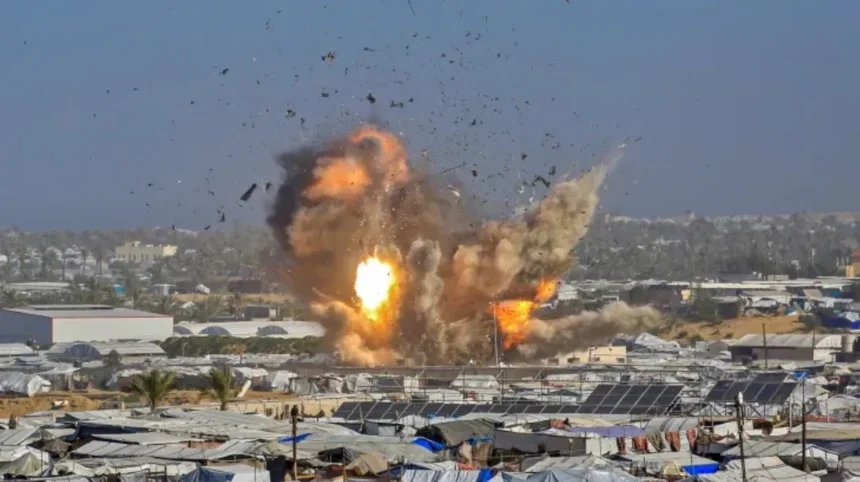
According to Al Jazeera’s live coverage, at least 29 Palestinians have been killed in Israeli attacks across the Gaza Strip, with medical sources reporting that the dead include a number of children. The strikes were carried out on Saturday in Gaza City and Khan Younis, as well as in areas sheltering displaced people, despite a ceasefire agreement that remains formally in place. Al Jazeera reports that the escalation comes a day before Israel is expected to reopen the Rafah border crossing with Egypt for the first time since 2024, under a limited arrangement for movement.
As reported by journalists for Al Jazeera, one of the deadliest incidents occurred when an Israeli strike hit a tent sheltering displaced Palestinians in the al-Mawasi area, northwest of Khan Younis, killing at least seven people, including three children. Another strike targeted parts of Gaza City, with medical sources citing multiple fatalities and injuries as emergency crews struggled to reach affected neighborhoods. The overall death toll of 29 cited in Al Jazeera’s live updates includes casualties from several separate incidents recorded since early morning.
According to Al Jazeera, Israeli military actions in Gaza have continued despite a phased ceasefire framework that has been in effect in recent months, raising renewed allegations of repeated violations by Palestinian officials and local authorities. Medical staff and hospital officials quoted by the outlet say the latest attacks have added to already severe pressure on Gaza’s health system, which has been strained by months of conflict and chronic shortages of fuel, medicine, and equipment.
What Are Officials and Parties Saying?
According to Al Jazeera, Palestinian medical and civil defense teams in Gaza have condemned the latest strikes as a serious breach of the ceasefire, stating that many of those killed were civilians sheltering in what they believed were safer areas. Local health officials quoted by the outlet say children and women were among the dead and wounded, and that bodies and injured people were brought to hospitals in Gaza City and Khan Younis following the attacks.
Al Jazeera reports that Hamas-aligned authorities in Gaza have accused Israel of using the period before the planned reopening of the Rafah crossing to intensify pressure on the population, calling the latest bombardments a “new massacre” and a violation of truce terms. The outlet notes that Israeli officials have previously justified strikes in Gaza as targeting armed groups and security infrastructure, though immediate official comment specific to the latest reported strikes was not detailed in the live updates.
Internationally, Al Jazeera’s reporting situates Saturday’s attacks within broader concern expressed by United Nations agencies and humanitarian organizations over repeated ceasefire violations and the humanitarian situation in Gaza. Prior coverage by Al Jazeera of the Rafah crossing issue has cited UN and aid agencies warning that any delay or restriction in reopening Rafah would further limit access to humanitarian aid and the movement of people needing medical care outside Gaza.
Supporting Details and Background
According to an earlier Al Jazeera news report, Israel announced plans to reopen the Rafah crossing on Sunday for the first time in nearly two years, but under conditions that would allow only limited movement of people and keep Israeli security control in place. That report noted that the crossing, which connects Gaza with Egypt, has been a key channel for humanitarian aid and travel, and its prolonged closure has deepened the enclave’s economic and humanitarian crisis.
Al Jazeera’s previous coverage of the ceasefire framework has described it as a multi-phase arrangement that includes the return of captives, a gradual easing of restrictions, and steps toward broader reconstruction and governance arrangements in Gaza. In that context, Hamas has repeatedly called for Rafah to be fully opened in both directions, without what it describes as “unilateral” Israeli limitations, and has urged movement to the next phase of the truce plan.
Regional media, including outlets cited by Al Jazeera in recent weeks, have also highlighted ongoing disputes over implementation of ceasefire terms, including the scale of aid allowed into Gaza, the status of detainees, and the presence of Israeli forces near populated areas. These disputes have formed the backdrop to recurring exchanges of fire and accusations of violations from both sides, even as diplomatic efforts to solidify the truce have continued.
What Are the Implications and What Happens Next?
According to Al Jazeera, the killing of at least 29 Palestinians, including children, is likely to intensify scrutiny of Israel’s adherence to the ceasefire and fuel further criticism from Palestinian authorities and international humanitarian organizations. The latest attacks occur just as Rafah is scheduled to reopen in a limited fashion, raising questions among observers and local residents about whether the crossing’s operation can proceed smoothly amid renewed violence.
Al Jazeera’s reporting indicates that humanitarian agencies are closely watching both the security situation on the ground and the practical impact of any reopening at Rafah, including how many people and how much aid will actually be allowed to pass. Analysts and officials cited in the outlet’s recent coverage have warned that without a stable security environment and clear implementation of ceasefire commitments, sporadic escalations and civilian casualties in Gaza are likely to continue.
In the immediate term, medical and rescue teams in Gaza, as described by Al Jazeera, are focused on treating the wounded from Saturday’s strikes and recovering bodies from damaged structures and tented shelters. Further developments will depend on whether the Rafah crossing opens as announced, how both Israel and Palestinian factions respond to the latest incidents, and whether international mediators can reinforce compliance with the existing ceasefire framework.
The confirmed death of at least 29 Palestinians, including children, in multiple Israeli strikes under an existing ceasefire underscores the fragility of the truce and the ongoing vulnerability of Gaza’s civilian population. The timing of the attacks, just ahead of the planned partial reopening of the Rafah crossing, places additional pressure on already strained diplomatic efforts and deepens humanitarian concerns in the besieged enclave.