


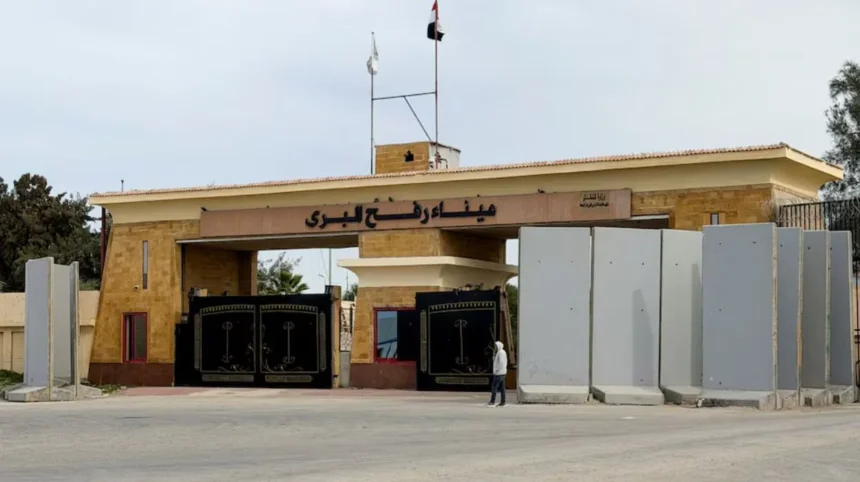
As reported by Steven Scheer and Rami Ayoub of Reuters, Israel plans to reopen the Rafah border crossing between Gaza and Egypt on Sunday for the movement of people, according to a statement from COGAT, the Israeli government agency that coordinates civilian policy in Gaza. COGAT said the crossing will be opened in coordination with Egypt and under specific security conditions after having remained under Israeli control since May 2024, about nine months into the Gaza war. According to Reuters, the Rafah crossing is effectively the only route in or out of Gaza for nearly all of the enclave’s more than 2 million residents.
As reported by Reuters, COGAT stated that residents who left Gaza during the course of the war will be allowed to return from Egypt, but only after prior security clearance by Israel. According to The Times of Israel, COGAT also said that exit from and entry into the Gaza Strip via Rafah will be carried out in coordination with Egypt and under the supervision of a European Union mission, echoing arrangements used in early 2025. The Associated Press reported that Israel described the move as a step forward in implementing the first phase of U.S. President Donald Trump’s ceasefire plan for Gaza.
What are the reactions and context?
According to The Times of Israel, the reopening of Rafah is taking place “in accordance with the ceasefire deal,” which envisions renewed pedestrian traffic in both directions between Gaza and Egypt. COGAT said in its statement that movement through the crossing will remain subject to prior Israeli security vetting, with individuals screened and identified before being allowed to pass. The agency stressed that only those who left Gaza during the war and obtain clearance would be eligible to return via Rafah at this stage.
As reported by Arab News, the announcement has drawn attention because Rafah is Gaza’s main gateway to the outside world and has been closed since Israeli forces seized the crossing. The San Francisco Chronicle, citing an AP report, noted that Israel characterized the reopening for “limited movement of people only,” underscoring that wider trade or large-scale humanitarian shipments were not included in the initial step. According to Al Jazeera’s account of the COGAT statement, Israeli officials framed the move as part of implementing a ceasefire framework and enabling a controlled flow of people after nearly two years of disruptions at the crossing.
Supporting details
According to Reuters, Israel took control of the Rafah crossing in May 2024 as fighting with Hamas continued, effectively shutting the main civilian exit and entry point for Gazans. Reuters reported that reopening Rafah was identified as a key requirement under the first phase of the U.S.-backed plan to end hostilities between Israel and Hamas following a ceasefire agreed in October. According to Reuters, Israel had previously said it would only reopen the crossing after recovering the body of the last Israeli hostage held in Gaza, a condition it said had been met earlier this week.
The Times of Israel reported that, beyond the EU mission’s presence at the terminal, an additional screening and identification process will be conducted at a designated corridor operated by Israel’s defense establishment in an area under Israel Defense Forces control. According to The Times of Israel, this layered mechanism is intended to verify the identity of travelers and manage security risks associated with cross-border movement. The San Francisco Chronicle, relaying AP reporting, added that the reopening applies only to the pedestrian crossing and that COGAT described it as allowing “limited movement of people only.”
What are the implications and next steps?
According to Reuters, reopening Rafah for controlled pedestrian traffic marks a significant step in easing the near-total isolation of Gaza’s population, given that the crossing is their primary link to the outside world. Reuters noted that the move is tied to the broader implementation of the ceasefire plan between Israel and Hamas, suggesting that further measures could follow if the truce holds and security conditions permit. As reported by Al Jazeera, humanitarian agencies have treated Rafah as a vital access point for aid and for civilians seeking medical treatment or refuge, so any sustained reopening is expected to be closely watched by international actors.
According to The Times of Israel, the presence of the European Union mission and the added Israeli screening corridor indicate that future crossings will remain tightly regulated and contingent on ongoing cooperation between Israel, Egypt and international partners. The San Francisco Chronicle, citing AP, reported that Israeli officials portray Sunday’s reopening as an initial, limited step embedded in a longer-term ceasefire framework for Gaza. Reuters indicated that further announcements from COGAT and involved governments are expected as the Rafah arrangements are tested in practice and potential expansions of access are considered.
In sum, Israel’s COGAT has announced that the Rafah crossing between Gaza and Egypt will reopen on Sunday for limited, security-vetted movement of people, particularly Gazans returning from Egypt, under a mechanism coordinated with Egypt and overseen by an EU mission. The step fulfills a key element of the ceasefire plan between Israel and Hamas and partially restores Gaza’s only civilian exit and entry point after its closure following Israel’s seizure of the crossing in May 2024.