


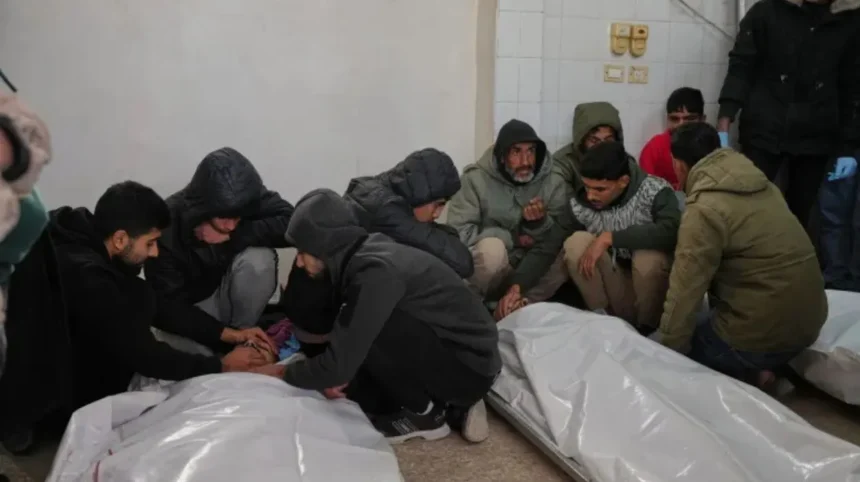
Israeli artillery, drone and naval attacks across the Gaza Strip have killed at least five Palestinians and wounded 11 others despite a ceasefire that has been in force for more than three months. As reported by Al Jazeera, the latest incidents occurred on Friday in the central Maghazi refugee camp and in the southern city of Rafah, according to Palestinian and Israeli authorities. Israeli forces said their operations were part of ongoing “targeted activities” in the territory, while Palestinian officials accused Israel of persistently violating the truce. The deaths add to a growing toll of casualties recorded since the ceasefire took effect in October 2025.
According to Al Jazeera, two Palestinian men were killed when an Israeli drone struck an area in or near the Maghazi camp in central Gaza. Palestinian news agency WAFA reported that the men were hit east of the camp in a zone from which Israeli forces had previously withdrawn under the ceasefire terms. Medical officials cited by Turkish outlet Daily Sabah identified the victims as 21-year-old Yasser Mohammed Abu Shahada and 20-year-old Walid Hassan Darwish. The Israeli military has not publicly released their names but has maintained that its actions target armed groups.
In Rafah, on Gaza’s southern border with Egypt, Israeli forces said an air operation killed three people they described as “terrorists” who emerged from an underground site. According to Al Jazeera’s reporting, the military said additional strikes were carried out in the area and that soldiers were searching nearby to “identify and neutralize” other suspected fighters. Palestinian authorities have not immediately released the identities of those killed in Rafah, and there was no independent confirmation of the Israeli characterization of the victims. The incident followed a series of Israeli operations around Rafah, a key point of contention in ceasefire talks.
Al Jazeera further reported that Israeli naval vessels opened heavy machine-gun fire toward fishing boats off the Rafah coast in a separate episode. WAFA said the boats were chased and targeted by gunfire, but there were no immediate reports of injuries. The reported attack comes amid longstanding restrictions on Gaza’s fishing zone and repeated complaints by Palestinian fishermen that they are fired upon or detained while working at sea.
What are the main reactions and context?
According to Al Jazeera, the latest deaths bring the number of Palestinians killed by Israeli attacks and operations since the ceasefire began in October to at least 492, with 1,356 others wounded, citing figures from Gaza’s Palestinian authorities. Reuters has reported a similar toll, noting that Israel’s military now acknowledges a Gaza death count of more than 71,000 since the wider war began, including over 480 people killed after the ceasefire started. Israel has frequently disputed the reliability of Gaza casualty statistics but has recently accepted that the overall death toll is broadly accurate.
United Nations Secretary-General António Guterres has urged full implementation of the ceasefire agreement, including a complete Israeli withdrawal from the Gaza Strip. According to WAFA’s coverage of his remarks, Guterres described the situation as a “de-escalation in firing without a complete halt,” underscoring concerns that continued military actions risk undermining the truce. He called on all parties to respect their obligations, emphasizing that sustained calm is essential for humanitarian relief and political progress.
Regional and international bodies have also expressed alarm at ongoing violence. The Organisation of Islamic Cooperation (OIC) warned the UN Security Council that continued Israeli violations put the ceasefire “at risk,” according to reporting by Daily Sabah. Speaking on behalf of the OIC, Türkiye’s UN envoy Ahmet Yıldız urged the council to uphold international law, move forward with Palestine’s bid for full UN membership, and press for Israel’s complete withdrawal from occupied territories as part of a lasting settlement.
Palestinian officials and humanitarian agencies have repeatedly highlighted the precarious conditions for displaced people in southern Gaza, particularly around Rafah and Khan Younis. As reported by Al Jazeera, Palestinian authorities say that hundreds of thousands of displaced Palestinians are sheltering in makeshift camps and overcrowded areas amid shortages of food, medicine and clean water. They argue that continued Israeli strikes in these zones, even at a reduced intensity compared with earlier stages of the war, are incompatible with the spirit of the ceasefire.
Supporting details and humanitarian impact
According to Al Jazeera’s report, Palestinian officials are demanding the immediate reopening of the Rafah border crossing to Egypt, which they describe as the only access point between Gaza and the outside world that does not lead into Israel. The reopening of Rafah is listed as a condition in the second phase of the US-mediated ceasefire agreement, which is intended to facilitate humanitarian aid and movement for civilians. Palestinian authorities say the crossing’s closure is severely hindering deliveries of essential supplies to displaced people in southern Gaza.
In the coastal al-Mawasi area west of Khan Younis, six Palestinians were injured when Israeli forces shelled a tent sheltering displaced civilians, according to accounts relayed by Al Jazeera from field hospitals and local reporters. The Anadolu news agency reported that a pregnant woman was among those hurt in the strike. Medical staff in southern Gaza have warned that fragile field facilities, including Nasser Hospital in Khan Younis, are struggling to cope with repeated influxes of wounded amid shortages of equipment and fuel.
The ceasefire, brokered by the United States in October 2025, was designed to halt large-scale hostilities between Israel and Hamas following months of intense conflict. As reported by Al Jazeera and other outlets, Washington announced in early January that the agreement had entered its second phase, envisioned as a step toward a definitive end to the war. However, the continued exchange of fire, targeted raids and limited airstrikes have raised questions about how far the ceasefire has been implemented in practice.
Diplomatic efforts have continued at the UN and in regional capitals to shore up the truce. The UN Security Council has heard repeated warnings that any significant escalation could undo months of negotiations, according to official UN readouts. Humanitarian agencies have pressed for clearer enforcement mechanisms and better monitoring of alleged violations, arguing that civilians will remain exposed to sudden outbreaks of violence until all sides adhere more strictly to the agreement.
What are the implications and potential next steps?
According to Al Jazeera, the persistence of Israeli strikes and operations, even at a limited scale, raises doubts about whether the ceasefire can deliver sustained security for civilians in Gaza. Analysts and officials quoted in international coverage say that without a verifiable end to offensive operations and a full withdrawal of Israeli forces, many residents will continue to live under the threat of renewed large-scale fighting. The ongoing casualties since October indicate that the current arrangement functions more as a fragile reduction in violence than a comprehensive cessation of hostilities.
UN officials and members of the OIC have linked the stability of the ceasefire to broader political steps, including progress on Palestinian statehood and accountability mechanisms under international law. As reported by Daily Sabah, the OIC has called for swift action on Palestine’s application for full UN membership, arguing that such recognition is “essential for a just and lasting peace and the credibility of the multilateral system.” Any movement on these diplomatic fronts is likely to face resistance and complex negotiations at the Security Council.
Future developments will also hinge on whether the conditions of the ceasefire’s second phase are met, particularly the reopening of Rafah and the expansion of humanitarian access. According to UN and media reports, aid agencies say that improved access could ease the humanitarian crisis but stress that relief efforts cannot substitute for a durable political settlement. For now, residents of Gaza remain caught between the promise of a ceasefire on paper and the reality of intermittent violence on the ground.
The latest reported deaths in Maghazi and Rafah underscore the fragility of the ceasefire and the human cost of its incomplete implementation. According to figures cited by Al Jazeera and Reuters, hundreds of Palestinians have been killed and more than a thousand wounded in Israeli actions since the truce began, even as international actors present the agreement as a path toward ending the war. How Israel, Palestinian factions, regional states and global powers choose to respond in the coming weeks will help determine whether the ceasefire solidifies into a lasting peace or erodes under the weight of continued violence.