


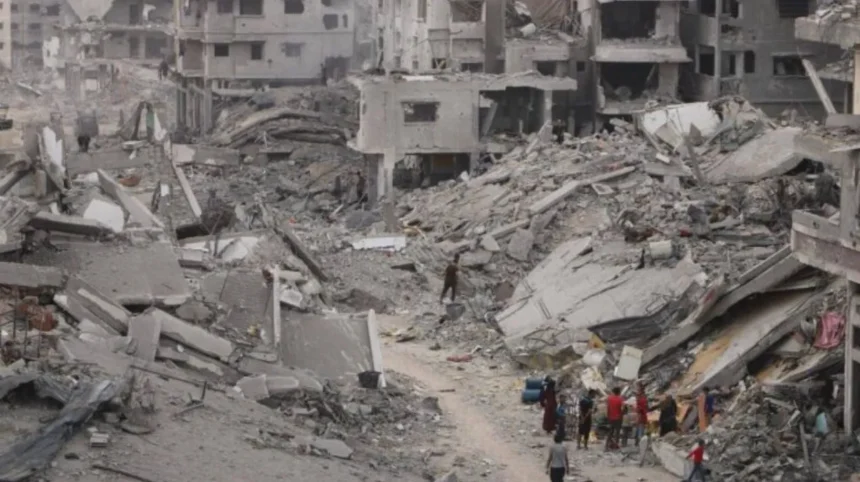
As reported by the Financial World, the Gaza peace deal has moved into its second phase under a United States–brokered 20-point “Comprehensive Plan to End the Gaza Conflict.” The plan was endorsed by United Nations Security Council Resolution 2803, adopted in November last year, which supports a phased approach to consolidating the ceasefire and stabilizing Gaza. According to The Telegraph India, the peace initiative aims to transform Gaza into a “deradicalised terror-free zone” that does not threaten its neighbors while setting a framework for large-scale reconstruction.
According to the Financial World, the second phase of the plan focuses on creating a “transitional technocratic Palestinian administration,” advancing the demilitarization of Hamas and other armed groups, and launching full reconstruction efforts in Gaza. The UN Deputy Special Coordinator for the Middle East Peace Process, Ramiz Alakbarov, described the start of this phase as “a critical step” and “a potential turning point for Gaza, a genuine chance for a better future.” The United States Permanent Representative to the UN, Mike Walz, said Washington remains committed to working with Israel, key Arab and Muslim-majority nations, and the wider international community to bring “peace, prosperity, security, and dignity” to the region.
As reported by The Telegraph India, the resolution also welcomed the establishment of a “Board of Peace” as a transitional administration with international legal personality to coordinate funding and guide the redevelopment of Gaza. A key feature of the plan, highlighted by the Financial World, is that this Board of Peace will oversee the phased process of implementing the ceasefire, political transition, and reconstruction. Former US President Donald Trump, who has publicly taken personal credit for ending the conflict, invited India to join the Board, though India has not yet responded to this invitation.
How has India responded?
According to The Telegraph India, India’s response was outlined by its Permanent Representative to the UN, Ambassador Parvathaneni Harish, during a UN Security Council open debate on the Situation in the Middle East. Harish stated that “India takes note of recent progress with regard to the implementation of UN Security Council Resolution 2803 to end the Gaza conflict” and used the occasion to “express appreciation to the United States in addressing this long-standing issue.” Public broadcaster Prasar Bharati’s news service also reported that Harish commended the US role in moving the deal into its second phase while the ceasefire has largely held.
Harish did not mention Donald Trump by name in his remarks, despite the central role of the Trump administration’s plan and Trump’s own claims of credit for ending the conflict. According to the Financial World, India framed its comments in institutional rather than personal terms, focusing on the implementation of the UN-backed framework and the broader international effort. Harish also restated New Delhi’s long-standing call for “dialogue and diplomacy” as the means to achieve lasting peace.
India reiterated its support for a two-state solution, with an independent State of Palestine existing side by side with Israel in peace and security, as reported by both The Telegraph India and the Financial World. Harish emphasized that India’s position is anchored in backing “a sovereign, independent and viable State of Palestine living within secure and recognized borders,” consistent with previous Indian statements at the UN. According to All India Radio News, Harish underlined that India sees the current peace plan as a step within this broader political horizon rather than an end in itself.
Supporting details and wider context
According to The Telegraph India, the Trump administration’s 20-point plan, announced on September 29 of the previous year and later endorsed by UNSC Resolution 2803, sets out security, governance, and reconstruction milestones for Gaza. It envisions comprehensive demilitarization of Hamas and other armed groups, guarantees that Gaza will not pose a threat to its neighbors, and lays out mechanisms to unlock international investment for rebuilding infrastructure. The second phase now underway is designed to consolidate the ceasefire and begin tangible improvements on the ground for Gaza’s civilian population.
A central element is the Board of Peace, described by the resolution as a transitional administration with international legal personality responsible for coordinating funding, setting redevelopment priorities, and monitoring compliance with the plan’s conditions. The Financial World reports that the Board will function as the main platform through which donor countries, international financial institutions, and regional partners channel assistance. Trump’s invitation for India to join this Board signals an attempt to involve major emerging powers in the reconstruction and governance track, but India has yet to formally indicate whether it will participate.
India’s engagement with the Palestinian cause predates the current plan. As reported by The Telegraph India, Harish noted that over the last two years India has supplied nearly 135 metric tons of medicines and other supplies to Palestinians. Ongoing Indian development projects in Palestinian territories are valued at around 40 million dollars, bringing cumulative support to more than 170 million dollars, according to the same report. These efforts include healthcare, capacity-building, and infrastructure initiatives, underlining New Delhi’s claim of being a consistent development partner for the Palestinian people.
What are the implications and next steps?
According to the Financial World, UN envoy Ramiz Alakbarov has framed the launch of the second phase as a “critical step” and a “potential turning point” that could offer Gaza “a genuine chance for a better future,” provided that the ceasefire holds and the plan’s benchmarks are met. The second phase will test whether armed groups in Gaza comply with demilitarization requirements and whether the transitional technocratic administration can gain enough legitimacy to function effectively. The United States, through Ambassador Mike Walz, has signaled that it intends to sustain diplomatic engagement with Israel, Arab states, and other partners to keep the process on track.
For India, the coming period may involve decisions on whether to accept Trump’s invitation to join the Board of Peace, which would deepen its institutional role in Gaza’s reconstruction. According to The Telegraph India, New Delhi is balancing its traditional support for the Palestinian cause with its growing strategic ties to both the United States and Israel. Any move to join the Board would align India more directly with the US-led framework, while continued humanitarian and development support will likely remain a constant feature of its policy.
As the Gaza peace deal advances through its second phase, the ceasefire’s durability, the effectiveness of the transitional administration, and the responsiveness of international donors will shape conditions on the ground. India’s explicit appreciation of US efforts underscores the importance it places on multilateral and diplomatic solutions to long-running conflicts, even as it maintains its emphasis on a negotiated two-state outcome. The trajectory of this process will determine whether the current plan can move from a diplomatic framework to concrete improvements in security, governance, and daily life for people in Gaza.