


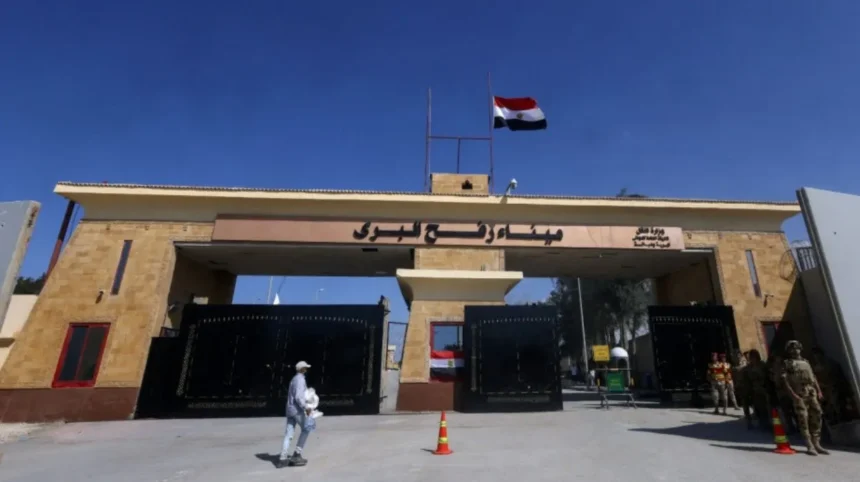
According to AZERTAC, regional governments and international mediators see the planned reopening of the Rafah border crossing between Gaza and Egypt as a critical test for the next phase of the Gaza ceasefire and reconstruction process. The crossing has largely remained closed since Israeli forces took control of the Palestinian side during operations in Rafah in 2024, severely restricting movement for civilians and aid. Israel has signaled that any reopening is closely tied to security conditions, including the search for the remains of the last Israeli hostage in Gaza and broader efforts to ensure that Hamas is disarmed.
As reported by Seth J. Frantzman in analysis carried by Yahoo News, there is widespread expectation in the Middle East that Rafah could reopen in a limited way within days, allowing people to both enter and leave Gaza with some regularity for the first time in more than two years. This step is described as essential to moving the ceasefire into its “next stage,” which includes implementing governance and economic measures that were outlined at recent international meetings, such as the announcement of a “Board of Peace” and a Gaza executive body in Davos. Israeli decision-makers view the control and regulation of Rafah as central to ensuring that any new civilian or commercial traffic does not enable the re-arming of militant groups.
AZERTAC notes that for Gaza’s population, Rafah has long served as a lifeline to the outside world, particularly when other crossings were closed or restricted. Humanitarian organizations argue that reopening the crossing is necessary to scale up aid deliveries and support those displaced by fighting in Rafah and other parts of the Gaza Strip. Regional states, including Egypt, Qatar, Saudi Arabia and Turkey, are portrayed as closely watching how the reopening is managed, seeing it as a barometer of whether the current ceasefire framework can hold and expand.
How Are Regional and International Actors Reacting?
According to The Jerusalem Post, regional expectations have risen after reports on the UAE-based Al-Ain news outlet that Israel agreed in principle to a “limited” reopening of Rafah under a mechanism involving European monitors and Palestinian staff who are not allowed to wear official Palestinian Authority uniforms. Al-Ain reported that the United States has increased pressure on Israeli Prime Minister Benjamin Netanyahu to reopen Rafah in both directions within a short, specified timeframe, even as Israeli officials stop short of confirming exact dates. Diplomats view this as a test of coordination between Israel, Egypt, the United States and new Gazan administrative structures over border management.
The BBC reports that Israel has publicly linked the timing of Rafah’s reopening to completion of a mission to recover the remains of the last Israeli hostage held in Gaza, underscoring how hostage issues remain intertwined with border and ceasefire arrangements. The New York Times similarly notes that Netanyahu’s office indicated the crossing would resume operations after the search concludes, and that Israeli forces later said they had located the remains of a soldier killed in the October 7, 2023 Hamas-led assault. These developments have prompted renewed appeals from international organizations for greater predictability in border access so that civilians can plan travel, medical evacuations and family reunifications.
Seth J. Frantzman’s reporting highlights skepticism among some commentators and officials who worry that even a formal reopening could still mean tight restrictions, with limited slots or narrow categories of people allowed to pass. Throughout the war, some Israeli voices advocated using Rafah primarily as an exit route without guaranteed return, a concept that has drawn concern among human rights advocates and neighboring states wary of long-term displacement. For governments in the region that are aligned with Washington, the way Rafah is managed is seen as a test of the credibility of U.S.-backed plans for Gaza’s post-war governance.
Supporting Details and Expert Commentary
Reporting in The Jerusalem Post recalls that Israel’s 2024 offensive in Rafah followed earlier operations in northern Gaza and Khan Younis aimed at dismantling Hamas’s military infrastructure. Large swaths of built-up areas near the border were bulldozed to create a clearer security buffer, reshaping the geography around the crossing and complicating efforts to restore normal civilian access. In 2025, the Gaza Humanitarian Foundation established food distribution points east of Rafah, underscoring the area’s role as a hub for relief operations even while the crossing stayed closed.
The Saudi-owned Asharq Al-Awsat and other regional outlets have described Rafah as Gaza’s “lifeline” to the world, noting that most of the Strip’s population is effectively reliant on a small number of corridors for trade, medical access and travel abroad. Experts quoted in these reports say that a functioning Rafah crossing, jointly managed with international oversight, could help stabilize Gaza’s economy and reduce pressure on internal markets that have been strained by war and blockade. At the same time, Israeli security analysts stress that any such arrangement must include robust inspection and monitoring to prevent weapons smuggling and the rebuilding of militant capabilities.
Daily Sabah notes that Israeli officials frame a controlled, conditional reopening of Rafah as part of a broader, U.S.-brokered ceasefire that links steps on the ground in Gaza to security guarantees for Israel. The crossing is expected to serve as a key entry point for humanitarian aid, construction materials and possibly foreign technical staff involved in reconstruction and governance projects. For Egypt, which has historically managed the other side of Rafah, the crossing remains sensitive domestically and diplomatically, as Cairo seeks to balance solidarity with Palestinians with concerns about security in the Sinai Peninsula.
What Are the Implications and Next Steps?
According to AZERTAC and other outlets, the Rafah crossing is emerging as a practical test of whether the ceasefire’s second phase—focused on reconstruction, governance and gradual normalization of movement—can be implemented in a way that satisfies both security and humanitarian priorities. If the reopening proceeds with meaningful two-way traffic, observers say it could strengthen newly formed administrative bodies in Gaza and bolster confidence among residents and regional partners in the broader peace roadmap. A more limited or frequently interrupted opening, by contrast, may reinforce doubts about the durability of current arrangements and prolong Gaza’s economic stagnation.
Reports from the BBC and The New York Times indicate that the immediate next step hinges on the formal conclusion of Israel’s search for the last hostage’s remains and subsequent political decisions in Jerusalem and Cairo on operating procedures. Negotiations continue over the roles of European monitors, Palestinian staff and security coordination across the border, with Washington and regional capitals applying diplomatic pressure to keep momentum. Analysts interviewed by regional media suggest that the outcome at Rafah could influence broader discussions on other crossings and on long-term arrangements for Gaza’s external trade and travel links.
In sum, current reporting portrays the Rafah border crossing as a central benchmark for Gaza’s transition from active conflict to a fragile, monitored ceasefire phase, in which movement of people and goods is gradually restored under strict conditions. The decisions taken in the coming days and weeks—on timing, scope of reopening and the mechanisms put in place—are expected to signal how far key actors are prepared to go in implementing their commitments under the emerging post-war framework for Gaza.