


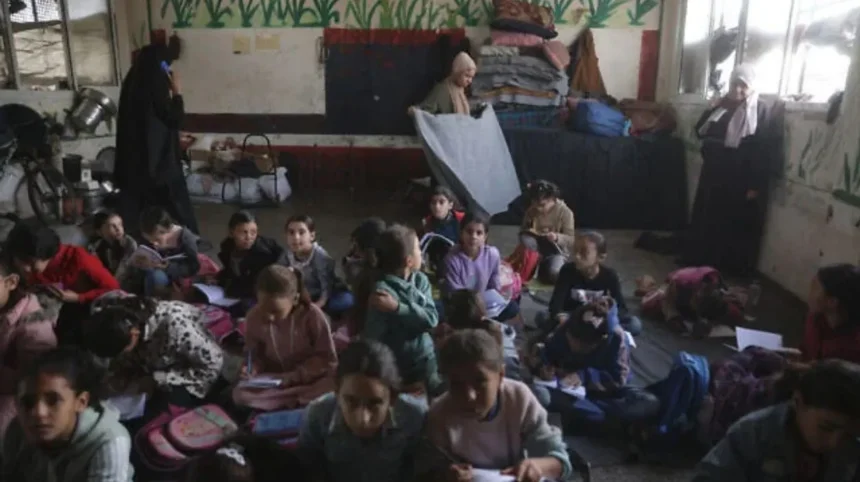
According to Reuters, the United Nations children’s agency UNICEF has for the first time in about two and a half years been able to deliver school kits containing learning materials into the Gaza Strip after they were previously blocked by Israeli authorities. The agency said thousands of kits, including basic items such as pencils, exercise books and wooden cubes for play, have now entered the enclave. UNICEF described the development as a significant shift after a prolonged period in which children and aid organizations struggled to support education without access to these supplies.
As reported by Reuters, UNICEF spokesperson James Elder said that in recent days the agency had received thousands of recreational kits and hundreds of “school‑in‑a‑carton” packages for Gaza. Elder added that UNICEF expects to bring in an additional 2,500 school kits next week, noting that these shipments have been approved by the relevant Israeli authorities. COGAT, the Israeli military body that oversees aid flows into Gaza, did not immediately respond to a request for comment on the deliveries.
According to UNICEF statements summarized by the United Nations and other outlets, the new inflow of supplies follows more than two years of restrictions on items such as notebooks, pencils, erasers and crayons entering Gaza. During that period, many children were reported to be trying to learn without basic materials, while teachers were forced to improvise in overcrowded, makeshift learning spaces. UNICEF and other UN bodies have repeatedly called for the lifting of restrictions on education-related items as part of broader humanitarian access demands for the territory.
What reactions and context have been reported?
According to Reuters and other outlets citing UNICEF, James Elder said the deliveries mark an important change after what he described as “a long two years” for Gaza’s children and organizations trying to provide education without adequate materials. He was quoted as saying the agency is “finally seeing a significant shift” in the ability to get school and recreational kits into the Strip. UNICEF has framed the new shipments as a step forward but has also underlined that the education system remains under extreme strain.
As reported by The Straits Times using Reuters material, UNICEF officials said children in Gaza have faced an “unprecedented assault” on the education system and on the entry of some aid materials, including school books and pencils. Elder noted that, in the absence of supplies, some children were studying in tents at night without lights, while teachers had to cope with severe shortages and damaged infrastructure. UN humanitarian updates similarly describe a situation in which basic learning and recreational items are seen as essential for children’s psychosocial well‑being after prolonged conflict and displacement.
According to UN situation reports, the educational and recreational kits now entering Gaza are intended to support hundreds of thousands of children who have been affected by school closures, displacement and the destruction of classrooms. The UN children’s agency has emphasized that the supplies are part of broader efforts to give children a sense of normalcy and routine, including structured play and learning activities. At the same time, UN officials continue to warn that humanitarian access remains constrained and that more consistent, predictable entry of education materials and other supplies is needed.
Supporting details and additional reporting
According to Reuters and UN-linked reports, UNICEF is scaling up its education response with the goal of reaching roughly half of Gaza’s school‑age children, estimated at around 336,000, with some form of learning support. Much of this teaching is expected to take place in tents because many school buildings have been badly damaged or destroyed during the war that followed Hamas’ attack on Israel in October 2023. UNICEF says most of the temporary learning spaces it supports will be concentrated in central and southern Gaza, where operating conditions are seen as relatively more feasible than in the heavily damaged north.
As reported by Reuters, Israeli authorities say the October 2023 Hamas-led assault on Israel killed about 1,200 people. Gaza’s health authorities, cited by multiple outlets, say tens of thousands of Palestinians have been killed in Israel’s subsequent military campaign, including many children. UNICEF has referenced official figures indicating that more than 20,000 children have died in the conflict, underlining the scale of the humanitarian emergency in which these education efforts are now taking place.
UN humanitarian briefings add that, since late 2023, about 5,000 recreational kits with toys and stationery have entered Gaza for the first time since restrictions were imposed in 2023, helping an estimated 375,000 children, including about 1,000 children with disabilities. These supplies, which overlap with the more recent school kits, are intended to help children develop language, motor, problem‑solving and social skills in formal and informal settings. UNICEF and partner organizations stress that such materials are a critical component of emergency education and psychosocial support, rather than optional extras.
What are the implications and what could happen next?
According to UNICEF and UN humanitarian officials, the approval and entry of school and recreational kits could signal a modest easing of specific restrictions on education-related supplies entering Gaza. Aid agencies say that if these approvals continue and expand, they may be able to support more structured learning for a larger share of Gaza’s children, many of whom have been out of regular school for prolonged periods. However, UN briefings stress that the broader humanitarian situation, including damage to infrastructure and limits on aid flows, continues to severely constrain education and other basic services.
According to Reuters, UNICEF plans to bring in thousands more school kits in the coming weeks, contingent on continued authorization from Israeli authorities and on security and access conditions inside Gaza. UN situation reports indicate that agencies will monitor how quickly the newly arrived materials can be distributed and used in learning spaces, including tents and other temporary facilities. Humanitarian officials say they will continue pressing for sustained access for education supplies and for broader measures to protect schools, teachers and students in any future developments.
Taken together, the recent deliveries mark the first time in more than two years that UNICEF has been able to bring school kits with basic learning materials into Gaza, after a period of tight restrictions on such supplies. Aid agencies describe the move as an important, though limited, step toward restoring some form of education for hundreds of thousands of children whose schooling has been disrupted by conflict, displacement and the destruction of school infrastructure. Officials emphasize that ongoing approvals, improved humanitarian access and reconstruction of education facilities will be critical if these initial gains are to translate into lasting improvements in children’s learning conditions.