


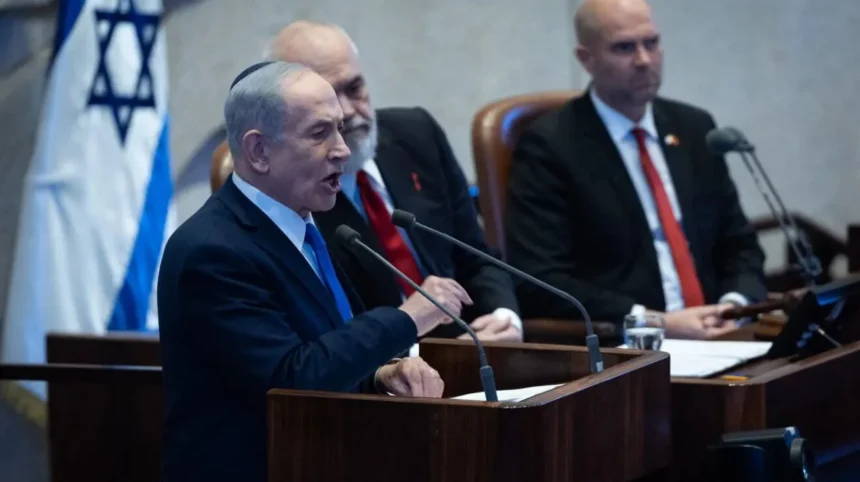
Israeli Prime Minister Benjamin Netanyahu has said that the next stage of the Gaza peace plan will focus on demilitarizing the territory rather than on reconstruction. Speaking after the return of the body of Israeli hostage Elisha Gvili, Netanyahu framed the transition as a shift from a ceasefire phase to one centered on disarmament of Hamas and other armed groups. As reported by staff writers of The Times of Israel, he described demilitarization as the core of Israel’s strategy for Gaza going forward.
According to The Times of Israel, Netanyahu made these remarks during a special session of the Knesset that also honored visiting Albanian Prime Minister Edi Rama. In that setting, he stated that “the next phase is disarming Hamas and the demilitarization of the Gaza Strip.” He argued that a focus on demilitarization is a prerequisite for any meaningful reconstruction, signaling that large-scale rebuilding will be conditioned on security changes on the ground.
Netanyahu also emphasized that Israel intends to press ahead with this phase irrespective of resistance from Hamas. He said that demilitarization “will happen the easy way or the hard way,” underlining that Israel sees the process as non‑negotiable. His comments came as international mediators and regional partners continue to work to maintain the ceasefire and advance the broader peace plan.
What reactions and context are emerging?
Netanyahu’s focus on demilitarization comes amid skepticism within Israel and abroad over whether Hamas will accept giving up its weapons. According to reporting in The Times of Israel, Israeli officials and analysts note that Hamas has previously rejected calls to disarm. This skepticism shapes expectations for the next phase and raises questions about how such a plan could be implemented on the ground.
As reported by The National, US officials visiting Israel recently held talks with Netanyahu on the second phase of the plan, which is understood to include steps toward full demilitarization of Gaza alongside political and administrative changes. Their discussions have been described as “positive,” with the United States backing efforts to reduce the military capabilities of Hamas and other factions. At the same time, mediating states are attempting to balance these security demands with humanitarian concerns and the need for long‑term stability.
Regional mediators involved in the ceasefire process have also pressed Hamas to disarm as part of the broader framework. According to The Times of Israel, Middle Eastern countries that helped broker the truce have tied sustained calm and future reconstruction funding to progress on demilitarization. This places additional diplomatic pressure on Hamas leadership, which has long argued that its weapons are necessary for resistance against Israel.
Supporting details and additional reporting
The second phase of the Gaza peace plan has been described in multiple outlets as combining security, governance, and economic components. According to the BBC, US Special Envoy Steve Witkoff announced the start of phase two earlier in January, saying it would move Gaza “from ceasefire to demilitarization, technocratic governance, and reconstruction.” His remarks underscored that disarmament and security arrangements are intended to precede or accompany large‑scale rebuilding.
Reporting by The National indicates that the US‑brokered agreement envisions a “transitional, technocratic Palestinian administration” to run Gaza during this phase. This body, sometimes referred to as a National Committee for the Administration of Gaza, would assume day‑to‑day governance responsibilities while demilitarization efforts proceed. Under the same framework, Hamas leaders could be offered amnesty and safe passage into exile if they agree to lay down arms, though it remains unclear whether they will accept such terms.
Background analyses, summarized by outlets such as the BBC and The National, suggest that demilitarization would involve dismantling Hamas’s military infrastructure, including tunnels and weapons production sites. These measures are intended to ensure that Gaza no longer poses a security threat to neighboring areas. At the same time, plans discussed publicly include eventual reconstruction and economic assistance, contingent on progress in disarmament and on new security arrangements involving international participation.
What are the implications and what comes next?
Netanyahu’s assertion that demilitarization, not reconstruction, defines the next phase signals that Israel will link large‑scale rebuilding in Gaza to verifiable security changes. According to reporting in The Times of Israel, he has warned that if Hamas does not demilitarize, that will hold back Gaza’s residents from realizing their aspirations. This stance suggests that the pace and scope of future reconstruction projects will likely depend on negotiations around disarmament and on monitoring mechanisms acceptable to Israel and its partners.
Future steps are expected to center on how to implement demilitarization in practice and who will guarantee it. As reported by the BBC and The National, the peace plan framework contemplates an expanded role for international actors, including a temporary stabilization presence and support for training Palestinian security forces. The coming period will likely test whether Hamas or other armed groups agree to any form of disarmament and whether the proposed technocratic administration can take hold amid competing political claims.
For now, Netanyahu’s comments make clear that Israel views the transition from ceasefire to demilitarization as the decisive test of the Gaza peace plan’s second phase. International mediators and governments will watch closely to see if the parties translate these stated goals into concrete steps on the ground, and whether conditions for sustained reconstruction and political stabilization can eventually emerge.